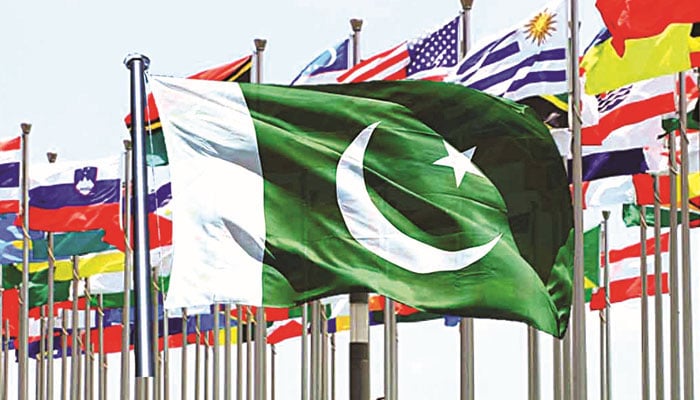
The world has changed and is no longer a one-party state with one superpower dictating to everyone else. It is a new age of ‘true’ multipolarity, a world in which the US, China, Russia, the EU, and new regional powers all vie for influence simultaneously. This change is no less than a geopolitical switch in a country like Pakistan, at the junction of South Asia, Central Asia and the Middle East. It’s an opportunity that Pakistan has not yet grasped.
Over the years, Pakistan’s foreign policy has been constrained between Washington and Beijing. The stress was very much present. The tide of American aid, IMF leverage and post-9/11 security needs tugged on one side. Another was China, which had been investing in CPEC, holding a veto on the UN Security Council, and increasing its regional presence. In general, Pakistan struggled in the middle, dealing with the two rather than developing a plan. That reactive stance needs to change to something more considered and deliberate.
Strategic autonomy does not imply isolation, neutrality or opposition to all choices. It implies that Pakistan’s foreign policy is based on Pakistan’s national interest, which is not on the whims and fancies of any foreign patron. As Turkiye, Saudi Arabia, and Indonesia have shown, it is perfectly possible to maintain strong relations with Washington and Beijing while developing an independent foreign policy identity. Pakistan must learn those lessons.
But it is most urgent from an economic standpoint. CPEC Phase II is underway, but Pakistan needs to go beyond just the builder part of the equation with China. The next phase in the relationship should focus on technology transfer, industrial co-production and market access, rather than solely on infrastructure development financed by loans. Pakistan, meanwhile, should not become a geo-economic slave of Beijing. Financial diversification is vital to strategic autonomy, and that necessitates seeking investment from the Gulf, the EU and the US.
The American side of the equation has always been transactional: Pakistan carries out counterterrorism and regional stability efforts; America offers aid and diplomatic protection. This model is coming to an end. Representatives from the Pakistani community believe the next step Pakistan needs from Washington is access, not aid. Market access, technology and investment. The changed trajectory of US interest in South Asia, in part owing to the desire to balance China’s dominance in the region, offers Pakistan space to re-engage on terms to its liking. Islamabad should approach them with confidence and a set of demands, and not as a supplicant.
The lack of economic statecraft has always been the missing element in Pakistan’s foreign policy. A strong economy is worth a lot more than diplomacy, and a struggling economy is asking for favours. That’s why there is no separation between domestic stability and foreign policy. The absence of strategic autonomy can be attributed to a lack of autonomy in Pakistan’s economic affairs, driven by limited control. Strategic autonomy can only be achieved if Pakistan’s own economic house is not permanently on fire, but is being pushed to its brink by a lack of control. The changes to be made at home, like tax broadening, export diversification and energy efficiency, are not just economic decisions. They are policy decisions that are outside the country.
Regional connectivity is also an area of weakness, perhaps one of the least developed aspects of Pakistan’s foreign policy. SCO membership, the potential of the Afghan transit corridor, and the prospect of energy trade with Central Asia suggest that Pakistan will not become a peripheral state that nervously observes great powers competing, but will become a regional power needed by great powers. This change of course will not occur in its own accord. It needs constant diplomatic investment, the normalisation of trade relations with India at some future stage, and an Afghanistan policy that focuses on stability rather than strategic depth.
The multipolar moment will not be put on hold. With the US-China competition intensifying, both nations will apply more pressure on smaller and middle powers to decide. Pakistan cannot remain silent in response to this pressure and can’t be propping up one side or the other. It ought to be a clear, bold foreign policy that states: We’re partners with those who value our interests and we are dedicated to a stable and prosperous region. That’s not a radical concept. It is just that Pakistan’s foreign policy deserved a good while.
The writer is a scholar at PIDE, Islamabad and can be reached at: [email protected]