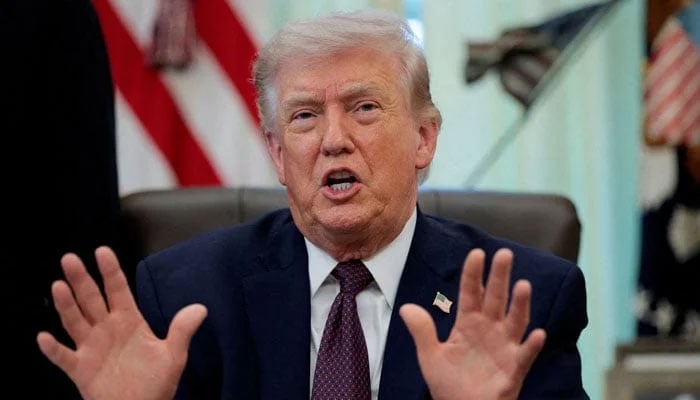
US President Donald Trump is a very rich man, probably the wealthiest president in US history. He loves gold, glitter and razzmatazz. His policies and actions point to his preference for a government of the rich, by the rich, for the rich. Is he bothered by the rising prices of oil and gas?
Yes, to the extent that these can damage his popularity and, consequently, his party’s prospects in the midterm congressional elections in November this year. Yet, he may be smiling over the growing sales of America’s oil as a result of the closure of a vital shipping route for Gulf countries’ oil and gas exports.
Having led the life of a wheeling-dealing property developer, with no prior experience of governance, war was almost an anathema to Trump. He promised to put an end to ‘forever wars’ and proved his point by beginning to wrap up the American and Allied occupation of Afghanistan.
What we have witnessed in Trump’s second presidential term amounts to a U-turn of his anti-war rhetoric. He threatened to bomb the world’s first great empire to smithereens. But he relented after six weeks, giving the impression that he was a reluctant warrior at heart. Does Trump realise that his threats of bombing Iran to the Stone Age resulted in the backlash of a proud nation to defend itself, albeit against a superpower?
The Iranians have reasons to be content as no country supported America’s war objectives except its partner in a dastardly attack that took thousands of lives, including Iran’s leaders, as well as innocent civilians, including more than a hundred students in a girls’ school.
It became clear with time where the property developer who likes to boast ad infinitum had landed his country. He was ‘winning’ while looking into a quagmire with no good options. He was looking for an exit. The difficulty arose when he wanted to declare victory before quitting. The man Trump chose as defence secretary had not become secretary of war without an objective. Pete Hegseth wanted to pursue a religious war blessed by a prayer meeting around Trump.
The off-ramp showed up with the help of intensive messaging by Pakistan, resulting in a ceasefire for two weeks. A bigger success was achieved with its indefinite extension at talks hosted by Prime Minister Shehbaz Sharif and COAS-CDF Field Marshal Asim Munir in Islamabad.
However, all did not end well as expectations for a second and conclusive round of talks between the US and Iran ran into roadblocks. Matters grew highly complex with the two belligerents trying to control maritime movement in and around the Strait of Hormuz.
Meanwhile, the ceasefire that came into effect after six weeks of air war morphed into a stalemate due to hardline positions taken by the Iranian and American negotiators.
Global oil and gas supplies have been curtailed due to Iran’s closure of the vital sea lanes through the Strait of Hormuz. The US blockade further down has greatly hindered shipping to and from Iran. The underlying cause of this eyeball-to-eyeball situation is their divergence on important talking points, notably Iran’s nuclear programme, US sanctions and unfreezing of Iranian assets.
The three-month-old conflict has left piles of collateral damage in the shape of oil and gas shortages, higher energy prices, adding to the miseries of the ordinary folks already seething over rising inflation. Collateral damage is also being experienced by the smaller Gulf states, whose struggling economies are on the verge of collapse.
Where do we go from here? Trump must believe in the old adage that kingship has to be won every day. He loves to score points on a daily, if not hourly, basis. Trump’s reality show is mocked by observers, claiming that the US has lost the war. It would be more appropriate to say that the Israel-US combo did not win. It is a stalemate that could lead to a partial agreement, with limited hostilities continuing. Despite Netanyahu’s persistent demands for more attacks and Trump’s verbal volleys, it seems unlikely that Trump will order large-scale operations.
To wind up, we need to examine whether President Trump has shed his vociferous opposition to America becoming embroiled in wars in distant parts of the world. His business model was tilted more in favour of conglomerates in diverse sectors of the economy. There are signs that while remaining a reluctant warrior at heart, Trump has embraced the premise that war, too, is America’s business. He may have diluted his disdain for the military-industrial complex and is now going along with massive increases in the defence or war budget over the coming years.
A sigh of relief is in order for all those under the skies of America’s overwhelming military presence across the globe and the corporate sector feeding the mightiest war machine in history.
The writer can be reached at: [email protected]