ISLAMABAD: Chairman Pakistan Peoples Party (PPP) Bilawal Bhutto Zardari said on Friday the Federation and provinces had reached a constitutional and consensual arrangement to meet Pakistan’s national security requirements without reducing provincial shares under the National Finance Commission (NFC) Award or altering the 18th Constitutional Amendment.
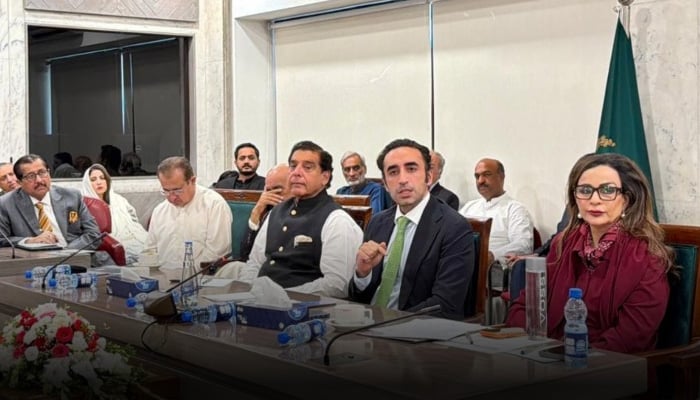
Addressing a joint parliamentary party meeting of PPP members from the National Assembly and Senate, Bilawal said the federal budget was being presented at a time when Pakistan was facing multiple security, economic and geopolitical challenges.
He said the country’s foremost challenge remained national security, referring to last year’s conflict with India and claiming that New Delhi was continuing efforts to create difficulties for Pakistan after failing to achieve its objectives. He also referred to security concerns linked to Afghanistan and terrorism. He said the rapidly evolving geopolitical situation across the region and the wider world required strategic decision-making, adding that uncertainty over international conflicts had increased concerns about global stability.
The PPP chairman said proposals had been floated suggesting that provincial shares under the NFC Award should be reduced to provide additional resources to the federal government. He strongly opposed such suggestions, arguing that provincial governments had demonstrated stronger revenue-generation performance than federal institutions in several sectors.
For the first time, he added, provinces were discussing with the federation how much they could contribute rather than how much they should receive. “This is a victory for politics and parliament. We have reached a conclusion under which all the provinces and federation will contribute towards national security requirements. This will not happen through reducing provincial shares under the NFC Award or by changing the 18th Amendment,” he said.
According to Bilawal, political parties had instead worked together to develop a constitutional mechanism that would allow the federation and provinces to collectively meet national security requirements while preserving provincial rights and constitutional protections. He said the arrangement represented a major political achievement because it enabled provinces and the Centre to contribute towards national security expenditures without reducing provincial allocations or reopening the NFC Award.
Bilawal stated that the Constitution already allowed both provincial and federal governments to provide grants for expenditures beyond their respective jurisdictions, and that Sindh and Balochistan had agreed to contribute under this framework for the next three years. He said the agreement had been reached on the basis of NFC Award’s existing formula and ensured that neither provincial financial rights nor the 18th Constitutional Amendment would be affected.
Bilawal said the federal government had initially sought provincial financial assistance for a broader range of expenditures, but negotiations resulted in an understanding that provincial contributions would be limited to agreed national security requirements. Describing the arrangement as a victory for democratic politics and parliamentary engagement, he said it demonstrated that complex national challenges could be addressed through political consensus rather than constitutional amendments or extraordinary measures.
Turning to developments in Azad Jammu and Kashmir (AJK), Bilawal said the situation remained a matter of serious concern for Kashmiris both inside and outside Pakistan. He alleged that India and Israel were pursuing policies aimed at undermining Pakistan’s interests and warned that hostile actors could seek to exploit instability in sensitive regions, including Kashmir and Balochistan.
The PPP chairman stressed that governments had a responsibility to uphold the rule of law and could not allow individuals or groups to take the law into their own hands. At the same time, he reiterated his party’s position that political disputes should be resolved through dialogue, constitutional processes and democratic engagement.
Bilawal alleged that the PPP had previously been denied its rightful mandate in Azad Jammu and Kashmir (AJK) despite strong electoral performance. He claimed that political arrangements made following earlier elections prevented the party from forming a government and resulted in what he described as an ineffective political structure. The PPP chairman maintained that unresolved issues in AJK should be addressed through consultation and dialogue among political stakeholders.
Bilawal said he had repeatedly urged protesters to remain peaceful and seek redressal through constitutional forums, adding that sustainable solutions could be achieved through elected institutions rather than confrontation on the streets.
He also criticised what he described as interference in the affairs of the elected AJK government, alleging that administrative institutions had been used in ways that undermined political authority and democratic decision-making.
Shifting his focus to Gilgit-Baltistan, Bilawal alleged that delays in the announcement of election results and subsequent administrative decisions had prevented the immediate formation of a PPP government despite what he described as a clear public mandate.
Concluding his address, Bilawal rejected suggestions that the PPP sought to weaken the federal government, adding the party would continue supporting initiatives that served the national interests. He, however, warned that the PPP would no longer remain silent in the face of what it considered political injustices against its elected representatives and voters.