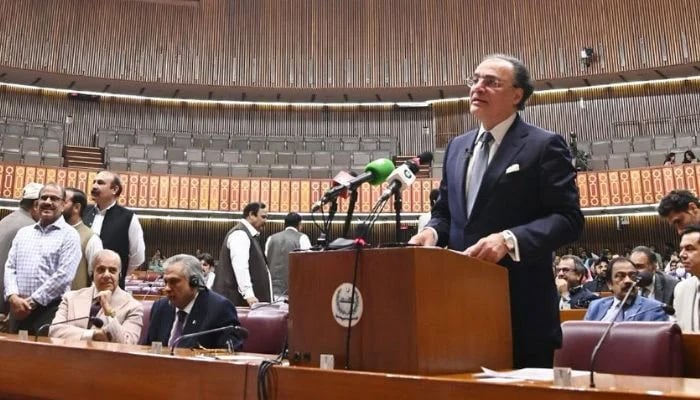
ISLAMABAD: Pakistan’s federal government Friday unveiled a Rs18.77 trillion ($68 billion) expansionary budget for fiscal year 2026-27, slashing income taxes for some salaried workers, gutting property transaction levies and abolishing the super tax for most corporations, while targeting a fiscal deficit of 3.6 percent of GDP as it navigates strict International Monetary Fund discipline.
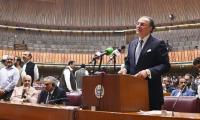
Finance Minister Muhammad Aurangzeb, presenting the country’s third consecutive budget under the IMF’s Extended Fund Facility, told the National Assembly the spending plan represented far more than a financial ledger. “This is not just a budget of numbers; this is a budget of transformation,” he said. “We have moved from a fragile economy to one where Fitch, Moody’s and S&P have upgraded Pakistan’s credit rating. Today, the world seeks our strategic partnership.”
The budget outlay is 6.8 percent (or Rs1.197 trillion) higher than the outgoing fiscal year’s Rs17.57 trillion. Real GDP growth is projected at 4 percent for the coming year, with inflation forecast at 8.2 percent.
To satisfy IMF benchmarks, the government set a primary surplus of Rs2.83 trillion, or 2.0 percent of GDP, a fourth consecutive year of surplus. However, the federal budget deficit balloons to Rs7.02 trillion, a 36.1 percent jump of Rs1.863 trillion above the current fiscal’s revised Rs5.157 trillion estimate. The overall deficit of 3.6 percent of GDP (or Rs5.226 trillion) hinges on provinces generating a combined surplus of Rs1.794 trillion.
Public debt servicing will consume Rs8.05 trillion. The Federal Board of Revenue has been tasked with collecting Rs15.264 trillion, a 17.6 percent increase over the revised FY26 estimate of Rs12.98 trillion, requiring Rs2.28 trillion in additional revenues.
Non-tax revenue is projected at Rs5.335 trillion, including Rs1.435 trillion in central bank profits, Rs1.676 trillion in Petroleum Development Levy and Rs1.04 trillion in provincial grants. Privatisation proceeds of Rs161 billion have been budgeted.
The federal government salaries and pensions rise 7 percent, while the minimum wage increases 10 percent.
Besides, salaried workers received targeted cuts. The tax rate on annual earnings between Rs2.2 million and Rs3.2 million drops from 23 to 20 percent; the Rs3.2 million to Rs4.1 million bracket falls from 30 to 25 percent; and the Rs5.6 million to Rs7 million band is reduced from 35 to 32 percent. An income surcharge on salaried workers has been abolished entirely.
For corporations, the government proposed abolishing super tax across six income slabs. Previously, those earning Rs150 million to Rs500 million paid between 1 and 7.5 percent. The super tax for incomes above Rs500 million has been reduced from 10 to 8 percent. Banks, oil and gas exploration firms and fertiliser companies remain subject to the surcharge. In real estate, property sales tax for filers drops from 5.5 to 2.75 percent, while purchase tax halves from 2.5 to 1.25 percent. Withholding tax on international debit and credit card transactions falls sharply from 5 to 0.5 percent. The Capital Value Tax (CVT) on foreign assets has been abolished. Taxes on women’s healthcare products and contraceptives have been scrapped. Customs duties on over 100 categories of industrial raw materials have been eliminated entirely.
Defence spending rises to Rs3 trillion ($10.9 billion). “Strong defence is not only vital for our security but has become a source of foreign exchange,” Aurangzeb said. “Our defence industry is now earning valuable forex.”
The federal development budget (PSDP) is set at Rs1 trillion. Pensions stand at Rs1.169 trillion, and Rs1.09 trillion in subsidies, mostly for the power sector, have been earmarked.
The Benazir Income Support Programme receives Rs838 billion, a 17 percent increase, expanding coverage to 12 million families.
For exports, the Export Finance Scheme mark-up rate has been slashed from 19 to 4.5 percent, export tax cut from 2 to 1.25 percent and the Export Development Surcharge abolished.
The IT sector’s concessionary 0.25 percent tax on export earnings is extended until June 30, 2029, as IT exports are expected to reach $4.5 billion this year, growing over 20 percent annually.
The budget’s most structurally ambitious measure may be its “Double Blind” faceless assessment system. “We are introducing a system where the taxpayer and the tax officer will never meet,” Aurangzeb declared. “No discretionary powers, no harassment, no corruption. Assessment will be purely data-driven through artificial intelligence and machine learning. Under the Double Blind Mode, even the officer will not know who they are assessing, and the taxpayer will not know which officer is handling their case. All communication will be through the FBR’s digital portal. This is not just reform; this is a revolution.”
Small retailers with annual sales up to Rs100 million can opt into a Fixed Tax Scheme requiring just 1 percent of sales, with no audit, no POS mandate and a one-page Urdu return. “Small shopkeepers are the backbone of our economy,” Aurangzeb said. This scheme gives them a green QR code, no inspector will enter their shop without it. The government also announced 5G services in five cities, the Digital Nation Pakistan Act, and conversion of 6,860 acres of Pakistan Steel Mills land into a Special Economic Zone. On energy, Aurangzeb said circular debt accumulation had been halted. “We have stopped the bleeding,” he said. Regarding power sector circular debt, he said, “No increase in circular debt this year, a historic first.”