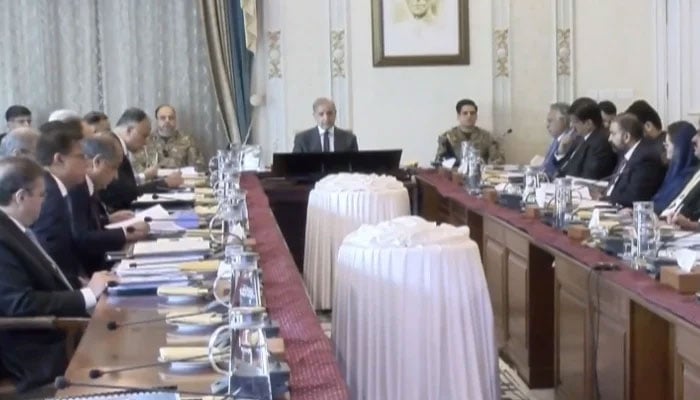
ISLAMABAD: The National Economic Council (NEC), the highest constitutional economic decision-making forum under the chairmanship of Prime Minister Shehbaz Sharif, on Wednesday unanimously slashed the national development outlay by Rs1,046 billion for the upcoming budget 2026-27.
The Centre’s Public Sector Development Programme (PSDP) was slashed from Rs1,126 billion to Rs1,000 billion, while the provinces’ annual development plans (ADPs) were reduced from Rs3,138 billion to Rs2,218 billion for the next fiscal year.
Punjab’s development budget was reduced from Rs1,450 billion to Rs749 billion (by 48 percent), Sindh’s from Rs816 billion to Rs704 billion, Khyber Pakhtunkhwa’s from Rs564 billion to Rs455 billion, while Balochistan’s development budget remained unchanged at Rs308 billion for the next fiscal year.
Both the Centre and federating units have axed their respective development outlays and preferred to freeze them at the level of the outgoing fiscal year – a move that aims to save Rs800 billion, a figure quoted by Federal Minister for Planning Ahsan Iqbal, in the next financial year to fulfill the desire of the federal government.
Ahsan Iqbal did not respond directly when asked how these savings of Rs800 billion would be utilised. He asked reporters to consult the Finance Ministry about the utilisation of the saved amount. The minister said that no new project will be launched in the next fiscal year except in the defence and interior sectors
“When the provinces agreed to reduce their ADPs, the federal government also reduced its PSDP from Rs1,126 billion to Rs1,000 billion for the next fiscal year, similar to the allocation of the outgoing fiscal year,” Ahsan Iqbal said while briefing a selected group of reporters after attending the NEC meeting on Wednesday.
He said that for infrastructure, the government allocated Rs602 billion for the upcoming budget, out of which the allocation for the energy sector stood at Rs116.2 billion, water Rs75.8 billion, transport and communication Rs355.9 billion, and physical planning Rs54.6 billion. For the social sector, the government allocated Rs74.5 billion for education (including HEC allocation of Rs45 billion), health Rs22.1 billion, the controversial SDGs Achievement Programme for parliamentarians Rs63 billion, governance Rs13 billion, science and IT Rs41.4 billion, special areas (AJK and GB) Rs88.8 billion, merged districts of KP Rs56 billion against a demand of Rs66 billion, and production sectors Rs12.6 billion.
The NEC approved a national development outlay of Rs3,669 billion, including a federal PSDP of Rs1,000 billion (with foreign aid of Rs255 billion), provincial ADPs of Rs2,218 billion (with foreign aid of Rs583 billion), and SOEs’ development programme of Rs451 billion. The NEC will meet quarterly instead of biannually and will protect the approved size of the PSDP from mid-course cuts.
The NEC also approved a GDP growth target of 4 percent, with agriculture growth at 3.6 percent, industry at 4.5 percent, and services at 4.2 percent. The CPI-based inflation target is 8.2 percent for the next budget. The size of the economy has been envisaged at Rs143.6 trillion in the upcoming budget. Investment as a percentage of GDP has been envisaged at 15 percent, and savings at 14.3 percent.
The current account balance has been projected to rise and will stand at 0.7 percent of the GDP, equivalent to $3.599 billion, in the upcoming fiscal year. Exports of goods will fetch $32 billion, while exports of services will bring $11.27 billion. Imports of goods are envisaged at $70 billion, and imports of services at $13.7 billion. Workers’ remittances are envisaged at $42.387 billion for the next budget 2026-27.
Quoting Article 156 of the Constitution, the minister said that he had briefed the NEC that the council would review the overall economic condition of the country and would, for advising the federal government and the provincial governments, formulate plans in respect of financial, commercial, social and economic policies. In formulating such plans, it would, among other factors, ensure balanced development and regional equity, and would also be guided by the Principles of Policy set out in Chapter 2 of Part II. The council would meet at least twice a year, and the quorum for a meeting of the council would be one-half of its total membership.
The NEC was informed that Pakistan lags behind all regional and comparable economies on developmental goals. It showed that per capita income in dollars has remained around the same level for a decade. In the 1990s, India, Bangladesh, China and Vietnam were in the range of $340 to $360, with Vietnam at its lowest ebb at that time. But in the last 30 years, every country has made a quantum leap, while Pakistan stands at $1,824, India at $2,675, Bangladesh at $2,653, China at $14,000, and Vietnam at $5,026.
He said that Pakistan could not make progress because of stagnant exports. Pakistan’s literacy rate has improved to approximately 63 percent, but it remains significantly below that of its regional competitors. Pakistan has approximately 25.1 million out-of-school children, the second-highest number in the world. Punjab has the highest literacy rate, while Balochistan faces the greatest educational deprivation.
The poverty and unemployment rates stand at 28.9 percent and 7.1 percent, respectively. The NEC was told that the population bomb is another challenge, as every year Pakistan adds a New Zealand’s worth of people, and every five years an Australia’s worth. This has serious implications, as every year Pakistan must build more schools, hospitals, and housing, and create more jobs just to maintain current living standards. He said that in the presence of provincial chief ministers, it was argued that while population is used as a criterion for the distribution of resources among provinces under the NFC Award, some progressive indicator – treating population as a disincentive – needs to be incorporated for resource distribution.
The countries that invested in human capital achieved higher exports. Export growth follows human capital growth. No country has become an export powerhouse with weak education outcomes, said the minister.
Pakistan’s socio-economic fabric is weakening. Youth potential is being lost. Inequality is rising, and social cohesion is at risk. There is a need for a paradigm shift, and the need of the hour is people-first development.
The minister said that hard-earned economic stability in Pakistan is at risk, and decreasing PSDP poses a challenge as it has fallen from 2.6 percent of GDP in 2017-18 to just 0.6 percent in 2025-26.
Pakistan cannot achieve economic take-off while lagging in human development and underinvesting in development. Today, Pakistan’s greatest challenge is not merely fiscal, political, or economic. It is a human development crisis, he declared. Unless the federation and provinces work together through a whole-of-government approach, Pakistan risks missing its demographic dividend and becoming trapped in a cycle of low productivity, poverty, and social instability, he added.
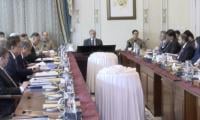
Earlier, Prime Minister Shehbaz Sharif chaired the NEC meeting. While addressing the meeting, he said that further strengthening the country’s defence remains one of the foremost national priorities.
“For the last few weeks, we have been holding consultations with the provinces on how to secure additional funds for defence needs,” he said. Adding that the entire nation has been rendering unparalleled sacrifices in the fight against terrorism. He particularly praised the people of Khyber Pakhtunkhwa and Balochistan, as well as personnel of law enforcement agencies and security forces, for their invaluable sacrifices in the war against terror. Expressing confidence in the country’s resolve, the prime minister said that terrorism would be eradicated through national unity and consensus.
The meeting was attended by Deputy Prime Minister and Foreign Minister Ishaq Dar, Defence Minister Khawaja Asif, Planning Minister Ahsan Iqbal, Economic Affairs Minister Ahad Khan Cheema, Finance Minister Muhammad Aurangzeb, Prime Minister’s Adviser Rana Sanaullah, Sindh Chief Minister Syed Murad Ali Shah, Khyber Pakhtunkhwa Chief Minister Sohail Afridi, Balochistan Chief Minister Sarfraz Bugti, Punjab’s Senior Minister Marriyum Aurangzeb and other NEC members.
The prime minister expressed gratitude to all four chief ministers for their exemplary cooperation with the federal government during challenging economic circumstances. He stated that the country would continue to progress through the same spirit of unity and cooperation among the federation’s constituent units. He emphasised the need for collective efforts to promote employment, boost production, enhance exports, and generate economic activity to accelerate economic growth.
He said that despite enormous challenges, Pakistan’s economy has attained stability. He commended the provinces for their cooperation in managing the petroleum crisis and successfully implementing the IMF programme. He also noted that the federal government had already allocated Rs128 billion from its limited resources in this regard.
Shehbaz also stressed the need to introduce incentives to increase exports, revive the manufacturing sector, and transform the economy, adding that such measures are essential to accelerate GDP growth and provide tangible relief to the people.
He appreciated the performance of the government’s economic team for its efforts in achieving economic stability.
Participants of the meeting paid tribute to the prime minister for maintaining Pakistan’s economic stability despite the negative effects of recent tensions in the Gulf region on the global economy, as well as for his diplomatic efforts aimed at reducing regional tensions.
The premier noted that rapid population growth remains one of the country’s major challenges. He emphasised that national priorities include reducing the growing burden of disease through an improved healthcare system, eliminating child stunting and improving children’s health, providing education to out-of-school children, and creating employment opportunities for young people. He further stated that the government is actively pursuing a strategy to equip youth with technical and vocational skills.
He reaffirmed that an export-led economy remains the government’s foremost priority for sustainable growth. He directed that greater coordination be established between federal and provincial development projects and emphasised that development initiatives should be aligned with national priorities and sustainable economic objectives. He expressed confidence that through collective national efforts, Pakistan would achieve development, prosperity and economic self-reliance.
The NEC unanimously approved its four-point agenda, a statement issued by the PM Office Media said. The meeting reviewed a performance report covering the activities of the Central Development Working Party (CDWP) and the Executive Committee of the National Economic Council (Ecnec) from April 2025 to March 2026. Participants were further informed that during this period, the CDWP approved 116 projects worth Rs316 billion, and the Ecnec approved 72 projects worth Rs5.117 trillion.
A report on the monitoring and evaluation of mega projects during FY 2025–26 was also presented. The meeting was informed that a new monitoring and evaluation policy has been developed, which includes a pilot project utilising artificial intelligence (AI) for the assessment and scrutiny of development projects.
The NEC approved 11 National Economic Development Missions under the “Uraan Pakistan” initiative. The Ministry of Planning and Development was directed to prepare a comprehensive roadmap for these missions in coordination with relevant ministries and provincial governments.
The prime minister thanked all participants for unanimously approving the agenda items and remarked that such consensus on national matters would further strengthen the federation. He stated that this spirit of unity and cooperation is the guarantee of Pakistan’s bright future.
Speaking after the meeting, KP Chief Minister Sohail Afridi said that he fought the case of KP’s people in the best possible manner in the meeting.
He said that the NFC Award was not being updated. The prime minister promised that the NFC would be finalized within 180 days.
He said that the NFC Award is being updated for the tribal districts. All provinces will approve the NFC. If there is no consensus among the provinces, then the summary will be sent by the prime minister to the President’s House.
Sohail Afridi further said that ensuring the implementation of the free movement of wheat is the responsibility of the federal government. Under the agreement signed with Passco, they were taking wheat at a rate above Rs 4,150 per maund. The federal government assured that the wheat price would not be increased.
Meanwhile, Federal Finance Minister Muhammad Aurangzeb said hat the Economic Survey would be presented today (Thursday), setting the stage for the upcoming Federal Budget 2026-27 and outlining key fiscal indicators and performance over the past year.
The Economic Survey, the pre-budget document, would provide a comprehensive overview of the country’s economic performance, including GDP growth, tax revenues, sectoral trends across key industries and other major fiscal and macroeconomic indicators for the outgoing financial year.
The finance minister announced the date for the presentation of the Economic Survey during a Senate session.