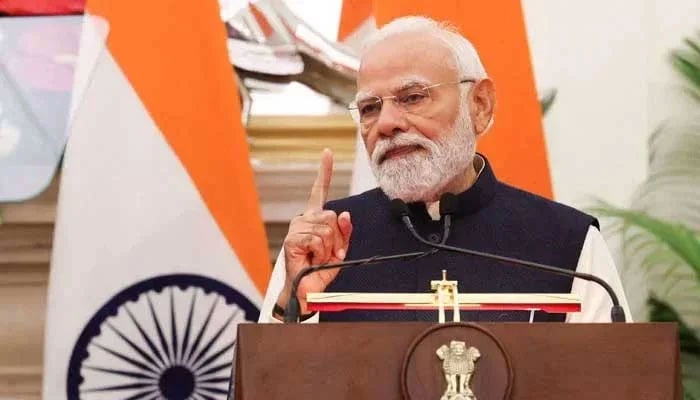
The popularly elected prime minister of the world’s largest ‘democracy’ visits a developed nation known for its free media. He makes a joint press appearance with his counterpart in the host country. As he’s on his way out after the briefing, a media person curtly asks him why he doesn’t take questions. Though this question also remains unanswered, it sets off an unprecedented uproar in the visiting premier’s country. The journalist in question, a lady, is taken to task by the media as if she had committed a mortal sin.
No, this isn’t an anecdote from a Bollywood political thriller but really a real-life incident. It came off when Indian Prime Minister Narendra Modi visited Norway in the third week of May. Modi, the heartthrob of the corporate media at home, seldom takes questions from journalists during his much-hyped visits abroad. He had never been confronted in a foreign land for being media-shy. However, while in Oslo recently, a journalist named Helle Lyng dared to ask him, “Prime Minister Modi, why don’t you take some questions from the freest press in the world?”
Instantly, the lady began to be trolled in Indian media – both mainstream and social. She has been branded as a “spy”, a “foreign [read Pakistan] plant” and being “disrespectful” towards a head of government. “How much does she know about India?” “How many books on India has she read?” Lyng has been presented by the Indian media as being wholly ignorant about their country. Her credentials as a journalist have also been put under question. Later, at a press briefing convened by the Indian embassy in Oslo, Lyng told the hosts that she wanted to ask Modi about human rights violations in India.
Why Modi, who’s presented by the Indian media as the strongest and the most patriotic leader that the country has ever had over its 4000-year-plus history, lacks the courage to face up to journalists abroad and why asking him an innocuous question can make a journalist face shafts of rollicking criticism at the hands of the Indian press? The answer consists of looking at three notable developments that have occurred in India over the past 15 years. The rise of corporate media, the rise of crony capitalism and the increasing marginalisation of the minorities, particularly Muslims, who make up the largest minority in India.
Since 2014 – the year when Modi was installed as prime minister – the Indian media has been increasingly corporatised. The leading Indian media houses are owned or controlled by mega conglomerates. The New Delhi Television (NDTV) Network, India’s first private channel, which in the good old days was known for its anti-establishment stance, is owned by Gautam Adani, a corporate mogul, who took control of it in 2022. The Adani Group also owns NDTV 24x7 (an English-language news channel), NDTV Profit (a business news channel), Indo-Asian News Service, one of India’s premier news agencies, and several regional news channels.
Likewise, Reliance Industries owned by Mukesh Ambani, India’s richest person, controls over 70 TV channels, magazines, and news websites. The most notable of these is Network18, a media conglomerate comprising CNN-News18 (an English-language channel), News18 India (a Hindi-language channel), CNBC-TV18 (an English business news channel) and CNBC Awaz (a Hindi business news channel). Reliance also owns Forbes India. The Z-media, another conglomerate, is owned by the tycoon Subhash Chandra. Republic TV, notorious for its disinformation and Islamophobia, is financed by an ‘invisible hand’.
The corporate media’s rise is primarily due to the pro-rich policies of the Modi regime. Under the Modi-led BJP government, India has become an oligopoly – to many, an Adani-Ambani duopoly – where the interests of a small number of ultra-wealthy take precedence over those of the millions of citizens living at the bottom and in the middle of the economic heap. These conglomerates repay their debt by serving as the BJP’s most loyal spokespersons and bankrolling its politics. They recruit and promote the journalists who compete with one another to sing Modi’s praises and do a hatchet job for him on anyone who points a finger at him. Not surprisingly, India is currently ranked third globally on the Crony Capitalism Index (drawn up by The Economist) and 157th on the World Press Freedom Index. The mainstream Indian media is aptly called Godi Media.
If a leader is used to speaking only to the converted, they will run with their tail between their legs the moment they suspect their audience can be even marginally critical. That’s what Modi does during his overseas trips. The ‘lion’ at home behaves sheepishly abroad.
At the above-mentioned press briefing convened by New Delhi’s embassy in Oslo, the Indian foreign secretary lectured Norwegian journalists on his country’s democracy, its long history, soft power, constitutionally-guaranteed civil liberties and human rights for all, and its secularism. He made a point of mentioning Mahatma Gandhi and his nonviolent freedom struggle.
Yes, constitutionally India remains a secular state and confers legally protected fundamental rights on the citizens regardless of caste and creed. Yet, there’s a difference, which is remarkably conspicuous in the case of India, between what a constitution on paper is and how it actually works. While in the good old days, India did exhibit a semblance of secularism and rule of law, the country has seen an increasing marginalisation of the minorities and de-democratisation since the onset of the BJP government in 2014. The key constitutional institutions, such as the Supreme Court of India and the Election Commission of India, have been complicit with the executive in both these developments.
For four years, the Indian Supreme Court sat on the petitions which challenged the change in the constitutionally guaranteed status of the overwhelmingly Muslim majority Occupied Jammu & Kashmir State on August 5, 2019 before finally ruling in favour of the Modi government on flimsy grounds just weeks ahead of the national elections.
Earlier in 2019, the SCI ordered that the disputed land where the historic Babri Masjid once stood be handed over to a trust to build a temple. The verdict represented a veritable setback to secularism. Likewise, the Election Commission has also lost its credibility for alleged voter fraud and manipulation in electoral rolls to benefit the ruling BJP. In the recent state elections in West Bengal, nine million voters, including 3.1 million Muslims, were allegedly disenfranchised, setting the stage for the BJP’s landslide victory.
Yes, Mahatma Gandhi taught and practised non-violence. Yet for the BJP and his diehard supporters, he, along with Jawaharlal Nehru, is one of the most hated persons for his secularism, particularly his concern for the Muslims who stayed in India after August 1947. Nehru is censured for his ‘appeasement’ to Muslims. This is the reality of Modi’s India.
The writer is an Islamabad-based columnist. He tweets/posts @hussainhzaidi and can be reached at:[email protected]