Every year, when hurricane and tornado seasons hit different parts of the US, we see footage of billions of dollars in damage. Flattened neighbourhoods, shredded roofs, entire streets reduced to debris. Aerial footage makes the devastation look surreal, with homes crumpled as if they were made of paper and matchsticks.
For people watching in the rest of the world, it raises an obvious question: when severe weather events are a common seasonal occurrence, why don’t Americans build their homes with bricks, stone and concrete, as in much of the rest of the world?
When European settlers first started landing on the East Coast of North America, they encountered dense forests. When they had to set up dwellings, trees were in the way. When they had to set up farms to grow food and raise livestock, trees were in the way. And when they wanted to travel further inland, yes, you guessed it, trees were in the way.
From the earliest days, wood and lumber have been the most abundant construction materials available. In the four hundred years since, the ecosystem, including supply chains, labour, expertise, regulatory standards and architectural practices, developed around these materials, has not been able to transition to alternatives despite recurring billions in damage.
Once a sector or industry develops, momentum makes the way things are done resistant to radical change. In Pakistan, the inertia of the status quo is so great that we paper over problems, usually by setting up parallel systems, rather than addressing the root cause. In this regard, our school system serves as a prime example.
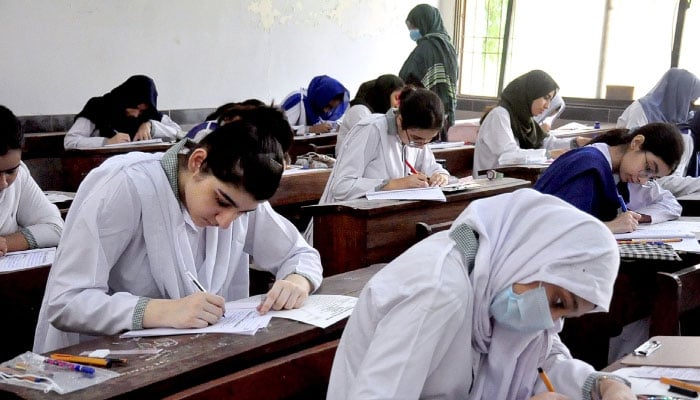
Around the 1990s, paper leaks from exam boards in the public school system began to occur with increasing frequency. In addition, mark inflation, wide variations in exam board standards that universities’ admissions processes were blind to, and an absence of any sense of urgency to get with the times and meaningfully update curricula, caused a gradual erosion of trust in the local exam boards.
All of these led parents and students to vote with their wallets and hop onto the private-school Cambridge education track in ever greater numbers. So complete is the surrender of the public school system that, late last year, the government of Sindh announced a pilot programme to introduce the Cambridge IGCSE in at least one public school in every district.
Last year, out of the approximately 680,000 students who appeared in Cambridge’s O-level, IGCSE and AS/A-level exams, around 100,000-115,000 – about 15 per cent of the total – were from Pakistan. They are supported by an ecosystem of teachers, schools, academies, tutors, services and learning materials that has developed over decades.
While private school education remains significantly more expensive than public schooling, access to private schools offering the Cambridge curriculum has been growing and so has the competition for opportunities after high school. The club of Cambridge-qualified high school graduates is no longer as exclusive as it used to be. Students walking the straight and narrow must put in an even greater effort to stand out because having passable grades is no longer enough.
Cambridge-track students make too big and too lucrative a market for shady players to leave it be. For others, it has created a darker incentive structure – a growing market for shortcuts like breaking exam secrecy and selling papers to a growing market of potential customers more deep-pocketed than public school goers.
Over the last ten years, there have been breaches of exam secrecy of increasing severity. In 2017 and 2018, there were reports of some exam questions circulating online, but with limited reach. In 2021, there were reports of more widespread sharing of the IGCSE Mathematics paper, helped by the wider adoption of messaging platforms. Things further escalated from 2022 to 2025 and, of course, a few days ago this year, when at least one exam paper was leaked and covered by extensive reporting, including details on the mechanics of the online marketplace for leaked papers.
My concern with this string of exam security breaches is that their escalating severity and the apparent lack of repercussions seem to mirror the slow, gradual pace at which our local examination system was allowed to fall apart. I understand that Cambridge Assessment International Education may want to guard details about internal operations, but should students not have assurance that procedural weaknesses were identified and patched, and those responsible were identified and will be prosecuted? Not to overstate the similarities, but if there are no consequences, how much difference in credibility remains between it and the local exam boards? While universities may not be able to institute an explicit ban on applicants with A-level qualifications from Pakistan, admissions processes in many countries leave enough discretion to apply an unannounced shadow ban.
I also want to make one last point: If the credibility of the CAIE suffers, it is not like there are no alternatives. While many urban middle-class households have to make sacrifices to afford their children an IGCSE and O/A-level education, it is no longer a choice reserved only for the societal elite.
The ‘elite’ have already moved on to other, even more expensive, options. The International Baccalaureate (IB) is growing in popularity. A little over a dozen schools in Pakistan’s Tier-1 cities offer IB Diploma programs at around two to 4 times the cost of an A-level education. In 2022, the number of students from Pakistan who received IB diplomas was only 264. That is what you could call elite.
Beyond that, a growing number of people for whom money is truly no object, bypass schools in Pakistan entirely and send their children to high schools abroad. There is a growing set of global destinations that market themselves as global education hubs for high school and university education.
If CAIE qualifications awarded in Pakistan face a prolonged credibility crisis, students from well-off households might start considering other options (such as the IB Diploma) when they enter high school. At present, IB diploma programmes do not benefit from the scaffolding and infrastructure that exist to support students on the Cambridge track, but that could start to change if demand continues to grow. It has happened once already, when students walked away from the local exam boards and followed the elite of the time, 30-40 years ago, to the A-level track. I don’t see why it could not happen again. To borrow some words from Jeff Goldblum’s Ian Malcom in Jurassic Park: ‘The elite find a way’.
Of course, all of these alternatives add up to little more than papering over problems because they leave the vast majority of students who do not have the opportunity to take Cambridge exams, or an IB diploma (or study high school abroad!) out in the cold. However, consider this: an estimated 45-50 million children are aged 5 to 19 years and, ideally, ought to be in a school. Considering this scale, importing our way out of our failing domestic school system is not an option.
Ultimately, the only way out of our dilemma is to revive the local school system and regain the reasonable level of trust and credibility it enjoyed decades ago. The only choice before us is whether to start the hard work today or put it off for another 20 years. If you are not convinced about the price of inaction, talk to American homeowners and insurance companies.
The writer (she/her) has a PhD in Education.