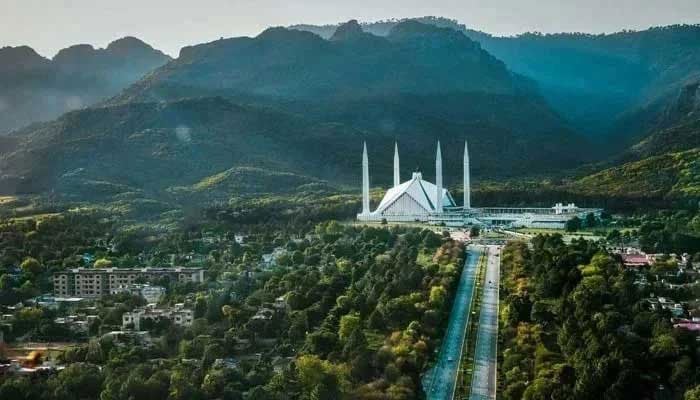
Islamabad has been without an elected local government for more than five years. Five years is long enough for a child to begin primary school and nearly finish it. Long enough for entire neighbourhoods to emerge on the edges of the capital without drainage, roads or water lines. Long enough for favoured bureaucrats to become permanent fixtures of governance.
And yet the administrative basics of local democracy remain stalled. In the same period, repeated media reports on so-called ‘Constitution Avenue’ planning and high-value land adjustments have highlighted how the governance of Islamabad has increasingly been shaped less by people-centric development than by property-development priorities and the influence of powerful stakeholders in prime real estate.
In most countries, the absence of local government in the federal capital for half a decade would trigger a political crisis. In Pakistan, it barely interrupts the news cycle. The country now lives in a permanent state of institutional postponement: postponed reforms, postponed elections, postponed fiscal restructuring, postponed constitutional clarity. Postponement itself has become a governing philosophy.
And now, amid this drift, Islamabad is again alive with rumours of constitutional engineering. The latest whispers concern a possible 28th Amendment – an attempt, according to speculation, to recalibrate the federation–province balance, revisit elements of the 18th Amendment and re-centralise governance in the name of administrative efficiency. No formal proposal exists. But rumours in Islamabad are rarely about law. They are about power: when governance fails, the reflex is to redraw structure rather than repair capacity.
Pakistan’s problem is not that power has been devolved too far. It is that governance has barely been devolved at all. The 18th Amendment shifted authority from Islamabad to the provinces, but the chain of devolution stopped there. Districts, cities and towns remain without meaningful fiscal or administrative authority and capacity. Provinces became new centres of centralisation, replicating the federal model rather than replacing it. The result is a federation where most citizens still experience the state as distant and uneven.
This has also distorted the fiscal debate. Pakistan is often presented with a false choice between creating new provinces or improving revenue sharing through the National Finance Commission (NFC) award. In reality, both address the same structural flaw: a fiscal system that has not adapted to demographic growth, urbanisation and regional inequality and has failed to focus on promoting economic growth. Whether through reweighted NFC transfers or new administrative units, the core requirement is the same – aligning fiscal flows with population, productivity and need.
To understand why this structure produces persistent stress, it helps to clarify what the Fragile States Index (FSI) measures. The FSI, produced by the Fund for Peace, is not a ranking of economic performance. It is a diagnostic framework for structural stress within states. It tracks pressures that accumulate beneath formal institutions: demographic expansion, uneven development, group grievance, economic decline, erosion of public services, loss of legitimacy and weak state authority across territory.
It does not measure short-term performance. It measures whether a state’s underlying architecture is becoming more or less resilient over time. On that measure, Pakistan has remained for nearly two decades in a narrow band between ‘High Alert’ and ‘Very High Alert’. Periodic improvements reflect stabilisation episodes – external financing, political consolidation or temporary macroeconomic relief – rather than structural reform.
The direction of travel matters more than the score. Pakistan stabilises intermittently but does not transform. It returns to fragility because its political economy remains unchanged. That political economy is visible across the country, not as a single crisis but as multiple regional expressions of the same structural condition.
Karachi is the clearest example. It generates a disproportionate share of national revenue yet is governed through overlapping provincial and municipal systems that diffuse accountability. Informal systems fill the vacuum left by formal governance. This is not a question of scale. Megacities globally function at far greater complexity. The issue is the absence of an empowered metropolitan government capable of matching the city’s economic weight.
In Balochistan, governance takes another form. The state is most visible through security infrastructure and extraction projects, while civic services remain weak. Vast distances separate citizens from schools, hospitals and administration. Even major development initiatives coexist with basic deficits in water and connectivity. This is not simply underdevelopment. It is a model in which coercive capacity expands faster than civilian capacity.
The former tribal districts illustrate incomplete integration in another form. The Fata merger into Khyber Pakhtunkhwa was framed as constitutional completion, but administrative capacity has not kept pace. Policing, infrastructure and service delivery remain uneven and governance remains in transition rather than consolidation. Even Punjab contains internal asymmetries. The corridor from Rawalpindi through Lahore to Faisalabad is highly developed, while southern Punjab continues to lag in human development, water access and fiscal attention.
These patterns align with the FSI indicators of uneven development and group grievance. They are not separate crises but expressions of a single structural condition: unequal state capacity across geographic space. This becomes more consequential when viewed in the context of Pakistan’s economic trajectory. Urbanisation is advancing, but policy remains misaligned with it. Cities are treated as administrative zones rather than productive systems.
If Pakistan is serious about export-led growth, urban reform must move from the margins to the centre of political economic policies. Fiscal transfers must follow people and productivity, not outdated boundaries. Cities require empowered metropolitan governments with authority over land use, transport, housing and climate resilience.
A credible urban policy would align housing, mobility, skills development and industrial zoning with export objectives. It would discourage speculative land hoarding, prioritise affordable housing near employment centres and integrate informal labour into the formal economy. Without this, urbanisation becomes pressure rather than productivity.
Pakistan’s urban transition is already underway. Whether it becomes a platform for sustained export growth or a source of instability will depend on governance choices, not demographics.
This is where the argument against decentralisation weakens. The claim is familiar: more provinces weaken the federation, smaller units are economically unviable and administrative multiplication leads to fragmentation. The logic is geometric – fewer units mean stronger unity.
But fragility is not geometric. It is institutional. The FSI shows no correlation between size and stability. Many fragile states are small; their instability reflects weak institutions, elite capture and failure to deliver services and legitimacy beyond narrow centres.
If size determined stability, small states would be stable and large federations unstable. The evidence does not support this. What matters is governance capacity. Pakistan’s problem is therefore not ‘too many provinces’ but rather too little governance below the provincial level and too much concentration above it.
Decentralisation is not fragmentation. It is the alignment between the state structure and social reality. Climate change now reinforces this structural stress. Glacial instability, groundwater depletion, floods, heat extremes and drought are no longer isolated shocks but simultaneous pressures on a weak administrative system.
Demographic expansion compounds this. Millions are added annually while economic growth remains constrained. Public debt is high, exports are narrow and fiscal space is limited. State capacity is being diluted each year.
Recent UN-backed assessments place Pakistan among countries with severe acute food insecurity. Millions face deprivation driven by inflation, climate shocks and economic volatility. Entire populations now sit one disruption away from crisis. Yet political debate in Islamabad remains focused on constitutional adjustment among elites rather than on administrative capacity, where governance actually fails.
This is why rumours of a 28th Amendment matter even if they never materialise. They reveal a governing instinct that still believes structural crisis can be solved through constitutional redesign rather than institutional repair.
But Pakistan’s fragility is no longer abstract. Power remains concentrated. Responsibility is dispersed onto institutions too weak to carry it. And the gap between them continues to widen. The fear of fragmentation has become a justification for paralysis. Yet fragmentation is already occurring – not in territory, but in the social contract itself. It is visible in the growing distance between citizens and a state that struggles to reach them.
That is the true measure of fragility. And it cannot be repaired by another amendment drafted in Islamabad while the capital itself remains unable to hold a municipal election.
The writer is former head of Citigroup’s emerging markets investments and author of ‘The Gathering Storm’.