Tracking climate disaster trends since 2010, the official climate chapter of the Pakistan Economic Survey 2024-2025 notes that Pakistan is among the world’s most climate-vulnerable countries.
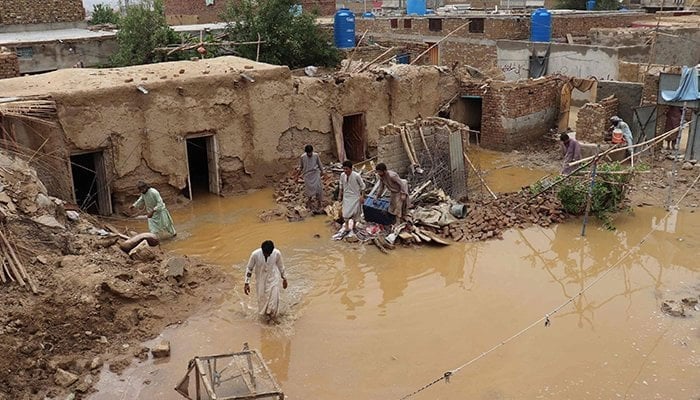
Floods remain the most destructive hazard. Between 1980 and 2024, Pakistan experienced 224 extreme natural disaster events. The 2010 super floods are recorded as Pakistan’s key climate catastrophe of the century. The 2022 floods are known as Pakistan’s largest recorded climate disaster and exposed severe weaknesses in resilience, preparedness and adaptation systems. The 2025 flood further broke several trends and myths.
Based on NDMA reports, Post Disaster Needs Assessment (PDNA), economic surveys and international recovery assessments, the estimated cumulative burden since 2010 counts more than 70 million people affected, more than 8000 deaths reported, more than four million houses damaged/destroyed, millions of acres of agricultre land affected, economic damages and losses exceeded $50 billion; tens of billions of dollars were needed for recovery and reconstuction. These figures are conservative estimates; many droughts, heatwaves, ecosystem/biodiversity losses, glacial hazards, and urban flooding impacts are not included in official accounting frameworks.
The evidence from official sources shows that Pakistan is no longer experiencing isolated disasters; it is facing a structural climate-risk economy. The 2010, 2022 and 2025 floods alone generated losses and damages exceeding $50 billion, yet annual allocations for disaster preparedness, risk reduction, anticipatory action and local resilience remain a fraction of that amount. This supports the argument that Pakistan’s disaster governance remains predominantly reactive rather than anticipatory.
As repeatedly highlighted in official assessments, recovery and reconstruction costs now substantially exceed investments in preparedness, local resilience, early warning systems, risk-informed planning and anticipatory action. “Anticipatory action is a proactive disaster management approach that involves taking protective steps before a predicted hazard strikes”. This requires pre-agreed finance and a pre-agreed action plan. The pre-agreed finance is known as ‘anticipatory action financing’.
Since 2010, almost every year, Pakistan has faced disasters of multiple natures. Looking at the losses and damages from disasters over the last 15 years, one finds that disaster financing has remained reactive, serving response purposes through revised budgetary estimates rather than being a regular anticipatory/preparedness head. The forecast for 2026 is also alarming, with heatwaves and monsoon-related flooding.
This means inclusive disaster risk reduction (DRR) and anticipatory action financing are not prioritised in annual budgets (both federal and provincial). In a climate-risk- and disaster-prone economy, anticipatory action can preserve development gains that would otherwise be lost to disasters we do not anticipate or prepare for appropriately. ‘Spending a dollar on anticipatory action saves seven dollars spent on disaster response’ is a concept that necessitates the need for budgeting (pre-agreed) anticipatory action financing, as disasters in Pakistan are a regular feature and we have to live with disasters and yet protect the gains of development, which is only possible through formal budgeting of anticipatory action financing.
The country’s federal disaster financing remains overwhelmingly reactive. In the budget document, funds are not allocated for disasters as a line item rather, they are counted in the NDMA’s regular federal allocation, which is extremely small against GDP, while large spending appears only after disasters hit through revised estimates, emergency heads, reallocations and recovery spending.
If we analyse the NDMA’s official allocation from 2022-2023 to 2025-2026, we find that during FY2022-2023 and FY2025-2026, budgetary estimates were changed from the original to the revised ones due to floods in 2022 and 2025, which shows that our financing of disasters is reactive and the financing for DRR/anticipatory action was not allocated in the budget. In FY2022-23, the regular budgetary allocation for NDMA was estimated at Rs630.6 million, while after the 2022 floods, it was revised to Rs18.62 billion.
Similarly, in 2025-2026, the revised estimated allocation was Rs2.97 billion. Normally, under the NDMA budget head, the financing allocated ranges from Rs630.6 million to Rs908 million, less than Rs1 billion. It only goes into the billions when a disaster hits. Using the official current value of GDP for FY2023-2024 and FY2024-2025, the NDMA’s regular federal allocation is far below 0.001 per cent of GDP. This is too meagre an amount amid the ever-increasing frequency of disasters that destroy infrastructure, schools, hospitals and houses, damage crops and livestock and, overall, reverse economic and developmental gains.
At the moment, the budget does not yet allow a clean split between disaster response and preparedness, a major governance issue. The 2024–25 and 2025–26 Annual Budget Statements explicitly acknowledge that data on public expenditure on disaster preparedness, recovery and rehabilitation were not available in the past, and that the federal government only decided in 2024 to tag more than 5,000 cost centres across preparedness, response, recovery/rehabilitation and reconstruction. This means Pakistan has been budgeting for disasters without a mature disaster-finance classification system. In policy terms, the country has suffered from ‘paralysis by analysis’. The risks are repeatedly identified, but fiscal architecture remains weak, fragmented, and reactive.
The fiscal gap is enormous. The official Fiscal Risk Statement says the 2022 floods caused $14.91 billion in damages and $15.23 billion in losses. It projects that without a dedicated natural disaster fund, the fiscal burden could reach Rs4,778 billion ($17 billion) in FY2026, Rs6,504 billion ($23 billion) in FY2027 and Rs8,677 billion ($31 billion) in FY2028 if disasters continue to occur. With a dedicated fund, the required allocation is estimated at Rs613.8 billion ($2.2 billion) in FY2026, Rs221.6 billion ($0.79 billion) in FY2027 and Rs240.5 billion ($0.86 billion) in FY2028. That means the present federal NDMA allocation of under Rs1 billion is not a disaster-risk financing; it is an administrative allocation.
Similarly, the provinces do not have dedicated funds for preparedness and anticipatory action, though during recent disasters, anticipatory action saved more lives and protected more infrastructure than traditional actions. The provinces also use emergency funds to respond to disasters, so the overall architecture is based on reactive funding rather than anticipatory action financing.
Pakistan’s disaster financing faces three structural problems: i) response dominates preparedness as major spending appears after floods and shocks, not before them; ii) local government is fiscally invisible despite the fact that local bodies are the first line of preparedness, evacuation, shelter management, drainage, heatwave response and community mobilisation; and iii) representation failure becomes allocation failure as resource allocation does not reflect national climate and disaster priorities and governance seems less responsive to citizens’ lived risks.
Defence against disasters is a big human and development security issue. So the budget for FY2026-27 should create a ring-fenced ‘National Anticipatory Action and Disaster Preparedness Window’ with sufficient allocations in the budget for i) National Disaster Fund/contingency reserve; ii) anticipatory action triggers and pre-arranged financing; iii) provinical matching grants for PDMAs, SDMA and GBDMA; iv) onward transfer of the budget allocation to local governments as preparedness grants; v) Early warning, National Emergency Operation Centre (NEOC), Pakistan Meteorological Department (PMD)/Federal Flood Commission and impact-based forcasting systems; and vi) community preparedness, simulations, evavuation, heatwave/drought protocols, etc.
For all these functions together, one would estimate the allocations from Rs250 billion to Rs300 billion. This would still be below the official fiscal-risk requirement, but it would mark a shift from a post-disaster compensation to a pre-disaster protection, preparedness, and anticipatory action.
The period from 2010–2025 shows a transition from episodic disasters to a condition of permanent climate risk. Pakistan is no longer facing isolated emergencies; it is confronting a recurring climate-disaster economy in which floods, droughts, heatwaves, glacial hazards and urban climate shocks repeatedly erode development gains.
The lesson from 15 years of disasters is that post-disaster response financing is fiscally unsustainable. The evidence increasingly supports a shift towards: anticipatory action financing, forecast-based early action, local government preparedness funds, climate-resilient infrastructure, shock-responsive social protection, provincial contingency financing and community-based disaster preparedness systems.
The writer is an Islamabad-based policy analyst. He is currently the deputy executive director (policy) at SDPI, Islamabad and can be reached at: [email protected]