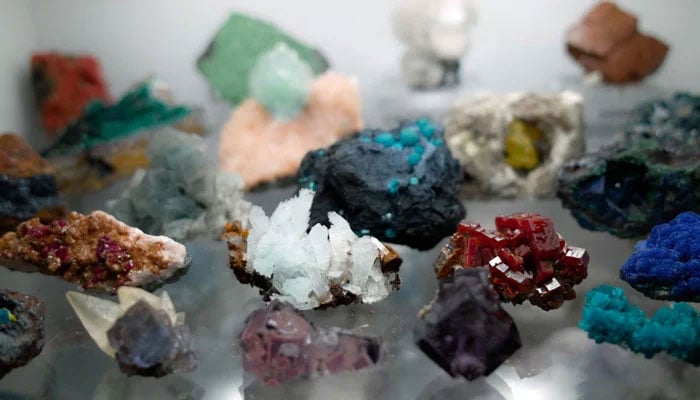
In the emerging global order, control over critical minerals is increasingly shaping technological leadership, industrial competitiveness, national security and geopolitical influence. Copper, lithium, cobalt, nickel, graphite, and rare earth elements are essential for electric vehicles, semiconductors, AI, defence systems, renewable energy technologies and advanced manufacturing.
According to the International Energy Agency, demand for critical minerals used in clean energy technologies is expected to more than triple by 2030, while copper demand could rise by nearly 40 per cent over the next decade.
China currently dominates the global critical mineral ecosystem, controlling much of the production, refining and processing of key strategic minerals. This concentration has heightened supply-chain concerns in Washington and other Western capitals amid growing US-China competition.
Under US President Donald Trump, securing diversified access to critical minerals has become a national security priority. As the US seeks alternatives to Chinese-controlled supply chains, many existing suppliers face economic, infrastructural or political constraints. In this evolving landscape, Pakistan is emerging as a strategically important but underexplored opportunity.
Pakistan possesses enormous untapped mineral wealth. The country reportedly holds the world’s second-largest coal reserves, estimated at over 185 billion tonnes, primarily in Thar, alongside the world’s seventh-largest copper reserves. Government-linked estimates place Pakistan’s total mineral potential at over $6 trillion. Balochistan alone hosts significant deposits of copper, gold, chromite, iron ore, lithium prospects, and rare earth minerals spread across nearly 600,000 square kilometres.
The Reko Diq project has emerged as the centrepiece of this strategic opportunity. Widely regarded as one of the world’s largest undeveloped copper-gold projects, Reko Diq is expected to produce approximately 200,000 tonnes of copper and nearly 250,000 ounces of gold annually during its initial operational phase. International estimates suggest the mine could generate almost $74 billion in free cash flow over a projected 37-year life cycle. The first phase of development alone is estimated at approximately $5.5 billion. Recognising the project’s strategic significance, the US Export-Import Bank has shown strong interest in supporting Pakistan’s mining sector, reportedly approving financing support worth around $1.25 billion.
Compared with competing mineral-producing regions, Pakistan offers several competitive advantages. In Australia, average mining labour costs can exceed $120,000 per worker annually, while environmental compliance and permitting processes often span 7-10 years. Canada similarly faces high labour and infrastructure costs, alongside severe weather-related operational constraints in several mining regions. Brazil offers lower production costs than Western markets but faces logistical and environmental challenges, especially in remote extraction zones. Several African mineral economies offer lower extraction costs but often face governance challenges.
Pakistan, by comparison, benefits from lower labour costs, relatively flexible investment structures, large-scale undeveloped reserves and strategic proximity to the Arabian Sea. Transport connectivity through Gwadar could significantly reduce shipping times to Middle Eastern and Asian markets. If security, water infrastructure, and regulatory consistency improve, Pakistan could emerge as one of the most cost-effective suppliers of critical minerals in the region.
However, the challenge is not geological; it is geopolitical. As the US explores opportunities in Pakistan’s mineral-rich south-western regions, regional instability threatens these ambitions. According to Pakistan’s security assessment, militant violence and separatist activity in Balochistan seek to undermine economic development, foreign investment and strategic connectivity projects.
For India, instability in Balochistan intersects with broader concerns regarding both Pakistan and China. Gwadar Port, a key component of CPEC and China’s Belt and Road Initiative, provides direct access to vital maritime routes through which a significant share of global oil trade passes. Its location strengthens links between western China, Central Asia, the Middle East and South Asia.
From Islamabad’s perspective, efforts to destabilise Balochistan not only pressure Pakistan economically but also constrain Chinese strategic expansion. Pakistan’s security institutions maintain that hostile intelligence networks exploit border regions to facilitate infiltration and sabotage, while groups such as the BLA remain a major security concern.
At the same time, the Afghan dimension further complicates the regional security environment. Pakistan has repeatedly expressed concerns regarding the operational freedom available to TTP elements inside Afghanistan. Islamabad maintains that TTP sanctuaries have intensified cross-border terrorism, strained bilateral relations with Kabul and increased instability along Pakistan’s western frontier. According to Pakistani security assessments, hundreds of terrorist incidents linked to cross-border infiltration have significantly impacted investment confidence in border provinces and mineral-rich zones.
The implications are no longer confined to Pakistan alone. Regional spillover is increasingly visible across Central Asia. Attacks originating from Afghan territory have reportedly killed Chinese nationals in Tajikistan, while extremist infiltration risks continue to expand across parts of Central Asia. These developments threaten major connectivity projects and trade integration initiatives linking Central Asia to Pakistani ports.
For the Central Asian Republics, access to warm-water ports through Pakistan represents a major strategic and economic opportunity. Central Asia collectively holds energy reserves worth trillions of dollars but remains heavily dependent on Russian transit infrastructure. Stable trade access through Afghanistan and Pakistan aligns closely with long-term US strategic objectives regarding Eurasian integration, energy diversification and regional balancing. Yet continued terrorism and proxy instability directly undermine these objectives.
If Afghanistan remains permissive towards transnational militant networks, broader American interests in Eurasian connectivity, counterterrorism cooperation and critical mineral supply chain diversification could face serious structural setbacks. A destabilised western Pakistan does not merely threaten Pakistan’s economy; it also threatens the viability of future trade corridors, regional integration projects and mineral supply chains that underpin global industrial resilience.
This creates a growing strategic contradiction for Washington. On the one hand, the US seeks secure, diversified access to critical minerals outside China-dominated systems. On the other hand, continued instability in Pakistan’s mineral-rich regions, driven by militancy, proxy rivalries, and deteriorating regional security, threatens the very environment necessary for such investments to materialise. Allowing an Indo-Taliban destabilisation nexus, whether direct, indirect, or opportunistic, to complicate engagement with Pakistan’s mineral sector would ultimately undermine broader US strategic objectives.
China’s position further highlights this contradiction. Beijing already maintains a mature and institutionalised economic footprint in Pakistan through infrastructure, energy, and connectivity investments exceeding $60 billion under CPEC-related frameworks. While China remains interested in Pakistan’s mineral resources, it is not structurally dependent on them because of its own reserves and processing dominance. Pakistan’s minerals therefore hold comparatively greater strategic importance for the US than they do for China.
In this geopolitical chessboard, stability in Balochistan and along Pakistan’s western frontier is increasingly linked to future supply chains, technological competition, AI infrastructure development, energy transition systems and global industrial resilience. Critical minerals are becoming the new strategic currency of power, much like oil shaped geopolitical alignments during the twentieth century.
The policy question before Washington is therefore unavoidable: will the US allow regional rivalries, extremist sanctuaries and an emerging Indo-Taliban convergence of interests to obstruct or stigmatise its long-term access to Pakistan’s critical mineral resources?
For the US, the answer may ultimately determine not only the future of its mineral security strategy but also its broader influence across South Asia, Central Asia and the evolving architecture of the global technological economy.
The writer is a public policy expert and leads the Country Partner Institute of the World Economic Forum in Pakistan. He tweets/posts @amirjahangir and can be reached at: [email protected]