Twenty years. That is how long Pakistan went without opening its offshore frontier to new bids. On Wednesday, May 20, the government awarded 23 exploration blocks covering approximately 54,600 square kilometres of the country’s maritime waters. Initial investment into phase one: $82 million. Projected investment into phase two: $1 billion.
Now consider this. Since its independence, 78 years ago, Pakistan has drilled exactly 18 exploratory wells in its entire offshore territory. Eighteen. In 78 years. In May 2026 alone, it awarded 23 blocks.
Plain fact: Pakistan’s offshore sits wedged between two proven hydrocarbon giants – Oman and Iran to the west, India’s Bombay High to the east.
Look eastwards. India’s Bombay High – discovered in 1974, just across the Arabian Sea – has produced over two billion barrels of oil. It once accounted for 38 per cent of India’s domestic production. It transformed India’s energy balance. It still produces today.
The reality: Pakistan sits on the same geological shelf. The same Arabian Sea. The same limestone formations that made Bombay High a giant have also been identified in the offshore Indus basin. Geologists call it an “anomalous gap in a prolific petroliferous belt”. Translation: everything around Pakistan has oil. Pakistan alone has not looked hard enough.
The signs are there. Along the entire Makran coastline, there are gas seepages, oil seepages and mud volcanoes that bubble methane to the surface. In 2013, an earthquake off Gwadar pushed a new island out of the sea. Methane. Hydrocarbons. The earth trying to tell us something.
Yes, one well drilled in the Indus offshore tested gas at 3.7 million cubic feet per day. Encouraging. Not enough to celebrate. But enough to keep looking.
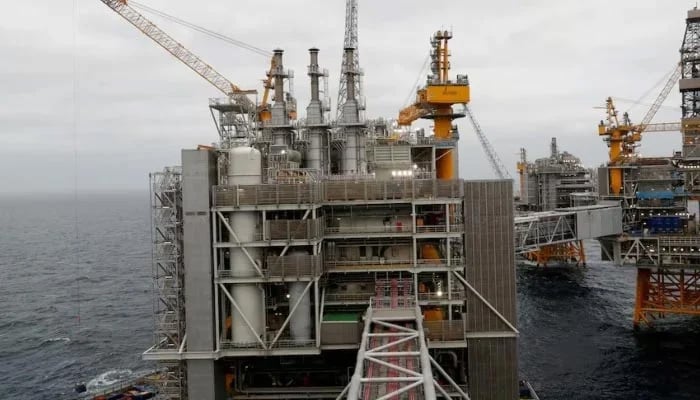
Here is the brutal arithmetic: 18 wells drilled in 78 years works out to one well every four years. Norway, which discovered its offshore oil in 1969, has drilled over 5,000 exploration wells since. The comparison is almost unfair. Almost.
The $82 million committed in phase one is a start. But let us be honest: $82 million across 23 blocks is thin. One deepwater well alone can cost $50–100 million. This is not yet a drilling programme. It is a signal. A declaration of intent.
The intent is welcome. The execution is everything.
Pakistan spends $20 billion a year importing energy it may well be sitting on. Twenty-three blocks have been awarded. The drills have not yet turned. When they do – and they must – the Arabian Sea may yet write a different story for this country. The tide, at last, is turning.
Remember: Norway found oil in 1969. Remember: Norway drilled 5,000 wells. Pakistan found courage in 2026. It awarded 23 blocks. The arithmetic of ambition is simple: you only find what you are willing to look for.
The good news is not discovery. The good news is movement. Pakistan has not found offshore oil yet. But Pakistan has reopened the door it kept shut for two decades. For once, policy is moving in the same direction as geology. The tide is turning.
The writer is a columnist based in Islamabad. He tweets/posts @saleemfarrukh and can be reached at: [email protected]