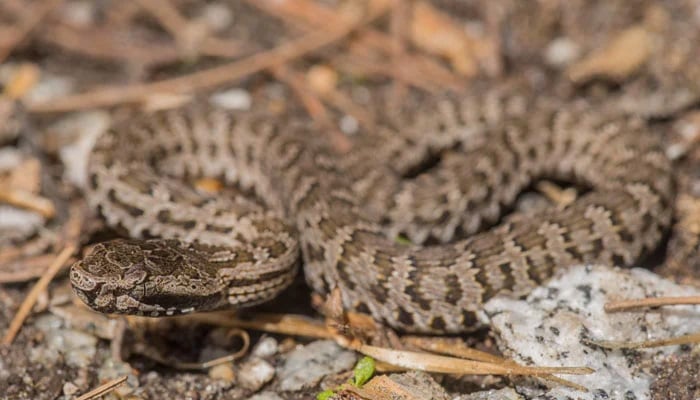
PESHAWAR: An international team of researchers studying snakes in Himalaya, Hindu Kush and nearby mountain areas have discovered that a venomous snake once believed to be only one species is actually made up of five different species hiding under the same name.
“The snake, commonly known as `Himalayan pit viper’ or Gloydius himalayanus, lives in the high mountains of Pakistan and nearby regions of India and Nepal” shared Rafaqat Masroor, a prominent herpetologist and member of research team.
The study, published in the Journal “Zookeys”, showed that what people for more than 150 years called one widespread snake was actually a group of five separate species-level lineages.
Three of these newly recognized species are completely new to science, out of which two are exclusively found in Pakistan’s mountain regions, highlighting the rich and unique biodiversity of the country.
Rafaqat Masroor who is also Curator of Pakistan Museum of Natural History, led the research along with scientist Daniel Jablonski of Comenius University Bratislava, who has been conducting extensive research in Pakistan and Afghanistan for many years.
The research team managed to collect specimens from the Kumrat Valley in Upper Dir District of Khyber Pakhtunkhwa in September 2020 and it was there that the holotype of what is now named Gloydius hindukushensis, the Hindu Kush Pitviper, was found freshly killed by local villagers who had encountered it on a path.
A second new species, G. hazarensis, the Hazara Pitviper, turned up in the northeastern Pakistan region between the Indus and the western Himalayan foothills.
And a third, G. nepalensis, the Nepali Pitviper, has apparently been sitting in museum collections from western Nepal since the 1970s without anyone realizing it didn’t belong to the species everyone assumed it was.
The scientists used modern DNA testing, body structure comparisons, ecological observations and museum specimens collected long ago. Some museum samples were more than 100 years old.
By comparing old preserved snakes through mesuomics with newly collected snakes from the mountains, researchers were able to uncover the hidden diversity.
The study strongly highlights the importance of museum collections.
Without preserved specimens kept in museums for decades, scientists would not have been able to compare past and present snakes properly.
The findings are also important for public health and conservation because pit vipers are venomous snakes.
If five different species were hiding within what people thought was only one species, their venoms might also differ, Rafaqat commented.
Scientists said this created an urgent need to study the venom characteristics of each newly recognized species.
If someone is bitten by a Gloydius in Pakistan, the species identity of attacking viper matters for understanding venom composition and potentially, treatment response, Rafaqat added.
Better understanding of venom differences could become important for snakebite treatment and the future development of effective anti-venoms.
With five distinct venom profiles now identified, the next step of the research is mapping venom composition across all the species to guide a future anti-venom.
Conservation experts also warn that recognizing separate species matters for protecting nature.
A snake once thought to be common and widespread may actually consist of several species with much smaller habitats.
Some of these newly discovered species could be rare and vulnerable to habitat loss, climate change or environmental disturbance in fragile mountain ecosystems.
Pakistan’s northern mountains remain one of Asia’s least explored biological regions and scientists say continued fieldwork, biodiversity research and support for museums are essential to better understand and protect its natural heritage.
The research study showed that even large and well-known animals like venomous snakes could still hide unknown diversity in remote areas.
This unique location had created rich biodiversity that scientists were only beginning to fully understand, Rafaqat remarked.