For decades, a major part of American and global strategic scholarship was built around the possibility of a China–US military clash. The literature of rivalry has generated colossal defence budgets, weapons programmes, forward military deployments, Indo-Pacific alignments, alliance-building, technology controls, supply-chain weaponisation and an elaborate US-led ecosystem aimed at constraining China’s rise. From military bases to semiconductor restrictions, from rare-earth anxieties to naval posturing, the dominant frame has been confrontation.
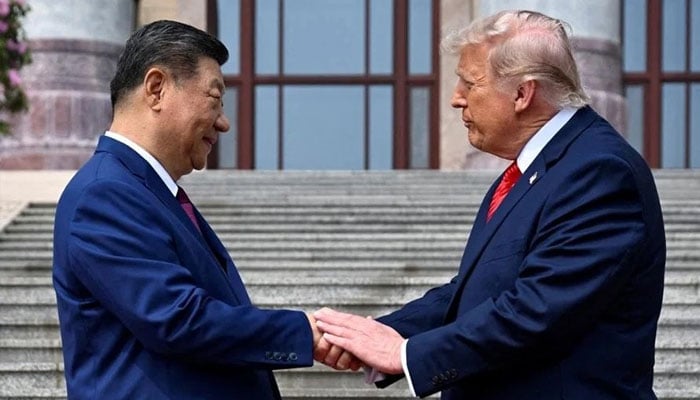
Against this backdrop, the China–US summit in Beijing was important not because it produced a grand bargain but because it signalled that wiser calculations can still intervene in dangerous strategic trajectories. At a time when the world’s two most consequential powers carry not only immense military capabilities but also decisive influence over global trade, technology, finance, energy security and diplomacy, the tone and direction of their engagement matters. Beijing showed that even adversarial relationships can be managed when leadership chooses sobriety over provocation.
President Xi Jinping and President Donald Trump approached the summit with a seriousness that reflected the complexity of today’s interdependent world. There was no theatrical grandstanding and no attempt to seek a quick fix to structural problems. The meeting reflected a recognition that China-US ties cannot be reduced to one issue or one interaction.
Theo outcome was political and strategic rather than merely transactional. Both sides appeared to accept that engagement is a necessity. The summit created space for continuing dialogue on trade, technology, Taiwan, Iran, energy flows and broader global stability. In a world already strained by wars, sanctions, supply-chain disruptions and economic fragmentation.
On Iran and the Strait of Hormuz, the two sides approached the issue differently but with some overlapping concerns. China continued to emphasise dialogue, sovereignty, non-interference and opposition to war as the correct path for addressing the Iran crisis. The US focus was no nuclear weapons for Iran and on urgent reopening the Strait of Hormuz. Both recognised that blocked Hormuz is a global economic problem. Energy flows, inflation, shipping, insurance, industrial production and global markets are all affected by instability in that narrow but vital waterway.
The Beijing summit therefore showed that even where China and the US disagree on methods, they may still share an interest in preventing uncontrolled escalation. China did not use the occasion to score rhetorical points across every global issue. It chose instead to stress the importance of dialogue, economic continuity and non-confrontation.
There were also tangible economic understandings. China announced plans to purchase 200 Boeing aircraft, expand agricultural imports including soybeans, beef and poultry, and seek extension of the earlier trade truce. Both sides also discussed tariff reductions, supply guarantees and the easing of trade barriers. These are not revolutionary breakthroughs, but in a relationship burdened by tariffs, sanctions, export controls and mutual suspicion, even limited movement on trade can help restore channels of confidence.
The summit’s value lies precisely in this combination: no exaggerated expectations, no sweeping settlement, but a calm return to structured engagement. Strategic stability is built through communication, crisis management, economic interdependence and the willingness to keep talking even when differences remain profound. This is where China’s broader approach to international relations becomes relevant. Beijing has long presented its external engagement through the language of mutual economic benefit, infrastructure connectivity, non-interference and dialogue. Whether through the Belt and Road Initiative, the Asian Infrastructure Investment Bank, the Silk Road Fund or the wider network of trade and connectivity projects, China has tried to expand its influence through economic statecraft rather than formal military blocs. Critics may contest aspects of this model, but its basic logic is clear: build influence by building roads, ports, energy networks, trade routes and financial institutions.
China is of course not without hard power, ambition or strategic calculation. It is a major military power with expanding technological and maritime capabilities. But its diplomatic method has often focused on preserving channels of engagement, especially where disputes cannot be immediately resolved. China’s relations with ASEAN, its participation in regional economic forums and its emphasis on connectivity reflect this approach. The Beijing summit was another example of that method: manage contradiction, reduce temperature, preserve economic links and avoid turning disagreement into rupture.
By contrast, US policy requires deeper reflection. For decades, Washington’s global role has been heavily militarised. Its interventions in the Muslim world, from Iraq to Afghanistan and Libya, have left behind enormous destruction, political fragmentation and public distrust. Both Republican and Democratic administrations have contributed to this record. The American tendency to see instability through the lens of force has repeatedly damaged not only the societies where it has intervened, but also America’s own credibility.
What made the Beijing summit interesting was that President Trump’s conduct appeared closer to the restrained logic of his recent strategic documents than to the older interventionist reflex. The 2025 National Security Strategy and the 2026 National Defense Strategy emphasise ‘America First’, a narrower definition of US interests, a focus on the Western Hemisphere and a revived Monroe Doctrine framework. They also speak of stable relations with China through strength rather than constant confrontation. This does not eliminate the coercive elements of US policy, especially in the Americas, but it does mark a departure from the expansive democracy-exporting language of earlier eras.
In Beijing, Trump, smarting from a historic failure to defeat Iran, sensibly did not behave like a leader looking for ideological confrontation. He engaged as a transactional but pragmatic president seeking trade relief, crisis management and strategic space. That has provoked criticism at home. Democrats and some foreign policy voices have argued that Trump conceded too much or gained too little. Former officials rooted in the old framework continue to speak of confronting China with allies, especially Europe, as if the world remains trapped in a cold-war template.
But that criticism misses the larger point. Europe itself has deep trade and economic links with China. The Global South does not wish to be forced into rigid blocs. The world economy cannot afford a permanent superpower collision. To insist that every China-US interaction must produce visible American advantage is to ignore the central requirement of our age: preventing rivalry from becoming catastrophic.
This is where domestic politics becomes dangerous for global stability. Opposition politics has its role; criticism of any president is legitimate. But when criticism becomes a competition in who can sound tougher on China, it narrows the space for diplomacy.
The Beijing summit should instead be judged by a different standard. Did it reduce tension? Did it keep channels open? Did it prevent reckless escalation over Taiwan? Did it identify shared concerns over Iran, Hormuz and global economic disruption? Did it produce limited but useful movement on trade? Did it show that the world’s two largest powers can still speak with seriousness? On these counts, the answer is yes.
The summit did not resolve the structural rivalry between China and the US. It did not end technology competition, military mistrust, Taiwan tensions or differences over global order. But it did something important: it reminded the world that leadership still matters. Tone matters. Restraint matters. Diplomatic architecture matters. In an era of proliferating conflict, even modest steps toward strategic stability are valuable.
In that sense, the Beijing summit was a necessary pause in a dangerous trajectory. It showed that despite mistrust, contestation and domestic political pressures, the two major powers can still choose dialogue over drift, restraint over provocation and strategic stability over strategic chaos.
The writer is a foreign policy & international security expert.
X/Twitter: @nasimzehra Email: [email protected]