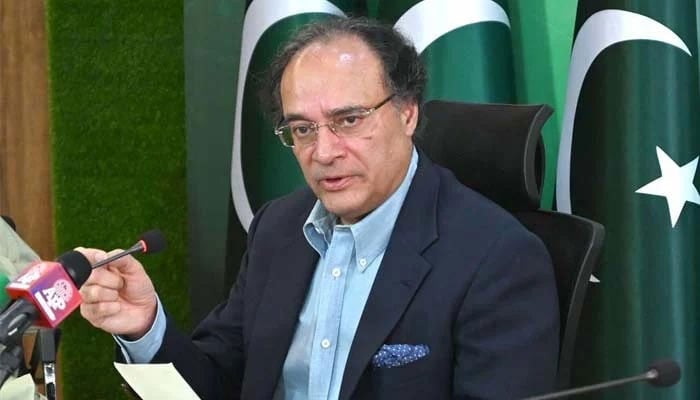
A powerful message last month from Finance Minister Muhammad Aurangzeb, promising to abstain from new foreign loans, marked a timely step towards resolving a key economic issue facing Pakistan.
In a country where successive governments have failed to avoid becoming more indebted, Finance Minister Aurangzeb’s remarks were significant enough to warrant a further debate on this subject. In brief, Pakistan’s salvation lies primarily in becoming self-reliant to the extent that its sovereignty is not periodically challenged by its lenders.
For long, successive governments at the federal and provincial levels in Pakistan have lived far beyond their means. Pakistan has a history of profligate official spending, which has badly damaged the country’s economic health. Meanwhile, the two vital sectors for reviving overall national economic growth – agriculture and industry – have long been neglected, causing a continuous downward slide of Pakistan’s overall well-being.
As Pakistan heads towards its annual budget due by the end of June, the country’s overall slowdown has cast a shadow over its future. In addition to a raft of existing challenges, the fallout from the US-Israeli war on Iran has hit a number of countries, including Pakistan, hard. Higher oil prices have widened international trade deficits for many oil importers, triggering difficult setbacks such as rising inflation, currency pressure and an economic slowdown. For Pakistan, conflict in the region has also forced it into an increasingly polarised region. Then there was the recent decision by the United Arab Emirates to withdraw $3.5 billion from Pakistan’s foreign reserves at short notice. For now, the UAE’s departure was immediately filled by Saudi Arabia, which deposited $3 billion to cover the gap.
While these tough economic realities have brought home the powerful reality of where Pakistan stands externally after the US-Israeli war on Iran, a host of internal pitfalls remain unresolved. It is within this framework that Finance Minister Muhammad Aurangzeb’s public remarks last month carried much food for thought.
It will be no surprise to long-term observers of Pakistan that the country has consistently lost ground over time due to its many policy failures. That Pakistan suffers from a chronic failure to force more of its influential citizens to pay their income tax dues has created a yawning gap at the centre of the country’s many weaknesses.
Even as Pakistan’s ruling class takes credit for expanding the tax net, the reality is that no more than 3.0 per cent of Pakistan’s population files income tax. Over time, a growing reliance on indirect taxes has hit consumers across the board, particularly the already poverty-stricken. Today, Pakistan has little hope of changing the destiny of a sizeable chunk of its population, or approximately 100 million people who live below the poverty line, amidst the ever-growing gap between the rich and the poor.
Pakistan’s future economic journey is set to remain meaningless unless the direction is radically changed through fundamental reforms in three key areas. First, the fallout from climate change has hit Pakistan very hard, prompting questions about the immediate impacts, followed by the medium- to long-term prospects. Across the agriculture sector, which is the key line of defence against climate change, there is an ongoing disaster that periodically unfolds. In a largely symbolic but telling occurrence last month, the government’s decision to delay the exports of Pakistan’s prized mangoes by a month was a much too obvious sign of the emerging future.
The decision was forced by rapidly changing weather patterns across the country, which have disrupted crop and fruit timelines nationwide. Other key crop-related areas continue to suffer, with unexpected consequences. The emergency is large enough to warrant focus at the highest level of the ruling structure, with required action to be taken as quickly as possible.
Second, Pakistan’s future economic policies must remain consistent in the medium to long term, free from divisions that run across the country’s politics. On this journey, it is vital to create, where necessary, new mechanisms to safeguard the economic direction, irrespective of political change at the centre or in the provinces.
Finally, Pakistan’s service delivery mechanisms have been severely weakened since the country embarked on a devolution plan in the early 2000s. Across the grassroots, at the country’s district level, local administrations have been severely weakened as their authority has been systematically stripped away. This needs to be reversed.
Finance Minister Aurangzeb’s remarks have outlined a key target for the future: reducing Pakistan’s indebtedness is essential to its survival.
The writer is an Islamabad-based journalist who writes on political and economic affairs. He can be reached at: [email protected]