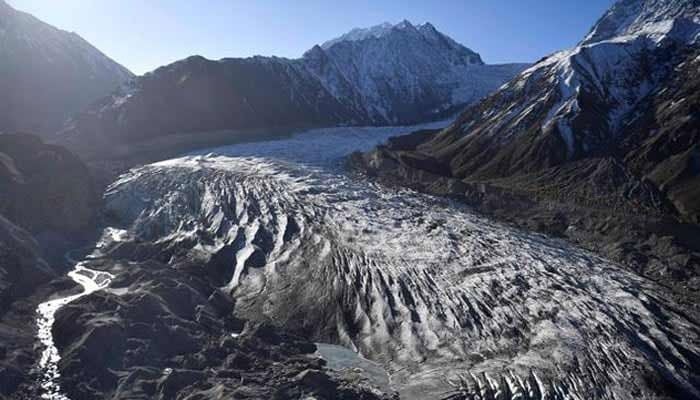
Amid growing concerns about Pakistan’s glacial governance, Prime Minister Shehbaz Sharif recently constituted a seven-member inquiry committee to investigate the GLOF-II project.
According to media reports, the committee will investigate the reasons for the failure of Early Warning systems (EWS) installed under the project. While announcing the inquiry, the PM rightly stresses that protecting citizens from climate risks is the state’s primary responsibility.
The concerns regarding the delays and ineffectiveness of our glacial governance are neither new nor rare. Last year, Senator Sherry Rehman described the progress as “glacial slow governance” and argued that “people are suffering because of procurement delays, administrative bottlenecks, and poor coordination ….and people of GB are paying the price of systematic failures”. Reportedly, ‘first responders’ have not been integrated into the early warning systems. To ensure transparency, accountability, and the inclusion of local voices, she also directed that public hearings be held.
International development agencies have also raised concerns about the slow pace of implementation of the glacial governance project. There was also a rise in public frustration; our social media timelines were inundated with posts criticising the project’s delays and ineffectiveness.
Pakistan is already discussing a similar adaptation initiative and it is critical to understand why a flagship climate adaptation project struggled to deliver sustainable outcomes.
We had the privilege to share the findings of our RASTA-funded research, ‘Evaluating the Effectiveness of Polycentric Climate Governance in Pakistan: A Case Study of GLOF-II’, with the committee constituted by the PM. It is interesting to note that much of the public debate has focused narrowly on the failure of Early Warning Systems. But the GLOF-II project was far more than a technological intervention. It was funded through international climate finance and aimed to protect vulnerable mountain communities from climate-induced disasters through early warning systems, community preparedness and climate-resilient infrastructure.
Most importantly, the project recognised that climate risks in glaciated regions are part of a broader polycrisis involving environmental, social, economic and governance vulnerabilities. In theory, GLOF-II adopted a polycentric governance approach involving multiple institutions across different levels of government. On paper, it reflected a whole-of-society approach. In practice, however, coordination remained weak and fragmented.
Our findings show that delays and operationalisation of funds were a persistent problem. Administrative disputes over accounts and fund transfers delayed the implementation from the outset. In glaciated regions, where harsh weather limits construction and field activities to a short window between March and October, even minor delays can derail an entire project cycle.
Short, unpredictable tenures, a recurring weakness in Pakistan’s governance, inevitably affect the quality of our climate governance architecture. It exacerbates the problems of governance. During the project’s first two years, seven project directors were replaced. Frequent leadership changes disrupt continuity, weaken institutional memory and blur accountability.
For this project, these concerns weren’t unknown. The project’s midterm evaluation reportedly described progress as ‘unsatisfactory’ and even suggested terminating the project if collaboration, communication and trust deficits could not be resolved. The evaluation also warned that many end-of-the-project targets were unlikely to be achieved.
While the issue of technical inefficiency is important, the more critical issue is the absence of meaningful community-centred governance that enables participation, accountability and local ownership. The Sendai Framework for Disaster Risk Reduction emphasises people-centred disaster risk reduction and the integration of indigenous knowledge to save lives. Last, in Roshan-Talidas, a shepherd alerted the community to evacuate before disaster struck, saving 300 livesin the absence of anearly warning system.
It is evident that Pakistan’s climate adaptation governance often overemphasises physical infrastructure and technological installations while undermining the importance of socio-political legitimacy, trust and local ownership. Currently, various governmental and non-governmental entities are installing physical early warning systems in our glaciated region. In an ecologically fragile mountain region, there is a dire need for serious reflection on the growing clutter. These systems themselves have ecological and maintenance costs.
Our glacial governance is currently marked by paradoxical successes where outputs are delivered, but the sustainability of outcomes remains questionable. Our research reveals that official narratives celebrating the project’s effectiveness were frequently contested by intended beneficiaries. Community-based disaster risk reduction centres and safe evacuation zones, for example, may become unused if communities are excluded from decision-making. Similarly, a livelihoods training programme without sustained support can produce ‘competencies without agency’.
Climate adaptation cannot succeed through tokenistic participation. Communities must be involved in risk framing, hazard mapping, project design, implementation and evaluation. Such participation ensures interventions that reflect local socio-ecological realities, terrain-specific constraints and seasonal variation, and reduces the risk of maladaptation.
Pakistan must move towards institutionalising community-led adaptive governance through formalised participatory structures led by accountable local governments. Regular communication with communities regarding project progress, delays and milestones can help rebuild trust and strengthen local ownership. Equally important is institutional reform.
Climate governance responsibilities remain fragmented across NDMA, PDMAs, DDMAs, EPAs, the Pakistan Meteorological Department and other agencies, often with overlapping mandates and unclear accountability. District Disaster Management Authorities, which serve as first responders, remain under-resourced and weak in many areas.
Pakistan’s climate governance crisis is primarily a transparency crisis. Data related to climate projects, implementation progress, budgets and evaluations often remain inaccessible to researchers, communities and even local stakeholders. Without institutionalised transparency and public access to information, adaptive governance becomes impossible.
We cannot stress enough that any future adaptation initiatives must therefore improve technical planning and context-sensitive design by using updated glacial lake data and scientific hazard assessments while integrating local expertise and community participation from the outset. Cost-capping approaches designed in distant offices must also be reconsidered for hard-to-reach mountainous regions where implementation realities differ drastically.
Lastly, the political sensitivities surrounding donor-funded climate projects often discourage open discussions about failures and limitations. But climate governance cannot improve without honest reflection. If Pakistan truly wants to prepare for an era of accelerating climate risks, it must move beyond symbolic adaptation and confront the governance failures/challanges that continue to turn climate vulnerability into climate catastrophe.
Maleeha Sattar teaches at Information Technology University, Lahore. Neelum Nigar is the director of the Institute of Strategic Studies, Islamabad.