Urdu literature would have remained stuck in the quagmire of conservatism and orthodoxy had the Progressive Writers’ Movement (Taraqqi Pasand Tahreek) not ushered in a new style of literature that dealt with the lives and problems of the common folk.
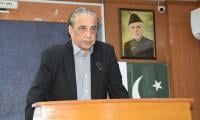
This was stated in a voice message of historian Dr Mubarak Ali that was played on Saturday at a conference commemorating 90 years since the foundation of the Progressive Writers’ Movement.
The conference was held at the Zaki Hasan Auditorium of Sohail University.
In his message, Dr Ali said the classic literature of Urdu was only meant for pleasure of the elite class, and did not produce any social consciousness. However, the progressive literature challenged the tenets of classic literature and connected literature with people.
He lamented the eventual decline of the movement in Pakistan after Partition and called for revitalising the movement. He warned that if the movement continued to remain in its current weakened state, our society would die due to entanglement with orthodox ideas and regressive attitude.
Sindhi writer and political activist Sohail Sangi spoke on the changes brought about by the Progressive Writers’ Movement on society.
He said the movement benefitted all the languages of Pakistan as it helped channel the imagination, ideas and emotions of the indigenous population of the land into their literature.
Prof Shahid Kamal said that in the early decades of the 20th century, Prem Chand and Iqbal were the two writers who reflected changing realities of the time in their literature.
Criticising the use of metaphors of Ashiana for home, Bijli for problems and likewise, he said such metaphors reflected fear of the writers of that era who were hesitant to call their home and resorted to use metaphors like Ashiana.
He said the progressive writers communicated directly what they believed and felt, and practically took part in societal evolution. He specifically mentioned Makhdoom Mohyeddin and his Telangana movement for the rights of farmers and abolition of feudal system.
Dr Ambreen Haseeb Amber talked about literary criticism in Urdu produced by the Progressive Writers’ Movement.
She said literary works preceded literary criticism but this was opposite in the case of the Progressive Writers’ Movement as it was a critical essay by Dr Akhtar Hussain Raipuri that paved the way for the movement as he had discussed in the piece what kind of literature was the need of the hour.
She said Indian critic Sharib Rudaulvi had remarked that the greatest achievement of the Progressive Writers’ Movement was literary criticism that enhanced public intellect and imparted awareness in society.
She also discussed the opponents of the movement, especially in Pakistan, who came up with the idea of Islamic literature and Pakistani literature to counter progressive writers. She named Muhammad Hasan Askari, Mumtaz Shirin, Muhammad Ahsan Faruqi and Jamil Jalibi among those who challenged the progressive writers’ philosophy.
She said that when some extreme ideas started to pour in from progressive circles, it was other progressives who often countered them. For example, she said when progressive writers like Dr Raipuri and Manjun Gorakhpuri charged Iqbal’s writings with fascism, other progressive writers came to Iqbal’s defence. Similarly Sajjad Zaheer had to write a book in defence of Hafez when some progressive elements targeted Hafez’s poetry.
Urdu in Sindh
An interesting speech at the conference was made by scholar Jami Chandio who discussed the history of Urdu poetry in Sindh.
The association of Sindh with Urdu did not start, as some quarters claimed, with the Partition in 1947 as poets living in Sindh had been writing verses in Urdu since the 17th century, he asserted.
He said that although Sachal Sarmast enjoys reputation for being a poet of Urdu language, he was not the first Sindhi poet to write in Urdu. He, however, explained that in the 17th Century, Urdu was not a developed language, due to which some argued that it was Hindi, not Urdu, in which some poets from Sindh had composed verses.
Chandio said foundations of Urdu poetry in Sindh were laid in the era that was the worst era of Sindh’s history — 16th and 17th centuries — when the Arghuns and Tarkhans ruled Sindh. He said the Arghuns and Tarkhans were descendants of Tatars, and like their forefathers, they were pillagers.
At that time, Thatta and Shikarpur were the two most important cities of Sindh and many poets living in Thatta began to try writing Urdu poetry. He said the first Urdu poet from Sindh is Mulla Hakeem Thattavi.
He named Mir Sadruddin Abu Turab Kamil as another Urdu poet from Sindh who came after Mulla Hakeem. Kamil was born in the same year Shah Latif was born, the scholar said. He then mentioned Mir Mehboob Sabir who was inspired by Wali Deccani and was a contemporary of Mir Taqi Mir.
Later, Chandio spoke on Sachal Sarmast’s Urdu poetry. One of the Urdu couplets by Sachal he recited was:
“Karun Main Kis Ko Bhala Apne Haal Se Aagah/ Tire Hi Dard Se Qissa Mera Tamam Hua”
About Mirza Qaleech Baig, who is considered the father of modern Sindhi literature, Chandio said Baig’s father and maternal grandfather both came to Sindh from Iran and so he was not a native. Even Baig’s first languages were Persian and Turkish, the speaker added.
He ended the speech on Sheikh Ayaz who is widely believed to be the greatest Sindhi poet after the creation of Pakistan.
Chandio said Ayaz initially wrote more in Urdu and less in Sindh. He said there were two collections of Urdu poetry by Ayaz titled ‘Neel Kanth Aur Neem Ke Patte’ and ‘Boo-e-Gul Nala-e-Dil’.