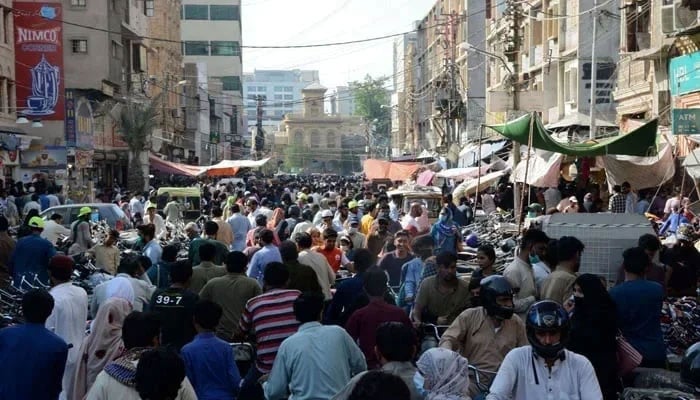
A country whose population is expected to double in 25 years needs its economy to double in 25 years also if its people are to maintain their standard of living. The emphasis here is on the word ‘maintain’. Actually improving things for the people, which Pakistan really needs to do, would require more than doubling the economy. Earlier this week, health experts and policymakers warned that Pakistan’s population could double from 250 million to 500 million within the next 25 years if rapid population growth was not effectively controlled. Meanwhile, Pakistan has achieved a GDP growth rate of 3.7 per cent, against an envisaged target of 4.2 per cent, for the current fiscal year, as per the latest government calculations. Assuming this rate holds constant, it would take a little more than 19 years for the economy to double in size. As such, the current economic growth rate is only slightly faster than the population growth rate. Unless the former accelerates or the latter significantly slows, Pakistanis can only expect a modest rise in living standards and prosperity over the next two decades or so. Given that almost half of the population lives below the global poverty line, this is unacceptable.
Even more alarmingly, it is, at least right now, hard to envision population growth slowing or economic growth accelerating significantly. For years, experts and policymakers have stressed the importance of family planning, not just for population concerns but also for its positive effects on maternal and child health. And while Pakistan’s fertility rate has declined significantly in the past three decades or so, things are clearly not moving in the right direction fast enough. As concerns the growth rate, it is hard to see how an economy in which every price signal tells the average consumer to spend less can grow more rapidly. The one thing that could turn the tide is investment, particularly FDI, but FDI has actually declined by 27 per cent over the first nine months of the current fiscal. Under such circumstances, it almost seems impressive that economic growth is somehow still faster than population growth.
When talking about population growth in the context of the economy, it is all too easy to slip into the trap of blaming ‘all those poor people for having all those kids’ as the main problem. This is certainly not the case. A lot can be done to improve the economy and the lives of all people with the current high population growth rate and it should not obscure the shortcomings of economic policy. What social support system do lower-income or even middle-class Pakistanis have to fall back on in their old age, other than a large family? In this sense, the unsustainable population growth rate is itself a sign of inadequate economic policy. If things do not change going forward, then most Pakistanis will be locked into a life of either poverty or something very close to it. And this is simply not sustainable.