Islamabad:British historian Victoria Schofield, who authored “Fragrance of tears” on BB Shaheed, has observed that the revocation of Jammu and Kashmir’s special status, combined with heavy militarisation and communication restrictions, intensified alienation in the Kashmir Valley and reinforced demands for self-determination.
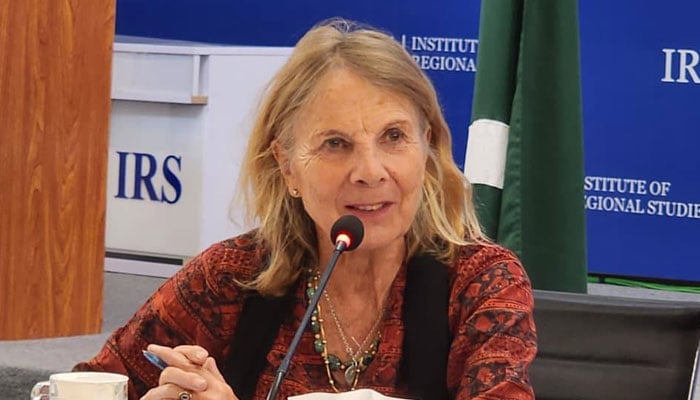
Ms Schofield was speaking at a policy discussion on “Jammu and Kashmir dispute: navigating pathways to peace” organiesd here by Institute of Regional Studies in collaboration with Youth Forum for Kashmir.
Ms Schofield stressed for an inclusive political process involving the genuine representation of the people of Jammu and Kashmir. She remarked that “the future is not in the rigidity of nation states but in the fluidity of cross-cultural and regional communication. To achieve peace in Jammu and Kashmir, dialogue must replace hostility.” She stressed that any durable resolution of the dispute must be grounded in on-ground realities rather than rigid cartographic claims.
She highlighted the strategic implications of the China dimension, particularly regarding Aksai Chin and the legacy of the 1962 Sino-Indian conflict emphasising that excluding China from analytical and diplomatic considerations would weaken any meaningful settlement framework.
Tracing the historical evolution of the dispute from the 1948–49 war to the post-Simla Agreement Line of Control, Ms Schofield noted that while territorial realities remained largely static, the strategic environment transformed significantly due to nuclearisation, technological developments and geopolitical competition. She warned that rapid military mobilisation, misinformation and escalatory rhetoric in a nuclearised environment increase the risk of miscalculation and wider regional confrontation.