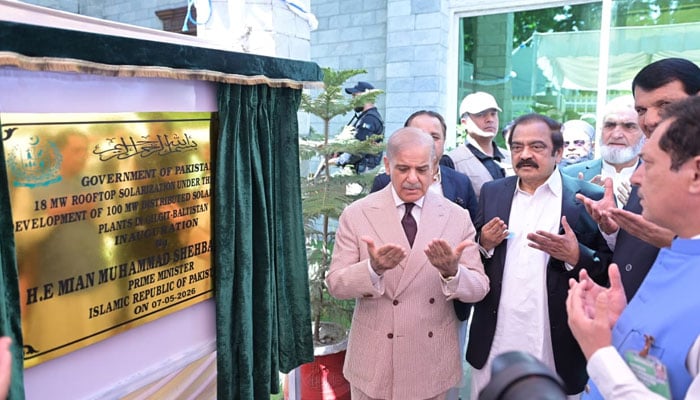
When Prime Minister Shehbaz Sharif stood in Gilgit on 7 May 2026 and pinned a firm completion date of mid 2027 on the 100 megawatt solar scheme for Gilgit-Baltistan, it was easy to dismiss the moment as another ribbon cutting in a long calendar of them. Pakistan does not lack for inaugurations. What it lacks is delivery. So the meaningful question is not whether the Prime Minister visited GB. It is whether the project he just put his name to can be finished on time, on budget and on terms that actually change how families in Hunza, Skardu, Ghizer and Diamer keep the lights on.
The arithmetic of the 100 MW scheme is more consequential than the megawatts suggest. GB sits at the end of a long and fragile transmission line. Winter brings load shedding that can stretch for sixteen to twenty hours a day in remote valleys, even when generation upstream is unconstrained. Diesel imports fill the gap at painful cost, and the region’s mini hydel network freezes precisely when demand peaks. A distributed, panel based solution that pushes power closer to the point of consumption is not an indulgence. It is the only realistic answer for terrain where copper wire is expensive and uptime is short.
There is also the question of fairness. Pakistan’s net metering policy has handed an outsized benefit to households in Lahore, Karachi and Islamabad who could front the capital cost of rooftop systems. GB residents, with lower incomes and far higher exposure to outages, have largely been spectators in the energy transition. A publicly financed 100 MW programme with free or near free panels, if it actually reaches the bottom two income quintiles, would be one of the most progressive energy interventions the federal government has launched in a decade.
But the file is full of warnings. The digital lottery for the free solar scheme launched in March 2026 has so far reached a fraction of approved applicants. Procurement disputes over panel origin, balance of system components and inverter standards have slowed similar schemes elsewhere. The 2024 Punjab solar tender was bogged down for months by litigation. If the Prime Minister wants his mid 2027 deadline to hold, the cabinet division and the Alternative Energy Development Board will need to clear procurement bottlenecks in weeks, not quarters.
Three operational disciplines will decide whether this scheme is remembered as transformative or as a footnote. First, transparent beneficiary selection. The lottery results must be published valley by valley, with audit access for civil society. Second, local installation capacity. Importing crews from Punjab to bolt panels in Astore is wasteful and patronising. The Karakoram International University and GB’s polytechnic institutes can train thousands of certified installers within a year if funding is released now. Third, after sales service. A panel without a working inverter is a roof ornament. The contract structure must bind suppliers to five-year maintenance with locally stationed technicians.
There is a wider point. GB is Pakistan’s water tower and its climate fault line. Glacier retreat is accelerating, and the run of river hydel projects that anchored the regional grid are losing reliable seasonal flow. Diversifying into solar is not a luxury. It is climate adaptation by another name.
The Prime Minister has set a public clock ticking. If by July 2027 the panels are humming in Khaplu and Chilas, he will deserve the credit. If they are not, the deadline will be quoted back at him by every opposition politician between here and the next general election. That is a useful pressure to keep on the file.
The writer is an energy economist in Berlin.