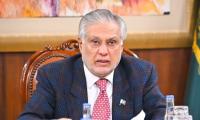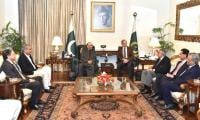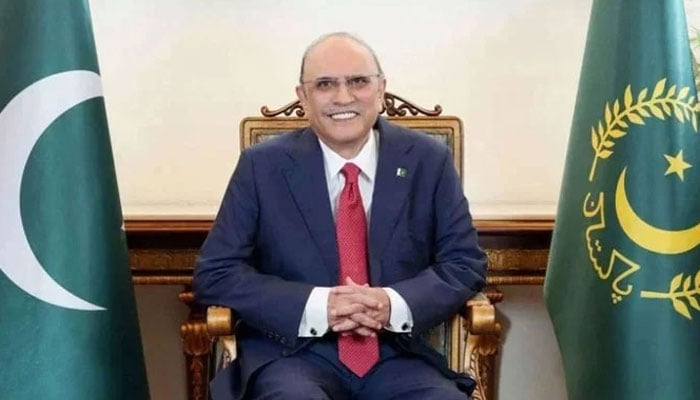
ISLAMABAD: President Asif Ali Zardari and Prime Minister Shehbaz Sharif held meeting on Monday at the Aiwan-e-Sadr and discuss the country’s overall situation, matters related to Afghanistan and the evolving regional situation.
Deputy Prime Minister and Foreign Minister Ishaq Dar, National Assembly Speaker Sardar Ayaz Sadiq, Interior Minister Mohsin Naqvi, Law Minister Azam Nazeer Tarar, Senator Saleem Mandviwalla and Dr Asim Hussain were also present.
The meeting paid tribute to the martyrs of ‘Marka-e-Haq’ and lauded the professional capabilities of Pakistan Armed Forces, reaffirming their unwavering commitment to national defence. President Zardari said maximum possible relief should be provided to the public despite difficult geographical and regional circumstances, tensions in the Middle East, and disruptions in global supply chains.
He also directed to take possible measures to reduce inflationary pressure, ensure the availability of essential commodities and provide relief to the common man.
Meanwhile, chairing a high-level meeting to review strategies aimed at increasing Pakistan’s exports, the prime minister stressed that export-led industrial growth was essential for achieving the country’s economic development targets and reiterated that the government was fully focused on enhancing exports and providing facilities and support to industries.
He directed the relevant authorities to formulate a comprehensive plan to facilitate small and medium-sized enterprises (SMEs), which played a crucial role in boosting exports. He also asked to develop strategies for promoting new businesses and industries that could contribute to swelling country’s export volume, PM Office Media Wing said in a press release.
The meeting was attended by Deputy Prime Minister and Foreign Minister Ishaq Dar, Minister for Economic Affairs Ahad Khan Cheema, Minister for Commerce Jam Kamal Khan, Minister for National Food Security and Research Rana Tanveer Hussain, Minister for Climate Change Dr Musadik Malik, Minister for Finance and Revenue Muhammad Aurangzeb, Minister for Information Technology and Telecommunication Shaza Fatima Khawaja, Minister of State for Finance and Railways Bilal Azhar Kayani, SAPM on Industries and Production Haroon Akhtar Khan and other senior government officials.
Highlighting the importance of innovation, the prime minister observed that research and development and innovations in industry and trade would help Pakistani products become more competitive in international markets.
He further directed that tax refunds for exporters should be released in a timely manner. During the meeting, participants were briefed on the government’s proposed export enhancement strategy. The draft policy was discussed in detail, and participants shared their recommendations and suggestions.
Meanwhile, the federal government on Monday extended its austerity drive and fuel conservation measures until June 13 amid uncertainty over the Middle East conflict, as diplomatic talks between the United States and Iran remain deadlocked.
The Cabinet Division issued a formal notification after Prime Minister Shehbaz Sharif approved the extension on the recommendations of the implementation committee.According to the notification, a 50% reduction in fuel supply for official vehicles will remain in place during the extended period.
The government has also decided to keep 60% of official vehicles off the roads as part of the ongoing austerity measures.PM Shehbaz first introduced the austerity plan on March 9 in a televised address, days after the government hiked the prices of petrol and diesel by 20%.
Fuel prices recorded a sharp increase in the country following oil supply disruption from the closing of the Strait of Hormuz, a key route for oil and gas shipping.Iran closed the strait in response to joint attacks by the US and Israel, which began on February 28 and ended on April 8 following a Pakistan-mediated ceasefire.
Despite the extension in the ceasefire, the two sides remain at odds over proposals for a permanent end to the war, particularly over their respective blockades of Hormuz.In the March 9 televised address, PM Shehbaz said that the entire region was gripped by Middle East conflict and stressed that Pakistan was pursuing diplomatic efforts to help defuse the crisis.
He then announced the austerity plan applicable across federal government institutions, including ministries, departments, autonomous bodies, state-owned enterprises, the legislature, defence organisations and the judiciary.
Apart from the fuel cut, the plan reduced government offices’ operations to a four-day workweek, though the banking sector and essential services were exempt.Federal and provincial government departments were required to reduce non-essential expenditure by 20% during the final quarter of the current fiscal year.
The plan imposed a ban on official foreign visits by ministers, parliamentarians, and government officials, except for obligatory trips.Up to 50% of government employees were to work from home on alternate days, except those in essential services.The measures also included mandatory economy-class travel for officials, and a shift from physical to virtual meetings to cut costs, among others.