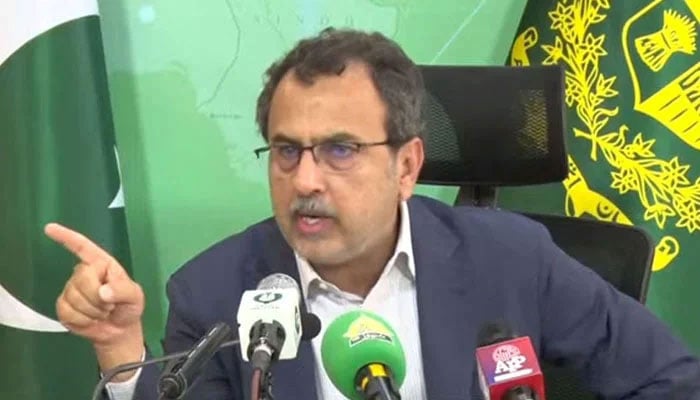
LAHORE: The power battery storage revolution has begun in the county and it will benefit both the consumers and the national grid, Federal Minister for Energy (Power Division) Awais Leghari said Monday.
In a major policy statement, Energy Minister said cheaper daytime power is going to drive battery adoption nationwide and this phenomena of electricity storage rollout tends to ease grid, cuts bills for all. The energy shift to utility, industrial and household scale batteries set to power night load, Leghari made the remarks via video link while addressing to media persons at a training workshop organised by the LUMS Energy Institute with Power Division.
The government plans to reduce daytime electricity tariffs to around Rs6–7 per unit in the near future. At that rate, even solar users may prefer to connect to the national grid and use solar power to charge batteries for use at night, he explained.
Investing in battery storage at utility, industrial, or household scale is a strong opportunity right now. “I encourage investors to take advantage of it,” Leghari said. The minister welcomed the use of batteries for electricity storage, saying it will help both consumers and the grid. Solar net metering combined with batteries for night use will lower the average cost per unit for consumers, because it reduces demand during peak evening hours. This allows the grid to rely less on expensive thermal power plants.
In addition, the national grid will need less generation in the evening, since batteries will prevent solar producers from feeding excess power into Discos’ networks at night. Rejecting claims that solar reforms are designed to benefit IPPs, Leghari said the IPP model has been buried for good and no new private power producers will be added. The government has also stopped participating in power purchase agreements. Solar producers have no link with IPPs, and government policy does not favour thermal power plants, he added.
To a question, he said that efforts are being made to overcome the twin monster of overbilling and power theft. Plans are afoot to convert at least 10 million single phase electric meters into smart ones, he said. He said that the replacement would also help check the charging of the detection bills by the discos on the pretext of anti-power theft measures.
He said out of the total 22,000 megawatt solar energy capacity in Pakistan, only 8,000 megawatt was on net metering while rest of 14,000 megawatts are off grid generation.
Awais Leghari said that the losses of the Discos were coming down due to government efforts like change in the board of directors. “The losses of Lesco alone have come down from Rs87 billion to just Rs22 billion in just a period of three years,” he claimed. He said that various Discos are being privatised soon.
Dr Fiaz Ahmad Chaudhry, Director, NGC and ISMO gave presentation on understanding generation capacity additions and power dispatch while Mahfooz Bhatti, Additional Secretary Energy Ministry, Zafaryab Khan, Syed Faizan Ali, Naveed Qaiser, Umer Farooq and Omer Haroon Malik also spoke on the occasion.