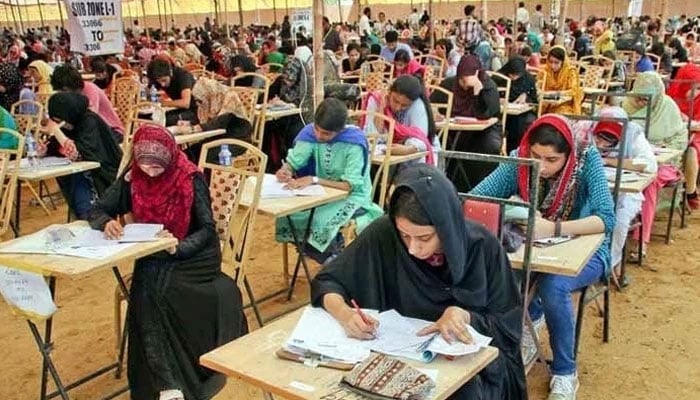
PESHAWAR: The Khyber Pakhtunkhwa government’s reported move to hand back the Medical and Dental College Admission Test (MDCAT) to the Educational Testing and Evaluation Agency (ETEA) has triggered renewed concerns among students, parents and academic circles, with critics warning that the province risks undoing reforms introduced after the controversial 2023 examination scandal.
The debate has resurfaced after official working papers showed the government was considering restoring ETEA’s authority to conduct MDCAT for future admission cycles despite the fact that the examinations held in 2024 and 2025 under Khyber Medical University (KMU) passed without major controversy.
Sources told The News that certain individuals, including government officials, political figures, owners of costly private educational institutions, and mafias used make millions of rupees every year during MDCAT, were trying to misguide the chief minister about shifting the responsibility of conducting the medical entrance test from KMU to ETEA.
“KMU has all the resources and technical expertise to conduct such important examinations. And then nobody can force or influence their process of conducting testing procedure and announcing results,” an official of the health department said.
The proposed shift comes nearly three years after one of the province’s biggest admission controversies exposed organized cheating networks, the use of sophisticated electronic devices inside examination halls and alleged attempts by influential quarters to secure admissions for candidates through illegal means.
Official figures from the 2023 MDCAT showed that 219 candidates were caught using unfair means through various methods, including Bluetooth-enabled electronic devices. Intelligence agencies had also alerted authorities before the examination that organized groups were allegedly facilitating cheating through concealed communication gadgets and micro earpieces in exchange for large sums of money.
According to an intelligence report submitted to the authorities at the time, “Bluetooth-enabled pocket-held devices connected to micro earpieces” were expected to be used during the examination, while handlers were reportedly charging up to Rs1.5 million per candidate for assistance in solving the paper.
The scandal intensified after allegations emerged that some influential individuals attempted to use their connections to secure medical seats for their children. Sources familiar with the developments said that after several candidates were caught, efforts were allegedly made in certain quarters to shift public focus towards claims of a paper leak instead of the organized cheating networks uncovered during the investigation.
The controversy ultimately led to intervention by the Peshawar High Court, the Pakistan Medical and Dental Council and the provincial government, following which KMU was tasked with reconducting the MDCAT in 2023.
Subsequently, the Health Department issued a notification on July 22, 2024, formally declaring KMU as the admitting university for conducting a “transparent and centralized” MDCAT for admissions to all public and private medical and dental colleges in the province for the 2024-25 academic session onward.
The notification stated that the decision had been approved by the provincial cabinet in its meeting held on June 27, 2024.Under the arrangement, KMU was also authorized to oversee admissions and regulate private medical and dental colleges in accordance with PMDC regulations.
The MDCAT examinations conducted by KMU in 2024 and 2025 were largely viewed by students and parents as transparent, with no allegations of organised cheating, paper leaks or administrative irregularities surfacing during the process.
Academic observers noted that KMU introduced stricter monitoring mechanisms and digital merit display systems under which merit positions and admission details were displayed publicly in the presence of students and their parents.
Irrespective of their status, parents and their children were sitting in front of large screens displayed by KMU to see results.However, the issue has once again come under discussion after official documents proposed restoring MDCAT authority to ETEA for future admission cycles.
The documents state that ETEA was originally established to conduct standardized entrance examinations, including MDCAT and ECAT, and had performed the responsibility for nearly 23 years.
It further states that Sub-Section (2) of Section (1) of the Educational Testing and Evaluation Agency Ordinance 2001 and the proposed ETEA Bill 2026 authorize the agency to conduct such examinations.
Officials supporting the proposal have argued that although KMU conducted MDCAT in 2024 and 2025, the arrangement was based on executive authorization rather than permanent legislative backing.
According to the official position, ETEA has now strengthened its institutional capacity through the introduction of a modern Computer-Based Testing (CBT) system, which authorities believe can ensure a more secure, efficient and transparent examination process.
Despite these assurances, concerns persist within academic and student circles over whether adequate safeguards have been put in place to prevent a repeat of the controversies that surfaced during the 2023 examination.
Questions are being raised about the future of the infrastructure and monitoring systems developed by KMU for MDCAT during the last two years.
Officials familiar with the process said the university had invested substantial resources in examination management systems, monitoring arrangements and administrative mechanisms specifically designed for conducting centralized medical admission tests.
Education stakeholders argued that any decision about the future conduct of MDCAT should prioritize institutional credibility and public confidence, particularly in a province where competition for medical seats remains among the most intense in the country.
When contacted, Adil Safi, Executive Director ETEA, told The News, “This is to be decided by the cabinet, but no decision has been made or process initiated so far.”
He added that following the promulgation of the ETEA Act 2026 on May 4, 2026, it would not be legally permissible for any other organisation to conduct the examination.
The proposed policy shift is expected to trigger a debate within government, academic and legal circles before a final decision was taken about the future framework for MDCAT in Khyber Pakhtunkhwa.