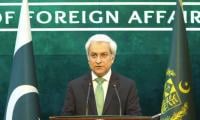
This article is adapted from my speech delivered at a seminar hosted by the External Publicity Wing in Islamabad last week, where I spoke on the theme of ‘Building Walls of Truth’ and the broader question of international cooperation mechanisms for information integrity.
There was a time, not too distant in memory, when truth was presumed to be self-evident. It did not require elaborate defence mechanisms, nor did it demand institutional scaffolding or international coordination. Facts were expected to stand on their own merit, and reality was largely shaped by shared understanding. That era, however, has quietly receded. Today, truth no longer simply exists; it competes.
We now inhabit a world where information is abundant but certainty is scarce. Facts do not merely inform public discourse; they contend with narratives designed to reinterpret, distort or even replace them. Conflict, once defined by territorial disputes and military engagements, has evolved into something far more subtle yet pervasive, a contest over perception. The battlefield extends into the minds of individuals and the collective consciousness of societies.
Recent regional and global developments illustrate this transformation. Events are no longer experienced uniformly; they are mediated, reframed and amplified through competing narratives. What emerges is not a singular version of reality but multiple, often conflicting interpretations. This fragmentation reveals a deeper vulnerability: the fragility of truth itself in an era of coordinated information flows.
The central challenge, therefore, is not merely the proliferation of misinformation or so-called ‘fake news’. It is something more fundamental. What happens to a society when truth becomes negotiable? The implications are profound. When truth is questioned, trust begins to erode. When trust diminishes, institutions weaken. And when institutions lose credibility, even the foundations of peace and stability become uncertain.
This is why information integrity must be understood not as a narrow media concern but as a core governance issue. It intersects with diplomacy, national security, and the very architecture of modern civilisation. At its heart lies the emergence of a new form of influence, one that transcends traditional categories of power. This new force can be described as narrative power. Unlike hard power, which relies on military or economic strength, or soft power, which draws on culture and values, narrative power shapes perception. In many ways, it is the most pervasive and least regulated form of power in the contemporary world.
Yet, within this transformation lies a striking paradox. While disinformation has become highly coordinated, adaptive and global in scope, efforts to uphold truth remain fragmented. Falsehood collaborates; truth competes. Governments operate within national boundaries, media organisations respond to market incentives and digital platforms function within commercial models. Disinformation, however, moves seamlessly across all these domains, exploiting gaps and inconsistencies.
This asymmetry creates a structural imbalance. A globalised challenge is being met with localised responses. The result is predictable: fragmented defences against a unified threat. It is precisely this imbalance that underscores the urgency of international cooperation. Defending truth in isolation is no longer viable because truth itself no longer exists in isolation.
To address this challenge, a shift in thinking is required, one that moves beyond reactive measures toward a more systemic and philosophical approach. At the core of this shift is the need to develop shared epistemic frameworks. Simply put, nations and institutions must begin to align on how knowledge is validated, verified, and trusted.
This alignment requires three fundamental transitions. First, there must be a shift from reaction to anticipation. In the digital age, the initial framing of an event often becomes its enduring narrative. By the time corrections emerge, the damage to perception is already done. Systems must therefore be designed to detect and address distortions at their inception, rather than after they have taken root.
Second, verification must evolve from a discrete act into a comprehensive ecosystem. Fact-checking, while essential, is no longer sufficient as an isolated function. It must become part of a broader, interconnected network that operates in real time across borders, languages and platforms. In a fast-moving information environment, delayed truth is effectively diminished truth.
Third, there must be a transition from regulation to norms. While regulatory frameworks are important, they are inherently constrained by jurisdictional boundaries and enforcement capacity. Norms, by contrast, shape behaviour at a deeper level. The international community has developed norms for warfare, trade and diplomacy. Yet in the realm of information, where the consequences are equally significant, such norms remain underdeveloped. This raises a set of complex but necessary questions. What constitutes responsible state behaviour in the information domain? Where should the line be drawn between free expression and strategic manipulation? How can accountability be ensured without compromising openness?
Within this broader context, countries that engage proactively in these discussions position themselves not merely as participants but as contributors to the evolving architecture of information integrity. Engagement signals a willingness to move beyond defensive postures toward constructive dialogue. It reflects an understanding that credibility is not asserted but earned through consistency, transparency and responsibility.
The media’s role in this landscape is equally critical. Journalists today operate at the intersection of speed and accuracy, where the pressure to be first often competes with the responsibility to be correct. This tension is not new, but it has been amplified by the velocity of digital communication. The future of journalism, however, will not be determined by how quickly information is disseminated, but by how reliably it is verified.
Trust, once lost, is difficult to rebuild. It depends not only on editorial judgment but also on the broader ecosystems that support responsible reporting. Collaboration among media organisations, fact-checking bodies, and digital platforms is essential to reinforce credibility in an increasingly complex information environment.
Technology, too, plays a decisive role in shaping this landscape. It is neither inherently beneficial nor inherently harmful; it reflects the intentions of those who design and deploy it. Artificial intelligence, for instance, can both generate sophisticated misinformation and enhance the detection of falsehoods. Algorithms can amplify distortions, but they can also be calibrated to prioritise accuracy and reliability.
The critical question, therefore, is not whether technology will influence the information ecosystem; it already does. The question is whether societies and institutions can guide its evolution in a direction that supports truth rather than undermines it. This requires a deliberate alignment of technological innovation with ethical considerations and public interest.
Ultimately, the preservation of truth in the modern world is no longer automatic. It is system-dependent. It relies on institutions that uphold it, media that respect it, platforms that prioritise it and nations that collaborate to protect it. In the absence of a shared commitment to truth, the possibility of a shared reality diminishes. And without a shared reality, the prospects for sustainable peace become increasingly uncertain.
If misinformation creates invisible barriers between societies, the task ahead is not merely to dismantle them but to build something more enduring. What is needed are not walls of division, but walls of truth, structures built on credibility, cooperation and collective responsibility.
Such walls are foundations of trust. In an era defined by complexity and contestation, they serve as a reminder that despite differences in perspective, truth must remain a common ground. Because without that common ground, dialogue falters, institutions weaken and the very fabric of society begins to fray. The challenge, therefore, is not simply to defend truth, but to sustain it, together.
The writer is a public policy expert and leads the Country Partner Institute of the World Economic Forum in Pakistan. He tweets/posts @amirjahangir and can be reached at: [email protected]