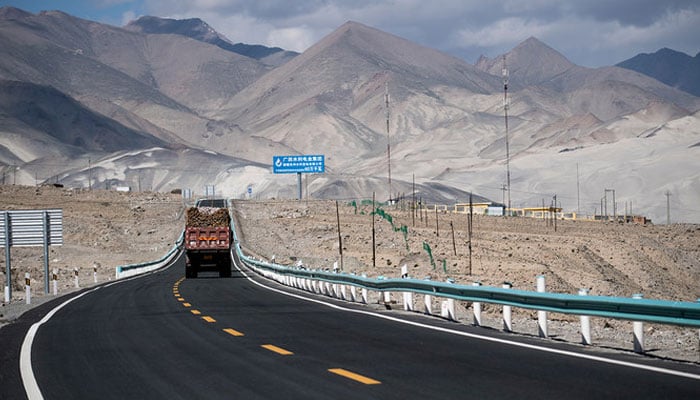
We have witnessed massive infrastructure development in Pakistan over the last two decades, infrastructure driven by national development programmes and connectivity initiatives under CPEC. Everyone in Pakistan is now familiar with motorways, signal-free corridors, ring roads, flyovers, underpasses and interchanges stretching across major cities.
But there has been another aspect. Civilised behaviour has been taken hostage by the sound of horns in congested traffic, where lane discipline is constantly violated, protocols and VIP vehicles, road rage and no passage for pedestrians and cyclists, waiting for a gap that never feels secure enough to take. During monsoon rains, the entire Karachi gridlocks because there has been a lack of master planning.
Our mobility crisis is not about infrastructure scarcity but another structural failure and absence of an integrated road transportation authority (RTA). The system cannot be built by widening and speeding roads, but by governance, enforcement, institutional coordination and civic discipline. Our roads can be made safer when rules are predictable, institutions are strong and people believe the system applies equally to everyone.
Road safety cannot be achieved solely through enforcement; it requires a system design. Globally, around 1.2 million people die in road accidents, with tens of millions injured annually. In developing countries, traffic-related losses account for 3-5 per cent of GDP through healthcare costs, lost productivity, fuel inefficiency and congestion. Pakistan also suffers from thousands of deaths each year, and many incidents are never reported formally.
We still interpret our transport predominantly as a construction challenge. Political attention tends to focus on flyovers, underpasses and ribbon-cutting ceremonies for infrastructure. We are confused that concrete is the language of progress, but we must realise that physical expansion of road networks without institutional reform produces movement without order.
Political economy is the main reason, as it rewards visibility over functionality, making our leaders more concerned with popularity and construction than with competence and governance. A flyover can be inaugurated, televised and politically branded while Institutional reform cannot. A comparative analysis shows that no major city has solved congestion through road expansion alone; therefore, it can only be addressed through modern public transport systems. Otherwise, expansion will only delay systemic failure.
This contradiction is visible across Pakistan’s major cities. In Lahore, we are continuously expanding arterial roads, but peak-hour congestion remains a problem that needs to be addressed. In Karachi, rainfall exposes the breakdown in coordination among drainage, land-use and transport systems. In Islamabad, mobility is often rationalised around protocol routes for government officials, with civilian movement suffering to accommodate administrative convenience. Our system and infrastructure increasingly serve hierarchy rather than universality across all major municipalities.
Our urban development suffers from institutional fragmentation, and this structural fault becomes even more lethal when our government treats mobility as an engineering concern rather than a governance ecosystem. Modern transport systems in functioning cities integrate roads, public transit, freight logistics, parking regulation, pedestrian planning, emergency response and digital monitoring under unified institutions.
Multiple agencies design roads, others manage signals, separate bodies handle enforcement, and yet others control land use or parking. Urban authorities, cantonments, municipal governments and traffic police operate with overlapping jurisdictions and minimal coordination. There is no integration or end-to-end coordination mechanism between these bodies, and therefore, no institution is fully accountable when systems fail. These administrative functions are scattered and reflect Pakistan’s dysfunctional architecture.
A way forward is to consolidate and integrate these bodies into a National Mobility and Transport Authority with unified authority over licensing, road design standards, enforcement systems, vehicle registration and urban transport coordination. Licensing is where we need to start, as in advanced systems, licensing authorities are operationally separate from enforcement agencies to ensure impartiality and professional standards. In our scenario, the overlapping roles compromise credibility and deteriorate standards. Of course, a driving licence is about mechanical ability, but it also involves behavioural discipline, legal awareness and civic responsibility.
The violations are visible every day: motorcyclists without helmets or lights, heavy vehicles occupying fast lanes, lane discipline routinely disregarded, indicators considered optional and wrong-way driving embedded in urban traffic behaviour, etc. The traffic police/wardens often focus narrowly on speed, while the main issues are reckless overtaking, use of a phone and unfit vehicles, which remain inadequately addressed.
Yet Pakistan’s experience also demonstrates that reform is possible: in 1998, an early motorway network, disciplined enforcement and institutional clarity produced noticeable behavioural transformation. It tells us that where systems are consistent, the compliance improves and endurance makes it even better.
In advanced urban systems, visual order is treated as part of the transport safety architecture, whereas in Pakistan it is largely shaped by fragmented regulation and commercial pressures. They occupy sidewalks, obscure vision and parking disputes frequently intensify into violent confrontations. Parking is a central instrument of urban design, and it can be reformed through pricing systems, digital regulation, structured infrastructure and strict enforcement.
The economic consequences are even more devastating: as congestion diminishes productivity, inefficient logistics raise costs and increase fuel consumption; road accidents impose long-term social and financial liabilities; and, above all, time wasted in traffic leads to structural economic leakage and mental health issues.
Therefore, Pakistan’s future mobility and transport ecosystem must shift from vehicle expansion to mobility justice – a system in which safety, accessibility and efficiency are not determined by income, vehicle ownership or proximity to elite corridors. It must be determined by the principal national priorities – metro systems, bus rapid transit, freight rail modernisation and non-motorised transport.
A civilised state is not assessed by the speed of its official convoys, but by the movement of its citizens through the cities with dignity, predictability, and safety. On any given day in Islamabad, Lahore or Karachi, this paradox is visible everywhere: a student waiting for a safe gap, a bus forcing its way forward, a car inching into space that does not exist, a motorcyclist slipping between systems that do not recognise him.
The tragedy is that Pakistan possesses the technical capacity and financial resources required for transformation but lacks institutional coherence and political seriousness. This can easily be reversed by a credible five-year mobility strategy: a single national digital licensing system, AI-assisted enforcement, integrated metropolitan transport authorities, and early road ethics education embedded in schools across Pakistan. The core governance pillars must include parking regulation, pedestrian rights, freight discipline and urban design, and they must not be treated as marginal concerns.
Roads not only reflect how a state behaves at speed but also how its society adheres to its true order when no one is watching. Ultimately, our government can continue to build roads as isolated infrastructure projects, or it can focus on building a mobility system grounded in law, integration, and public trust.
The writer is a political economist, public policy commentator and advocate for principled leadership and regional cooperation across the Muslim world.