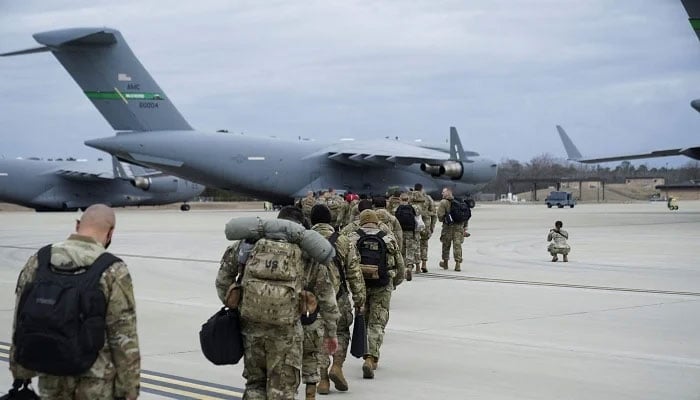
According to a 2025 report by the Stockholm International Peace Research Institute (SIPRI), global military expenditures have surged to $2.887 trillion. In 1982, world military expenditures were $600 billion, which had swollen to $2.5 trillion by 2025. Out of $2.887 trillion, the US’s defence spending is $954 billion, which in 2026-27 is expected to rise by $1.5 trillion.
The top five countries in military expenditures are: the US, China, Russia, Germany and India. Europe’s contribution to military expenditures rose sharply to 14 per cent to $864 billion. India’s defence spending rose by 8.9 per cent to $92.1 billion and is expected to touch $100 billion in 2026-27.
The US, with around $1 trillion in defence spending, has a debt of $37 trillion, and its economy is in dire straits amid rising fuel and food prices. China’s defence spending of $336 billion and Russia’s spending of $190 billion reflect these two countries coping with rising security threats from the US, Nato and Ukraine.
Statistics on global military expenditures are alarming to those who lament the surge in defence spending while the world grapples with rising poverty levels, inflation and higher food and fuel prices. The diversion of resources from human security to militarisation is at the expense of eight billion people.
America’s defence spending of around $1 trillion, despite its debt of $37 trillion, suggests the Trump administration is not mindful of factors that worsen the economic predicament of the American people. Tax cuts for multi-billionaires, cuts in social services, Medicare and Medicaid tend to enhance the poverty level in the US. The only American president who really cared about controlling defence expenditures and his country’s debt was Bill Clinton, who, during his two terms, brought military spending down to around 250 billion dollars and took measures to slash the debt. But things changed when his successors – George W. Bush, Barack Obama and Donald Trump – failed to address growing economic challenges triggered by a surge in defence spending and rising debt.
It is estimated that since 1945 till today, the US has spent around $10 trillion because of its involvement in Korea, Vietnam, Iraq, Afghanistan and other wars in different parts of the world. Although Obama failed to control military spending or reduce debt, he was right when he said that a nation should live within its means. Can the US, with a debt of $37 trillion and a surge in economic crises, afford to spend $1.5 trillion on military spending?
There is a close connection between a surge in military expenditures and armed conflicts. As long as inter- and intra-state conflicts remain unresolved, control over defence spending is not possible. Underdeveloped countries in Asia and Africa divert their limited resources from development to defence due to unresolved conflicts with their neighbours.
India, which has not been able to control poverty, is spending more than $92 billion on military spending. If China is spending $336 billion on defence, it is the world’s second-largest economy with foreign exchange reserves of around $2 trillion and can afford to increase military expenditures.
The perilous implications of the surge in military expenditures need to be examined from three perspectives. First, diversion of resources from poverty alleviation and development to militarisation is lethal for the survival of humanity. The resources used for human destruction can be utilised to improve the economic well-being of millions of people.
Unfortunately, the UN and its so-called disarmament commission miserably failed to compel major spenders to review their relentless spending on militarisation. If even 50 per cent of world spending is reduced, millions of people can be pulled out of hunger, poverty, illiteracy and social backwardness. Second, the only plausible way to reduce military expenditures is to take steps to manage and resolve conflicts. As long as armed inter- and intra-state conflicts remain, not much can be done to reduce military expenditures. That requires serious efforts in peace-making and peacekeeping.
But the reality on the ground is different. Wars in Sudan, Ukraine, Gaza and Iran consuming billions of dollars serve the interests of the military-industrial complex and arms-exporting countries and companies. For such countries and arms-exporting companies, conflict is their bread and butter because if the conflicts are managed or resolved, how would they earn money? As a result, the vested interests of the military-industrial complexes of different countries, particularly the US, prevent the peaceful management and resolution of conflicts.
Finally, not only are the economic and social consequences of the arms race and military expenditures a major threat to the world, but the environmental implications of the use of lethal weapons also cause a serious threat to the global environment and ecology. The firing of missiles, bombs and drones by Israel in Gaza and the US-Israeli colossal bombing against Iran also caused serious environmental hazards. The same is the case with Ukraine, where, for the last four years, Russia and Kyiv have been involved in the use of lethal weapons against each other, with serious environmental consequences.
It is high time that the relevant world and regional stakeholders, despite their diverse interests, agree on limiting defence spending. That would require the UN, EU, Nato and other organisations like the SCO, BRICS, G-20, D-8, GCC, African Union and ASEAN to ponder on practical measures to manage and resolve conflicts so that there is little justification for a rise in military expenditures. The resources diverted from defence spending can be used to address issues of poverty, underdevelopment, global warming and climate change, thereby better securing the future of the world.
The writer is a meritorious professor of International Relations and a former dean of the Faculty of Social Sciences, University of Karachi. He can be reached at: [email protected]