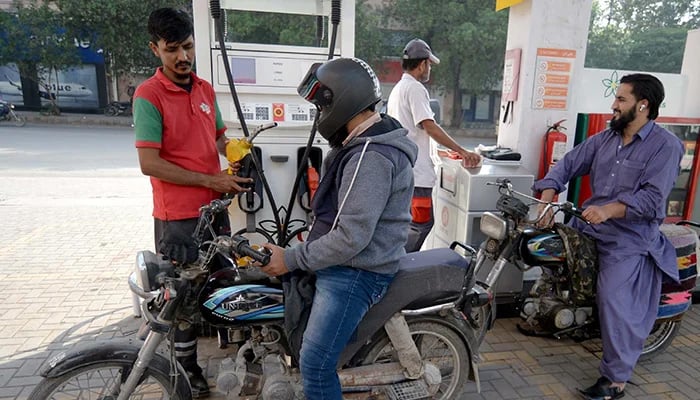
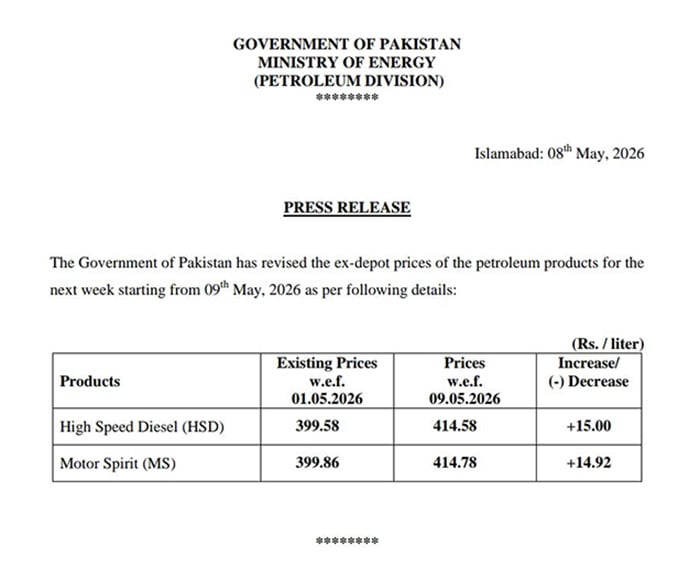
The federal government jacked up the prices of petrol by Rs14.92 and diesel by Rs15 per litre on Friday.
In a notification issued on Friday, the Petroleum Division said new fuel rates will come into effect from May 9.
The price of petrol has jumped from Rs399.86 to Rs414.78, while the HSD price increased from Rs399.58 to Rs414.58 per litre.
This marks the third consecutive increase in petrol and diesel prices after cumulative hikes of Rs33.28 on petrol and Rs46.16 on diesel over the previous two weeks.
According to sources in the Petroleum Division, the petrol and diesel levy has been raised by Rs13.91 per litre.
The levy on petrol has increased from Rs103.50 to Rs117.41 per litre, while the levy on diesel has increased from Rs28.69 to Rs42.60 per litre, according to sources.
Meanwhile, the price of kerosene oil has been reduced by Rs41.80 per litre, according to a notification issued by the authorities.
Following the cut, the new price of kerosene oil has been fixed at Rs318.96 per litre.
The government has been reviewing petroleum prices every Friday night amid global oil market volatility linked to the US-Iran conflict.
Global oil prices were up more than 1% on Friday after renewed fighting broke out between the US and Iran, threatening a fragile ceasefire and dashing hopes of progress toward reopening the Strait of Hormuz, a key oil and gas transit route.
Brent crude futures were up $1.41, or 1.41%, at $101.47 a barrel as of 0123 GMT. West Texas Intermediate (WTI) US crude futures rose by $1.12, or 1.18%, to $95.93 a barrel. At the market open prices had risen by more than 3%.
Petrol is mainly used by commuters in small vehicles, rickshaws and two-wheelers. Higher fuel prices significantly impact the budgets of middle and lower-middle-class households, who rely on petrol for daily travel.
On the other hand, a significant portion of the transport sector relies on high-speed diesel.
Its price is considered inflationary since it is predominantly used in heavy goods transport vehicles, trucks, buses, trains, and agricultural machinery such as tractors, tube wells, and threshers.
The consumption of high-speed diesel particularly contributes to the increased prices of vegetables and other food items.