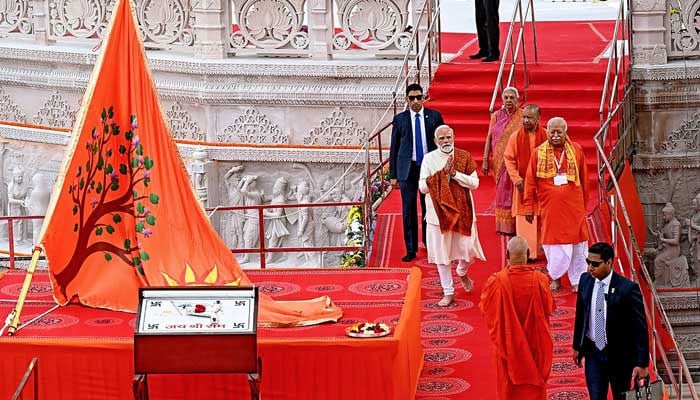
Hindutva came to power at the national level in India in 2014. Nearly a decade later, it has now taken hold of state power in West Bengal as well. The Indian states bordering Bangladesh, such as Tripura, Assam and West Bengal, have all become strongholds of Hindutva.
But there is little reason for people of Bangladesh to be alarmed by this. Whether it is the Indian National Congress or the BJP that governs in Delhi, India’s policy towards Bangladesh has remained broadly consistent.
The roots of that policy lie in a colonial mindset shaped by the Permanent Settlement of 1793 under British rule, when a class of clerks, assistants and record-keepers suddenly assumed the role of zamindars in eastern Bengal. India’s approach to Bangladesh still reflects that feudal mentality.
Congress leader Pranab Mukherjee, through the military-backed 1/11 government in Bangladesh, effectively installed Sheikh Hasina in power under a modern version of that ‘permanent settlement’. His sense of entitlement toward Bangladesh has since been echoed by Indian diplomats and policymakers, even after Hasina’s fall during the July uprising, revealing a continuity of attitude.
The worldview towards eastern Bengal articulated by Bankim Chandra Chattopadhyay during the Bengal Renaissance in Kolkata continues to shape India’s perception of Bangladesh today. The economic strength, cultural refinement and aristocratic heritage of eastern Bengal during the Sultanate, Mughal and Nawabi periods were dismantled after the Battle of Plassey. In the chaotic aftermath, minor British functionaries became suddenly wealthy and constructed an artificial aristocratic order, out of which that ‘Bankim mindset’ emerged.
Influenced by British colonial culture, these local ‘brown philistines’ cultivated an imagined Aryan identity, with Kolkata becoming a hub of that illusion. Yet the so-called Aryans of northwestern India have often dismissed Bengal’s version of Aryanism. The heavy burden of ‘high culture’ placed upon Kolkata since the Bengal Renaissance has even been a subject of ridicule in those circles.
In today’s world, it seems almost absurd that caste hierarchies still persist in Kolkata, with some claiming upper-class status. In contrast, Europe’s Renaissance fostered a more egalitarian social ethos. This highlights the difference between India’s semi-rural ‘enlightened society’ and Europe’s urban enlightenment.
Whenever caste, religion, lineage or ideology defines social hierarchy, it indicates a failure to become truly cosmopolitan. In Bangladesh, limited English education has led some to seek modernity through Kolkata, but in doing so, they often absorb Hindu religious rituals under the guise of ‘culture’. Meanwhile, those who engaged more deeply with English education have drawn inspiration from the European Enlightenment instead.
In Dhaka, a section of society has attempted to promote secularism through the lens of the Bengal Renaissance, but in practice has steered many toward Hindutva. As a result, Pranab Mukherjee effectively framed the Awami League as a Hindutva-aligned project as early as 2009. Though he began as a leftist and rose through the Congress ranks, his later political gestures reflected a shift towards Hindu nationalist symbolism, one that even his own daughter declined to follow.
Historian Jodunath Sarkar, a scholar of the Bengal Renaissance, once envisioned West Bengal along a Zionist model. Prime Minister Narendra Modi has openly embraced Israel as a ‘fatherland’, positioning India as a ‘motherland’ inspired by it. Even earlier, in 2002, Gujarat became a kind of laboratory, followed later by Kashmir, northern India, Assam and now West Bengal.
Policies targeting Muslims – killings, revocation of citizenship, detention camps in Assam, demolition drives in Uttar Pradesh and the exclusion of millions of Muslim voters from electoral rolls in West Bengal – represent forms of demographic engineering. BJP leader Shuvendu Adhikari openly framed electoral outcomes along religious lines, claiming Muslims voted for Mamata Banerjee while Hindus voted for him.
This poor man’s Zionism in India began with the discovery of a supposed temple beneath the Babri Masjid. Since then, there has been a recurring drive to locate temples under mosques and justify their demolition. Alongside this, films portraying Muslim rulers of the Delhi Sultanate and Mughal era as villains have fueled historical revenge narratives under Narendra Modi’s leadership.
The transformation of India into a Hindutva state over the past decade is not a sudden metamorphosis. India’s first prime minister, Jawaharlal Nehru, had draped a deeply communal society in a veneer of secularism inspired by European Enlightenment ideals. But figures like Pranab Mukherjee within his own party reflected enduring religious conservatism. By covering, rather than curing, communalism, the problem resurfaced dramatically in 2014.
Ideologies like Nazism and Zionism are extreme and destructive. And now Hindutva may surpass them in its consequences. A troubling aspect is the way political actors are ‘groomed’, just as the Awami League was shaped. Similar efforts are allegedly underway with groups like the Afghan Taliban. Certain collaborators within Muslim political circles in India have aligned themselves with Hindutva projects, even aiding the BJP’s rise in West Bengal. Comparable networks exist in Bangladesh as well.
These Muslim actors, often outwardly religious, contribute to Hindutva’s expansion while invoking Islam rhetorically. During Sheikh Hasina’s rule, they allegedly received state support. Her government’s alignment with policies perceived as Islamophobic is the reason she now resides in Delhi as a state guest, while her political allies maintain connections in Kolkata.
Hindutva, which began its journey in Kolkata under the cover of the Bengal Renaissance, has now returned there. This should not be surprising. The key lesson for Bangladesh, however, is not to respond to religious hostility with more hostility.
Society is a mosaic of diverse people. Among them are those in Bangladesh who celebrate the BJP’s victory in West Bengal. They may dream of an Akhand Bharat, but such provocations must not be entertained. The so-called enlightened circles of Dhaka, shaped by the Bengal Renaissance, resemble a field of hidden landmines, constantly stirring tension among ordinary people. They rationalise Hindutva’s rise while selectively framing narratives, blaming minor incidents involving visibly religious individuals while ignoring deeper causes.
In the 2006 World Cup final, when Marco Materazzi insulted Zinedine Zidane’s sister, Zidane reacted, and it was Zidane who was sent off. The provoker remained.
Today’s saffron progressives play the role of Materazzi, constantly provoking with subtle hostility. The wisest response is not to react. Over time, such forces will appear outdated and unsophisticated to newer generations, fading like wrinkles of an ageing ideology.
The writer is the editor-in-chief of E-SouthAsia. He can be reached at: [email protected]