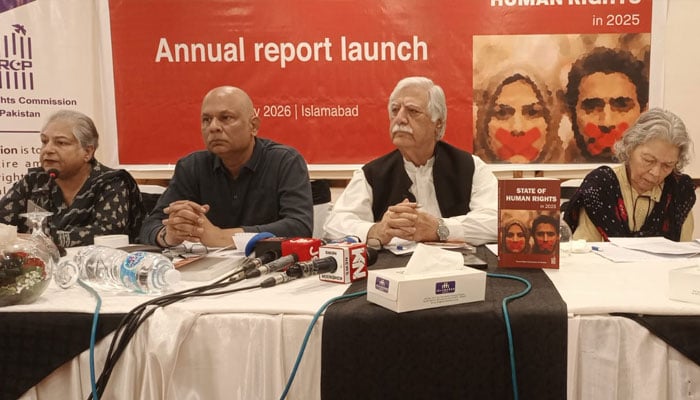
The 2025 annual report by the Human Rights Commission of Pakistan should be seen as a warning. Released on Monday, the State of Human Rights 2025 report shows a Pakistan in which civic space is shrinking, dissent is increasingly penalised and institutional safeguards are steadily weakening. Taken together, its findings suggest a systemic drift away from constitutional protections and democratic norms. None of this is a surprise but it does point to a basic theme: the right to question authority, seen as the cornerstone of any functioning democracy, is slowly being curtailed. Amendments to the Prevention of Electronic Crimes Act (Peca), alongside the routine invocation of sedition and anti-terrorism laws, have created an environment where journalists, activists, lawyers and political workers operate under constant threat. The result is predictable: fear, self-censorship and a public discourse stripped of critical voices.
Equally alarming has been the documentation of the expansion of coercive state powers. Changes to the Anti-Terrorism Act 1997 mark a serious departure from due process. When the state acquires the ability to detain without accountability, the burden of proof shifts dangerously away from institutions and onto citizens. The erosion of judicial independence adds to these concerns. The report has critiqued the 27th Amendment’s effect of increased executive influence over judicial appointments. A weakened judiciary has immediate, human consequences. For families of the disappeared, for victims of extrajudicial killings and for political actors seeking legal recourse, the courts are often the last line of defence. If that line falters, justice becomes elusive. The numbers cited are difficult to ignore. There has also been a focus on the staggering number of police ‘encounters’, particularly in Punjab. And also the rising gender-based violence against women and transgender persons.
Yet, the report is not without moments of cautious optimism. Legislative progress, such as the National Commission for Minorities Act, and reforms like the Child Marriage Restraint Act in Islamabad and Balochistan, also show that the state is capable of moving in the right direction. Similarly, progressive judgments by higher courts on women’s rights show that institutional resistance to regression still exists. But these gains remain fragile and few. The gap between law and practice is perhaps the most telling feature of Pakistan’s human rights landscape. Yes, progressive laws exist, but enforcement is selective. Protections meant to uplift vulnerable populations remain underutilised, while punitive laws are applied with disturbing efficiency. Pakistan faces overlapping crises – economic strain, climate vulnerability, terrorism and political instability. In such conditions, the temptation to centralise power and suppress dissent often grows. But history has shown us that sustainable stability cannot be built on curtailed freedoms. There is also the unpopular fact that a state cannot claim strength abroad while tolerating fragility at home. The HRCP report should not be dismissed as routine criticism but rather as an opportunity for course correction. Reversing the contraction of civic space, restoring judicial independence and ensuring that laws serve citizens rather than control them are essential for the country’s long-term stability. If these warnings continue to go unheeded, the cost will not just be borne by activists, journalists or political opponents. It will be paid by the broader public, in the gradual erosion of rights that are far harder to reclaim once snatched away.