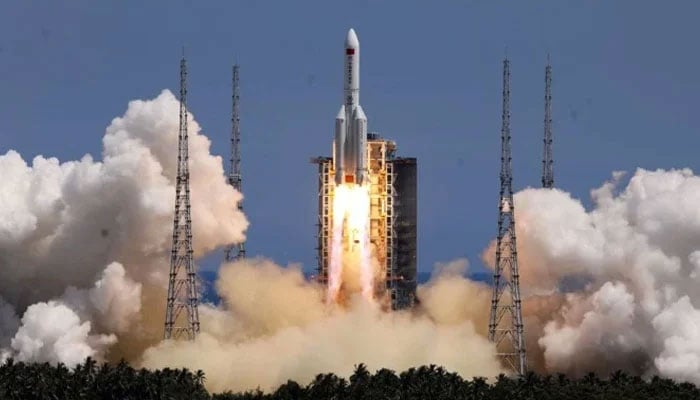
Last month brought a rare and welcome moment of optimism: China’s decision to include two Pakistani astronauts in its manned space programme. For a country more accustomed to crises than breakthroughs, this suggests that Pakistan’s future need not be confined to terrestrial constraints. This milestone builds on a trajectory that has quietly gathered pace. In 2024, the lunar satellite ICUBE-Q successfully entered the moon’s orbit, making Pakistan the sixth country to launch its first-ever moon satellite. ICUBE-Q rode on the Chinese rocket Chang’e 6 lunar probe and pointed to the growing collaboration between China and Pakistan in lunar exploration. Earlier collaborations had already yielded tangible gains: satellites like PRSS-1 and PakSat-1R have strengthened telecommunications, disaster response and agricultural monitoring. For a developing country with limited resources, such partnerships have made what would otherwise be prohibitively expensive ventures possible.
There is no denying that cooperation with China has opened doors that might have remained firmly shut. It has accelerated Pakistan’s entry into domains that define modern state capacity – space, data and advanced technology. It has also provided something less tangible but equally important: inspiration for young Pakistanis. Yet optimism must not obscure a harder question: is Pakistan building capacity, or merely accessing it? If collaboration does not translate into meaningful knowledge transfer, local expertise and institutional growth, it risks entrenching dependence rather than reducing it. This concern is not unique to the space sector. Across industries, there is a growing tendency to favour importing ready-made solutions over investing in indigenous development. Pakistan must therefore treat its space collaboration as a bridge. The selection of astronauts should be accompanied by robust training pipelines, research partnerships and opportunities for Pakistani scientists and engineers to work at the cutting edge. Government-backed exchange programmes, scholarships and institutional linkages can ensure that exposure translates into expertise. The foundations need equal attention. Universities and research institutions require sustained investment, not sporadic funding. The private sector, too, must be encouraged to participate in innovation ecosystems rather than remain confined to service delivery.
Equally important is governance. Space is deeply embedded in everyday life, from communication networks to environmental monitoring. This makes regulatory frameworks, data protection policies and civilian oversight indispensable. Pakistan must ensure that its expanding capabilities serve the public interest and that satellite data is used responsibly and not captured by a narrow set of actors. None of this diminishes the significance of China’s support. On the contrary, it actually shows its value. Strategic partnerships can accelerate progress, but only if they are leveraged wisely. Caution, in this context, is foresight. Pakistan can continue as a consumer of advanced technologies, reliant on external expertise – or it can begin the slower, more demanding journey towards self-reliance. The view from space may be inspiring. But the real challenge lies closer to home: in building the institutions, skill and vision needed to ensure that Pakistan is learning to navigate the stars on its own terms.