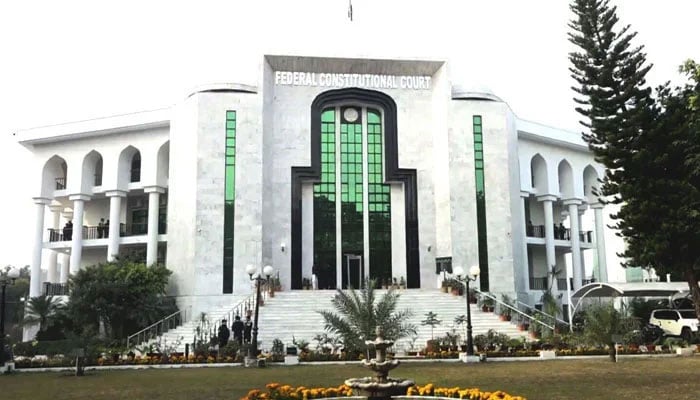
The Federal Constitutional Court (FCC) has upheld the constitutionality of the Super Tax regime, while excluding capital gains from the disposal of immovable property or securities held for a prescribed period. For instance, where no tax is payable on capital gains arising on disposal of immovable property or securities either for being held beyond a certain period, inherited or otherwise exempted from the ordinance, no super tax shall be payable on such capital gains on disposal of immovable property or securities. The same principle shall apply to any capital gains on the disposal of agricultural property. It would be fair to say that this ruling will be a help to the revenue authorities, with the FBR’s tax shortfall widening to Rs684 billion in the first 10 months (July-April) of the current fiscal. One could also argue that, if anyone should be paying taxes right now, it is wealthier individuals and corporations. However, even with the survival of the Super Tax, most Pakistanis are living under a very unfair revenue regime and it is not as though formal businesses do not have legitimate concerns when it comes to taxation. Even when short, the revenue burden falls disproportionately on the salaried classes and formal, registered businesses or the corporate sector.
The salaried classes, in particular, have often played the biggest role in picking up the nation’s tab, reportedly paying Rs365 billion Income Tax in the first eight months (July-February) of the current fiscal year, more than the collective contribution of all wealthy segments, including retailers, wholesalers, exporters and property tycoons. This whole arrangement is doubly unfair when one considers that the salaried do not get much out of their disproportionate tax contribution in terms of public services. And now, with the Middle East conflict driving inflation to a 20-month high in April and fuel hikes and power disruptions, the overall burden on the ordinary people of this country is fast becoming unbearable. However, even businesses and corporations are increasingly chafing at the tax burden. The Overseas Investors Chamber of Commerce and Industry (OICCI), representing more than 200 multinational companies operating in Pakistan, has urged the government to gradually abolish the super tax over three years and rationalise the capital value tax (CVT) on foreign assets in the 2026-27 budget. Similarly, the patron-in-chief of the Pakistan Textile Exporters Association (PTEA) has called for eliminating super tax, minimum tax, and advance tax, terming them multiple layers that increase the cost of doing business.
With the pressure on the government to increase tax collection and meet IMF targets rising and a seeming unwillingness and/or inability to broaden the tax net, any significant relief for the salaried and formal businesses seems far away. That being said, if any relief is on offer in the upcoming budget, it ought to be the salaried class that is prioritised. No business, formal or otherwise, in this country can thrive when ordinary taxpayers are barely making ends meet. It is also hoped that the disruptions caused by the Middle East conflict and Pakistan’s high exposure will be factored into IMF demands going forward. This is not to say that the Fund is necessarily the bad guy in this story, having pushed for several sensible economic reforms. The 11 new conditions it has reportedly placed on Islamabad include amending the PPRA rules to eliminate the SOEs’ preferences in awarding procurement contracts without competition. Reforming the bleeding state sector is just as crucial as broadening the tax base. The longer the government takes to make meaningful progress on these reforms, the worse it will get for ordinary Pakistanis, and that will eventually impact the government too.