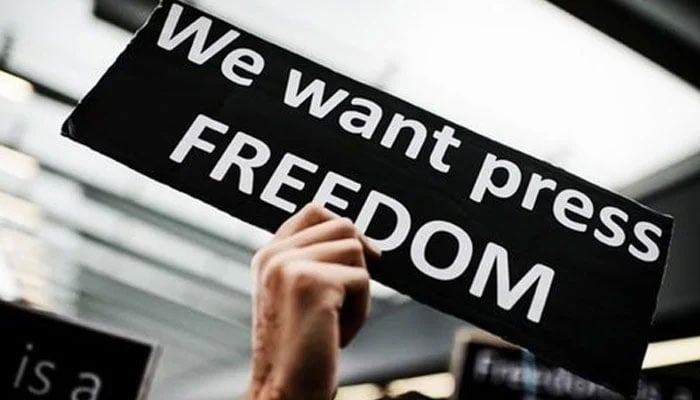
On World Press Freedom Day, the global state of journalism offers little cause for celebration. The latest findings by Reporters Without Borders paint a sobering picture: press freedom has fallen to its lowest level in 25 years. For the first time since the World Press Freedom Index began, more than half the world’s countries are now classified as “difficult” or “very serious” environments for journalism. This is really a structural decline. The numbers alone are disturbing: journalists killed, journalists detained. But all this only hints at a deeper, more insidious trend. Across continents, governments are not just restricting media but are actively delegitimising it. The playbook is now familiar: undermine credibility, question motives and brand critical journalism as partisan or even treacherous. Under US President Donald Trump, the US has seen a measurable erosion in press freedom rankings, reflecting the fact that even long-standing democracies are not immune to this populist instinct. Similarly, in India under Prime Minister Narendra Modi, the media landscape has become increasingly polarised and constrained. That India now ranks below conflict-ridden Palestine is not just ironic but quite deeply troubling for a country that prides itself on democratic credentials.
The situation becomes even more disturbing when viewed alongside data from the Committee to Protect Journalists, which highlights the disproportionate toll on Palestinian journalists in Gaza. When war zones begin to mirror, or even surpass, peacetime democracies in terms of press freedom constraints, something fundamental has gone wrong in the global order. Yet, while it is easy to point outward, introspection at home is unavoidable. Pakistan’s ranking at 153 is a reminder that we are firmly embedded within this crisis. The concerns flagged by RSF – legal pressure, political interference and a shrinking space for dissent – are neither abstract nor new. The amendments to the Prevention of Electronic Crimes Act (Peca) have further institutionalised a culture of caution, if not fear, among journalists. Increasingly, censorship no longer requires overt bans. Self-censorship has become one of the most effective tools of control. And it’s not like this happened overnight. Pakistan’s media has endured cycles of pressure: channels taken off air, newspaper circulation disrupted, journalists harassed or sidelined. In recent years, digital spaces – once seen as a frontier of relative freedom – have also been systematically policed through coordinated trolling, intimidation and reputational attacks. What began as partisan weaponisation of online narratives has now matured into a broader culture of silencing, transcending political transitions. The result is a media ecosystem where the boundaries of permissible speech are constantly negotiated, often invisibly. Journalists learn to read between the lines not just in what they report, but in what they choose not to. And that is perhaps the most dangerous outcome of all.
There is, however, a fundamental miscalculation at the heart of this global and local clampdown. Media control may offer short-term political comfort, but it erodes long-term institutional credibility. Democracies cannot function on managed truths. A press that is constrained, coerced or co-opted cannot serve its essential role as a watchdog. Pakistan’s current political arrangement may appear stable, even insulated from dissent. But history offers ample evidence that suppressing the press does not eliminate scrutiny; it merely delays and distorts it. The absence of a robust opposition may reduce immediate pressure on those in power, but it simultaneously increases the burden on journalists to hold the line. And hold it they must, because despite shrinking spaces, the fundamental instinct of journalism remains unchanged: to question, to investigate and to speak – even when doing so comes at a cost. World Press Freedom Day should not be reduced to symbolic gestures or ritual statements. It must serve as a moment of reckoning.