The World-Wide Fund for Nature (WWF) and GSK have offered a variety of solutions to local communities in Karachi and Lahore, and at the Keenjhar Lake under its five-year ‘freshwater resilience programme’ in Pakistan.
The partnership aims to develop collaborative, locally led solutions to improve freshwater sustainability for communities, habitats and biodiversity, and accelerate progress towards the UN 2030 Agenda.
A solar-powered drinking water filtration plant was installed at the welfare dispensary in Sharafi Goth, Landhi Town, Karachi, with the supply line extended to the adjacent Government Girls College.
The plant now provides free safe drinking water to around 1,500 people — including local community members, female students and dispensary visitors — delivering estimated annual savings of approximately Rs 2.7 million for the community.
Similarly, four ablution water reuse systems (AWRS) were installed at Baitul Mukarram Mosque and Masjid-e-Aqsa in Karachi, and two additional systems were installed in Engineers Town, Lahore, with a combined capacity of 18,660 m³ per year.
In addition, 15 toilet blocks and a sewage drainage system were rehabilitated at the Government Girls and Boys Higher Secondary School in Bin Qasim Town, Karachi, directly benefitting 1,144 students from an underprivileged community.
Two urban green spaces were also restored at Jamia Masjid Hanifia Alamgir Trust and Government College, Sharafi Goth, using dense, multispecies native planting suited to Karachi’s arid climate. The 1,084 m² of new green cover supports improved microclimates and healthier urban environments for approximately 1,500 local residents.
Furthermore, a community biodiversity monitoring group at the Keenjhar Lake is now operational. The group, made up of local resource users, conducts regular observations of key species and habitats, identifies potential threats and documents ecosystem changes.
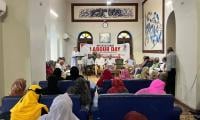
The project also conducted capacity-building activities, including awareness sessions at NED University, Government Degree Girls College (Sharafi Goth), and Hanifia Alamgir Masjid. A community session at Keenjhar Lake was attended by 32 university students as part of an onsite learning visit.