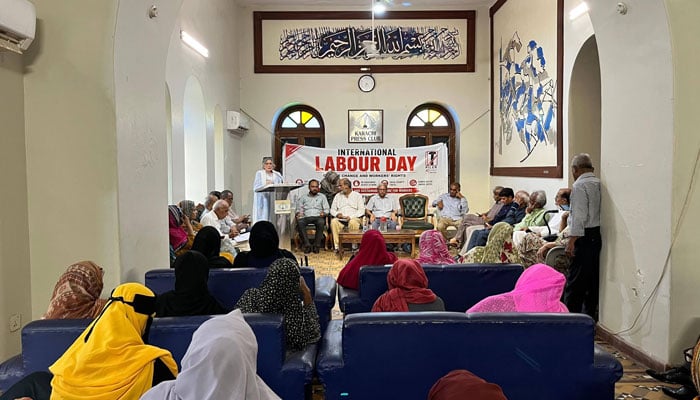
Speakers at a seminar on climate change and workers’ rights have warned that Pakistan’s working class is bearing the heaviest cost of a crisis they did not create, and that the country’s policy response remains “dangerously inadequate”.
Labour leaders, researchers and economists demanded a worker-led climate response, and phasing out fossil fuels.
The seminar was organised by the Pakistan Institute of Labour Education & Research, whose Director Abbas Haider recalled that the 2015 Karachi heatwave had killed more than 5,000 people, according to the Edhi Foundation’s count, against an official toll of 1,300, with the dead concentrated in working-class neighbourhoods, where power and gas outages compounded the disaster.
Haider said women bear a disproportionate burden, both as workers and as the household members absorbing the strain of failing infrastructure. He highlighted a rise in domestic violence cases linked to that strain.
He said that 30 per cent of textile and garment sector workers are women, most of them hired through third-party contractors, and they are denied the right to unionise, with social security institutions largely failing to cover them.
He also highlighted the alarming findings from Sindh’s social security system: of the 800,000 workers registered with the Sindh Employees Social Security Institution (Sessi), only 80,000 are receiving services.
Pakistan Fisherfolk Forum leader Saeed Baloch said workers experience climate change not only at the workplace but also at home and in their communities. He called for the needs of mining workers to be central to any green transition.
Baloch criticised the government’s proposed solar tax and continued reliance on coal, and said farmers and fishermen are losing their livelihoods as Paris Agreement commitments remain unfulfilled. “The May Day demands must include getting rid of fossil fuel dependency.”
Aurat Foundation leader Mahnaz Rahman warned that Pakistan’s engagement with climate realities arrives late, producing late policy responses. She criticised wasteful government spending on fossil-fuel-powered vehicle convoys, and said that meaningful climate policy must be centred on social justice and workers’ priorities. “In this climate crisis, we need social justice.”
Human Rights Commission of Pakistan Vice-chair (Sindh) Qazi Khizer called for an independent investigation by leading HIV specialists into an outbreak in which 78 children born at the Valika Hospital under Sessi tested HIV-positive, describing it as harm caused by the state itself.
Khizer also highlighted 26 million children out of school, a deepening housing crisis in a city growing by 600,000 people a year, unpaid overtime, and workplaces without harassment committees — conditions he described as modern slavery. He called for the day to be dedicated to HIV-affected children, farm workers in Sindh living without shelter, and all workers.
National Trade Union Federation leader Nasir Mansoor framed climate action as a matter of survival for trade unions — a fight for livelihoods as well as the planet.
Economist Kaiser Bengali offered a candid reckoning with four decades of attending May Day events, arguing that the rights to strike and to unionise have been progressively eroded, and the collective strength of workers and students dismantled.
Bengali cited the case of journalist Iman Mazari being sentenced to 17 years over a retweet as evidence of the narrowing space for dissent. He spoke of meeting a woman whose children had never tasted an egg, and children afraid to taste ice-cream because they had never had it.
The speakers also called for heat stress to be specifically included in occupational safety and health law, and for the revival of the National Labour Council for a collective struggle of the working class.