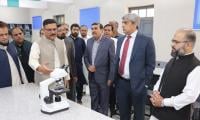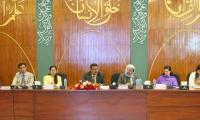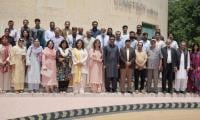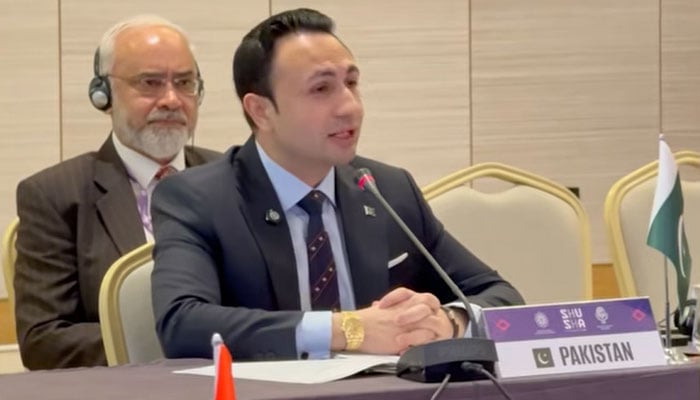
Islamabad: Pakistan sharpened its pitch for regional tourism integration and investment at the Economic Cooperation Organization (ECO) conference in Shusha, with Sardar Yasir Ilyas Khan, Coordinator to the Prime Minister on Tourism, emerging as a central voice in shaping the forum’s economic and policy direction.
Representing Islamabad at the high-level gathering marking Shusha’s designation as ECO Tourism Capital 2026, Sardar Yasir framed tourism not merely as a sector of growth, but as a strategic instrument of regional connectivity, economic resilience, and soft diplomacy.
The conference, attended by senior officials from across ECO member states including Türkiye, Iran, Kazakhstan, and Uzbekistan, focused on unlocking cross-border tourism flows and fostering sustainable development. Within this multilateral setting, Pakistan’s intervention was notably structured, data-driven, and forward-looking.
In his keynote address, Sardar Yasir outlined a reform-backed roadmap aimed at scaling Pakistan’s tourism economy over the next decade. Citing current annual growth of approximately 10% and employment of 4.7 million people, he projected a near doubling of the workforce to 8 million jobs, alongside a targeted $40 billion contribution to GDP.
He invited ECO member states and private investors to engage with Pakistan’s expanding tourism landscape, pointing to opportunities in infrastructure development, hospitality, and curated destination experiences, including religious, medical, and adventure tourism.
A key policy proposition, the introduction of a unified regional visa framework, modelled on the Schengen system was presented as a practical mechanism to stimulate intra-regional travel and economic integration.
Underscoring Pakistan’s improving accessibility, Sardar Yasir highlighted a growing network of transport and digital infrastructure: five international airports, 15 domestic airports, more than 12,000 kilometres of motorways, and extensive railway connectivity.
This physical backbone, coupled with ongoing digital expansion, including a 5G rollout, was positioned as critical to transforming Pakistan into a competitive and investor-friendly tourism destination.
Beyond policy, Pakistan deployed cultural diplomacy with calculated precision. A curated culinary showcase, featuring traditional dishes such as ‘biryani’, ‘nihari’, and ‘seekh kebabs’, served to introduce delegates to the country’s cultural depth, reinforcing a narrative of diversity and heritage.
On the margins of the summit, Sardar Yasir held bilateral meetings with tourism authorities from Türkiye, Kazakhstan, and Uzbekistan. Discussions centred on expanding cooperation through joint tourism roadshows, hospitality exchange programmes, and stronger academia-industry partnerships. With Pakistan set to host ECO-related events in 2027 in Lahore and Islamabad, Sardar Yasir extended formal invitations to member states, signalling Islamabad’s intent to position itself as a convening hub for regional tourism dialogue.
While multilateral forums often produce broad declarations, Pakistan’s engagement in Shusha stood out for its policy clarity and strategic messaging. As Coordinator to the Prime Minister on Tourism, Sardar Yasir Ilyas Khan presented a coherent vision that links domestic reforms with regional ambition, projecting Pakistan as both a serious market and an emerging leader in tourism diplomacy.