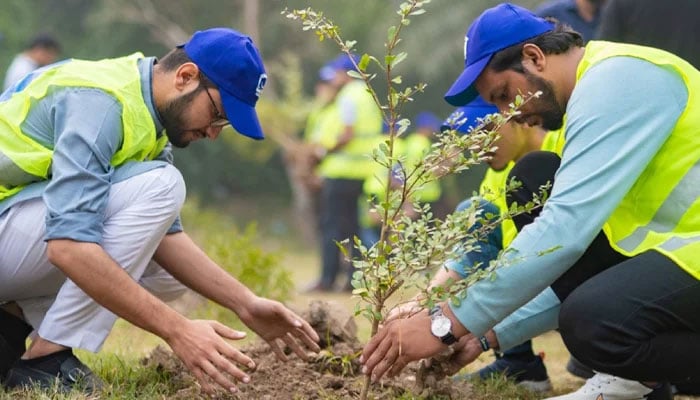
LAHORE: Under an ongoing afforestation campaign, the Environment Protection and Climate Change Department (EPCCD) has overseen the plantation of more than 531,000 saplings across Punjab.
EPD officials said the initiative was taken to improve air quality and stricter environmental regulation around industrial areas. According to official figures, 510,178 trees were planted during the main drive, while an additional 21,331 saplings were planted between January and April 28, 2026, taking the cumulative total to 531,509 trees.
District-wise data shows a broad spread of activity across the province, with Faisalabad leading with 60,372 trees, followed by Kasur (37,160) and Bahawalpur (31,255). Other major contributors included Jhelum (17,855), Bahawalnagar (17,153), Vehari (15,770), Jhang (15,425), Bhakkar (15,420) and Pakpattan (15,390). Districts such as Sahiwal (14,972), Okara (14,850), Rawalpindi (14,724), Rahim Yar Khan (13,874) and Sargodha (13,840) also posted strong numbers, while Layyah (12,860), Hafizabad (12,785) and Narowal (12,185) maintained steady participation.
Moderate plantation activity was recorded in Attock (11,040) and Muzaffargarh (11,132), along with Gujranwala (9,985), Nankana Sahib (9,690), Phool Nagar (9,700), Sialkot (9,399) and Gujrat (9,342). Lower figures were observed in Lahore (8,080), Khanewal (8,598), Sheikhupura (8,560), Mandi Bahauddin (8,250), Chiniot (7,975), Lodhran (7,010), Mianwali (7,105) and Multan (6,825), while comparatively smaller numbers were reported from Khushab (6,295), Chakwal (5,617), Rajanpur (5,120), Toba Tek Singh (5,000) and Murree (1,315).
Director General, Environment Protection Agency Punjab, Dr Imran Hamid Sheikh, highlighted that green buffer zones are being established around major industrial clusters across Punjab, including areas in Faisalabad, Lahore, Gujranwala and Kasur.
“We have directed industries to develop dedicated green belts around their premises to act as natural barriers against emissions, dust and noise pollution,” he said. Secretary Environment Protection and Climate Change Department, Silwat Saeed, said the plantation drive was aligned with a wider climate resilience strategy that integrates afforestation with regulatory enforcement and urban environmental management.
“The department is working on multiple fronts — from vehicular emissions control to industrial compliance and expansion of urban forestry. The introduction of mandatory green buffer zones around industrial estates is a major policy step to reduce pollution at source,” she said.