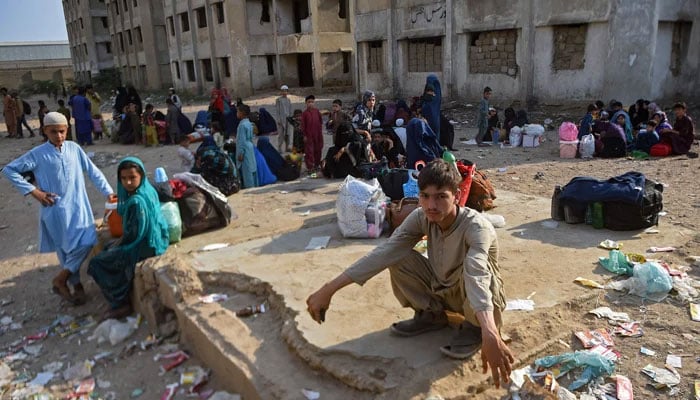
An intelligence report has raised alarm over the growing presence of illegal Afghan nationals in the outskirts of Karachi, prompting authorities to recommend intelligence-based operations (IBOs) and strict verification of residents in affected areas.
A quiet unease has begun to settle over parts of the city, particularly Orangi Town, MPR Colony, and the hilly stretches of Aliabad Pahari. Residents have noticed subtle changes—families returning at night, doors opening in buildings that were previously sealed, and unfamiliar faces blending into narrow streets.
Authorities have taken notice. A detailed report compiled by relevant agencies indicates that dozens of Afghan families, previously evicted, are gradually returning. In MPR Colony alone, Blocks A through D show signs of renewed occupancy. Multi-storey buildings that had stood nearly empty are now home to 50 to 60 families.
The report warns that such unchecked resettlement could create environments vulnerable to exploitation. Officials fear that prohibited groups could use these neighborhoods as safe havens, hidden within the dense urban fabric.
The situation, according to officials, has been exacerbated by what they describe as leniency at the local enforcement level, allowing people to return without proper documentation or scrutiny. Consequently, authorities have shifted to a more assertive approach.
Recommendations are clear: intelligence-based operations should be launched, entry and exit routes monitored, and, if necessary, sealed during search operations. Landlords will be held accountable for fully registering their tenants, with violations subject to strict legal action.
An official letter says: “Reportedly, MPR Colony (Blocks A, B, C, D), within the limits of PS Orangi Town, is densely populated, with a majority of residents from the Pashtun community. In the past, a large number of illegally residing Afghan families settled in the area. Under the government’s Afghan Repatriation Plan, several families voluntarily returned to Afghanistan, while remaining individuals were detained by police and sent to Afghan centers for repatriation.”
Current estimates indicate a Pashtun population of approximately 100,000 in MPR Colony, of which around 20% appear to be Afghan but identify as Pakistani. Among them are 50 to 60 families, reportedly possessing Pakistani documents, residing in 4- to 6-storey buildings. Many of these documents have not been fully verified by any institution.
According to the information, due to alleged delays and leniency in repatriation efforts, reports suggest that foreign Afghan residents are returning to MPR Colony and adjacent Aliabad Pahari. Authorities fear that banned organizations may exploit these areas as safe havens to continue their activities through facilitators.
It is recommended that in view of a report sent earlier on the presence of possible elements of banned organisations in the above areas, in all blocks of MPR Colony and in Aliabad Pahari area, IBOs may be conducted by Rangers and police by cordoning the entry and exit routes so that no one can escape. It is also recommended that regular verification of the details and documents of the residents may be done so that only illegal foreign residents can be identified.
Furthermore, all landlords may be directed to ensure complete verification and registration of their tenants. And legal action may be taken against those who have given accommodation to foreign Afghan nationals on rent so that all such persons do not become facilitators of foreign Afghan nationals. This process may be continued on a permanent basis so that no enemy of the country gets a chance to achieve his nefarious goals.