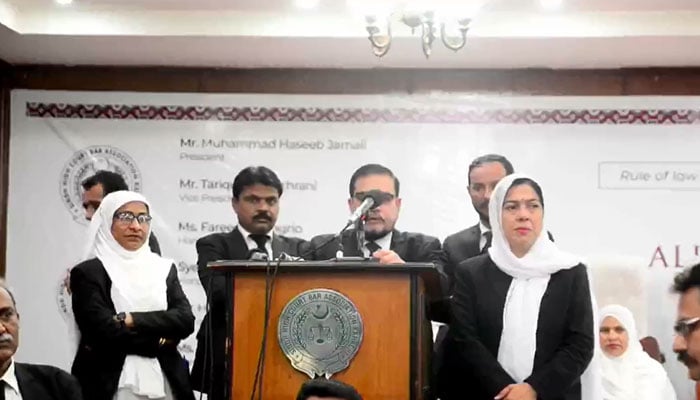
Speakers at a lawyers’ convention on Monday vowed to continue struggle for the rule of law, abolition of the controversial 26th and 27th constitutional amendments, protection of rights of citizens and restoration of genuine democracy in the country.
Addressing the convention under the title ‘Rule of Law’ at the Sindh High Court Bar Association, former Supreme Court Bar Association (SCBA) president Hamid Khan said the convention was organised for the supremacy of law in the country.
He criticised the democratic institutions and said that the elite class of the country had been benefited through Form 47. He said the 1973 Constitution was an effective piece of legislation but unfortunately the party, which had made the constitution, was now itself involved in supporting unconstitutional amendments.
He said lawyers had come out to protect the judiciary and they would continue struggle for the rule of the law and restoration of the constitutional institutions.
Former SCBA president Munir A Malik said that although his colleagues who were in 2007 lawyers movement were now playing their last overs, the new leadership of the legal fraternity was playing on the same principles.
He said that such conventions changed the mindset of people. He said the Supreme Court larger bench should telecast live proceedings of the hearings against the 26th and 27th constitutional amendments.
Former SCBA president Ali Ahmed Kurd criticised the government for worse human rights situation in the country. He said political and rights activists were being incarcerated for criticising the government’s undemocratic policies and condemned politically motivated cases against them.
Former member of the Judicial Commission of Pakistan Akhtar Hussain said that people of this country had been struggling for 70 years. He said constitutional amendments brought in recent years were against the basic principles of the constitution and due to such amendments, the supremacy of the constitution no longer existed.
He criticised the appointment criteria of the judges in the superior courts under the constitutional amendments. He said the problem of corporate farming still remained because of the feudal system and until land reforms were made, such problems would continue to arise.
Former Supreme Court Bar Association president Abid S Zuberi criticised the ruling political parties stating that they were currently standing with the establishment. He said efforts were being to minimise the constitutiuonal role of the judiciary.
Pakistan Tehreek-e-Insaf General Secretary Salman Akram Raja said the Form 47 government was set up by violating the mandate of the people of the country and his party would continue struggle for the rule of the law and independence of the judiciary.
Sindh High Court Bar Association President Haseeb Jamali said that lawyers from all over the country were united for the rule of the law and independence of the judiciary, and they would continue struggle against controversial constitutional amendments.
Lahore High Court Bar Association President Babar Murtaza Khan said the basic responsibility of every lawyer was to work for the rule of law. He said the 26th and 27th amendment cases should be heard and decided on a priority basis and it was unanimous opinion of the lawyers that controversial constitutional amendments, which undermined the independence of the judiciary, must be declared ultra vires the constitution.
The presidents and secretaries of bar associations from other cities also addressed the convention and said that lawyers would not accept any law that undermined the independence of the judiciary and rule of the law.