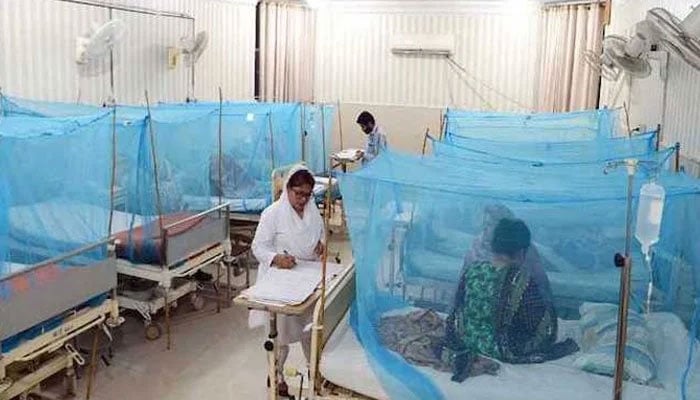
Rawalpindi : With the rise in temperature, the environment is becoming favourable for breeding of mosquitoes including ‘aedes aegypti’, the vector that causes dengue fever, and according to health experts, it is time to take serious measures both by the concerned government authorities and individuals to avoid a possible outbreak of dengue fever in the coming weeks.
Individuals and the concerned government authorities should give proper attention to check breeding of mosquitoes as the elimination of possible breeding sites of mosquitoes from inside homes, offices and indoor environments at the time would reduce the chances of a possible outbreak of dengue fever.
According to experts, the human behaviour and habitat play an important role in the spread and control of dengue. The factors including congested living, continued presence of solid waste, trash, and poor water storage practices are the main reasons for poor dengue control. During the low transmission season, April and May, certain preventive and control measures help reduce the larval density of the dengue vector.
It is important that the greater the larval density, the greater would be the chances of a severe outbreak of dengue fever in an area. The dengue mosquitoes both ‘aedes aegypti’ and ‘aedes albopictus’ are vectors for causing dengue fever as the female mosquitoes carry one of the four types of dengue virus from the dengue patient to the healthy person and transmit the disease.
In the absence of an effective drug or vaccine, it is believed that the best strategic options to minimise losses due to dengue fever spread are effective vector control and better case management that help prevent deaths and reduce viral transmission.
Studies reveal that the optimal temperature for ‘aedes aegypti’ larvae is 28 C. Above this the rate of development is high and below 18 C, the growth gets prolonged. Above 36 C, larval development is not complete. Extreme hot and dry weather may kill most of the eggs and render adult vectors inactive. The temperature at present is suitable for hatching of mosquitoes’ eggs and larval growth.
Experts say that it is time to launch public awareness campaigns to make people aware of the fact that the best public health initiative to reduce transmission of dengue virus is to control vector mosquitoes and to avoid mosquitoes’ bites.
It is worth mentioning here that the population in the twin cities of Islamabad and Rawalpindi faced dengue fever outbreak last year, which hints that the eggs of ‘aedes aegypti’ would have been in abundance in the region that would be hatched on getting moisture on favourable temperature.
The elimination of possible breeding sites of mosquitoes inside homes can reduce the chances of a possible outbreak of dengue fever to a significant extent.