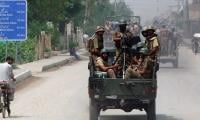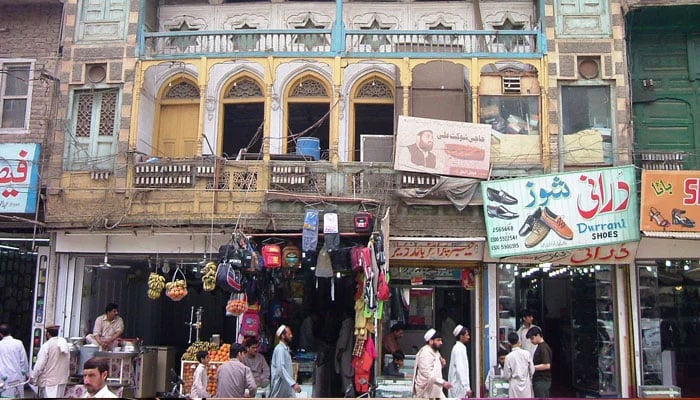
PESHAWAR: A new book has been published on the Qissa Khwani Bazaar massacre of April 23, 1930, offering more information on the tragic incident when British troops opened fire on unarmed demonstrators in Peshawar that led to heavy casualties.
The tragedy happened 96 years ago. The British colonial authorities put the death and injury toll at 179, while independent estimates suggested that around 400 citizens were killed in the firing.
Authored by Canada-based Urdu and Hindko writer from Peshawar, Aftab Iqbal Bano, the 260-page latest publication is dedicated to those who lost lives in the massacre, as their sacrifice ultimately contributed to freedom from the British occupation and the creation of Pakistan.
The book is divided into 22 chapters, each discussing various aspects of the tragedy in detail.Instead of directly narrating the incident, the author, who has 13 Urdu and Hindko language books to her credit, has devoted the first two chapters to explain the dictatorial mindset in the world in general and in the subcontinent in particular. The book argues that the British placed little value on human life.
The third and fourth chapters discuss the rise and fall of the Ottoman Empire and the launch of the struggle in the subcontinent to save the Caliphate. The writer believes this movement triggered resistance against the British occupation, as people had previously accepted repression as their fate.
Chapter five focuses on Muslim leaders who spearheaded the Khilafat Movement, including Maulana Muhammad Ali Johar and Maulana Shaukat Ali.Chapters six, seven, eight, and nine describe the oppressive attitude of the British toward Hindus, Muslims, and Sikhs, stating that this led to a shared desire for freedom among all three communities.
These chapters also mention significant events, including the April 13, 1919 Jallianwala Bagh massacre in Amritsar, East Punjab, where scores of people were killed and many injured when British troops opened fire on civilians.
Chapter 10 outlines the circumstances that forced Muslims of the subcontinent to launch own struggle for freedom after the British and other Western powers weakened Turkiye, symbolizing the decline of the Ottoman Empire at the end of World War I.Chapter 11 lists public gatherings organized by the Tehreek-e-Khilafat in Peshawar, which, according to the author, clearly conveyed to the British that they would have to leave the region.
Chapters 12, 13, and 14 form the core of the book, providing a detailed account of the events of April 23, 1930.Chapter 15 critically examines six inquiry reports, their findings, and outcomes. The author believes that official reports reflected dishonesty on the part of government-appointed inquiry committees, while reports by political parties were based on facts.
Chapters 17 and 18 discuss the tyrannical methods employed by British troops in Peshawar and Kohat, which were brought to the attention of Muhammad Ali Jinnah by Allama Muhammad Iqbal.The final section of the publication includes 55 photographs with captions, adding to readers’ understanding of the historical events.