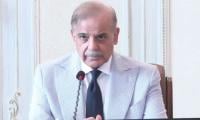
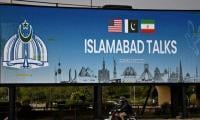
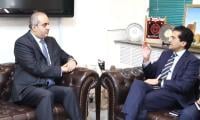
ISLAMABAD: Federal Interior Minister Mohsin Naqvi held separate strategic meetings with United States (US) Chargé d’Affaires Natalie Baker and Iranian Ambassador Reza Amiri Moghadam on Monday, finalising a comprehensive diplomatic and security framework ahead of the second round of US-Iran peace talks.
During his visit to the US Embassy, Minister Naqvi briefed Chargé d’Affaires Natalie Baker on a rigorous, multi-tiered security grid designed to protect high-profile international delegations. The interior minister confirmed the deployment of over 12,000 security personnel from the Islamabad and Punjab Police alongside the Federal Constabulary.
To ensure an absolute security environment, the government has enforced a total lockdown of the Red Zone, restricted public movement, and activated continuous drone and closed-circuit television (CCTV) surveillance across sensitive corridors. Additional measures include closure of government offices and educational institutions within the high-security perimeter and the positioning of elite commandos and snipers at strategic vantage points and transport hubs.
Ms Baker expressed her country’s appreciation for Pakistan’s proactive mediation and the seriousness reflected in these extensive logistical arrangements. Simultaneously, in his meeting with Ambassador Reza Amiri Moghadam, Minister Naqvi reaffirmed Pakistan’s commitment to facilitating a sustainable resolution to regional tensions through direct engagement. He briefed the Iranian envoy on his recent visit to Tehran and underscored the deep-rooted, brotherly ties between Pakistan and Iran.
Ambassador Moghadam commended Islamabad’s constructive diplomatic outreach, noting its vital role in de-escalating regional volatility. Minister Naqvi reiterated Pakistan’s principled stance that the dispute between Iran and the US should be resolved through dialogue to ensure long-term stability in the Middle East.
With all logistical, administrative, and ‘fool-proof’ security protocols now finalised, the interior minister expressed his firm optimism that the upcoming phase of negotiations in the federal capital would yield a significant breakthrough in reducing international friction.
The meetings were attended by senior officials, including the chief commissioner, director general FIA, inspector general of police Islamabad, and deputy commissioner, ensuring full coordination across all administrative tiers for the high-stakes meeting.
Meanwhile, the Red Zone remained under a total security lockdown, with all thoroughfares strictly closed to public and commercial traffic. This disruption extended well into the surrounding areas, as intermittent road closures were enforced along the Islamabad Highway and major arterial routes connecting Nur Khan Airport to the federal capital to facilitate the secure movement of official delegations.
To maintain the high-security posture, a heavy presence of police, paramilitary units, and army contingents was maintained throughout the zone and at key sensitive locations. These ground operations were supported by continuous aerial and electronic surveillance conducted through the Safe City network and specialised intelligence control centres. To ensure the integrity of these arrangements, law enforcement leadership remained engaged in a cycle of coordination meetings, constantly refining protocols to guarantee an impenetrable security environment.