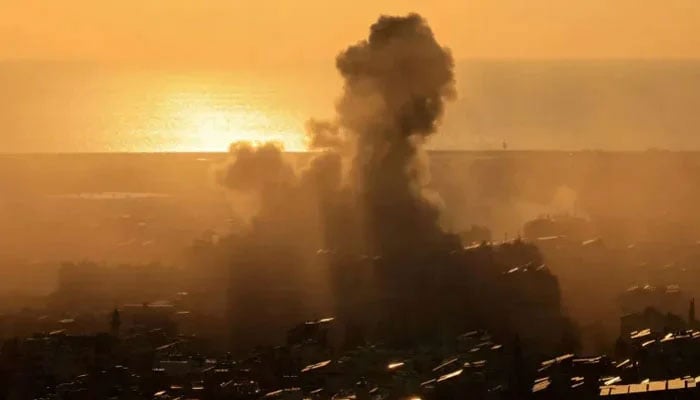
With the US-Israeli war on Iran unleashing a global fallout in different forms, Pakistan faces an increasingly sharp blowback for the foreseeable future. In other words, the conflict right next door to Pakistan has laid the groundwork for escalating the country’s internal challenges in the times to come.
Even an unexpected U-Turn by US President Donald Trump to halt the attacks will not provide assurances for countries, including Pakistan, to feel reassured over their future. In brief, the damage that has already been done will continue to unfold in times to come. In this background, Pakistan faces a two-pronged challenge – one beyond its frontiers and the other within. On the external front, the unpredictability surrounding Trump’s past words versus actions is sufficient to create serious doubts over the US president’s ability to end the war conclusively.
Amidst much fanfare, Trump summoned a meeting of the so-called ‘Board of Peace’ in February this year, surrounding expectations of an imminent end to the conflict in Gaza. Instead, Israel’s war on Gaza continues and has even expanded to engulf Lebanon as well.
The blowback for Pakistan from this conflict ranges from a direct hit due to sharply rising energy prices to getting caught in a polarised world. A refund of $3.5 billion to the UAE, placed in Pakistan to boost the country’s liquid foreign currency reserves, provides the most visible evidence of this trend. In response to the UAE’s demand, Pakistan requires a deft handling of its ties with the Arab world, built on a history of more than five decades of near kinship. In response to external measures that represent hostility, Pakistan must not forego its continued push to nurture friendship at multiple levels.
Within Pakistan, the ruling structure needs to take the country well beyond its current response. That must be built upon a reassessment of the internal challenges and required solutions, notably the most pressing ones. Broadly, Pakistan’s economy remains in a danger zone, having survived a default on foreign debt repayments just three years ago. With economic growth presently remaining neutral at best, given its marginal edge over Pakistan’s population growth, the economic pie in real terms is just not expanding rapidly enough.
Besides, with the dangerous threat from climate change looming over the horizon, Pakistan needs to radically alter its developmental policies. The ruling structure’s obsession with bricks and mortar, as seen in increased spending on infrastructure, needs to be drastically scaled back. Instead, the road to Pakistan’s future must be built upon tackling the domestic fallout from increasing insecurity in areas surrounding more pressing matters, notably the food supply chain or the energy-related links tied to society at large.
The manner in which the federal government recently handled the domestic energy prices raised more questions than answers over its ability to tackle a vital part of the crisis. After a spectacular increase in domestic fuel prices, Prime Minister Shehbaz Sharif immediately stepped into the fray, ostensibly in response to a visibly harsh response from urban dwellers. The oil price increase and a subsequent partial decrease left a large segment of the public that relies on diesel sales, which were hit hard.
With diesel prices raised by almost 60 per cent in one go, key sectors, from public transport to farm incomes, were stung badly. Already, reports from Pakistan’s rural belts suggest a sharp increase in costs associated with the upcoming wheat harvest.
In the near future, other costs such as prices of meat, vegetables, fruits, eggs and poultry are bound to rise, as inflationary trends hit the world hard, including Pakistan. And with Pakistan’s state structure already weakened due to years of neglect, price controls for ordinary consumers across the country have focused largely on large, organised urban markets, which mainly cater to relatively well-endowed customers. Pakistan’s present trajectory, left unattended, creates the danger of a further rise in poverty in times to come.
Meanwhile, there seems to be no scope left for the State Bank of Pakistan to reduce interest rates, as a cross-section of stakeholders has repeatedly urged in the recent past. Instead, a continued fall in interest rates over the past year or so is now in danger of going into reverse.
Going forward, Pakistan faces an urgent need for unprecedented national unity, of the kind seldom seen in memory. More importantly, areas that were in pressing need of reform in the past and have remained immune to a long-overdue overhaul must now change, voluntarily or not.
Forcing the wealthy to join the segment of Pakistan’s tax-paying few has never before mattered as much in a country with large-scale tax evasion. But meeting the challenge that Pakistan faces today requires measures that were ignored in the past to protect the interests of the relatively few.
The writer is an Islamabad-based journalist who writes on political and economic affairs. He can be reached at: [email protected]