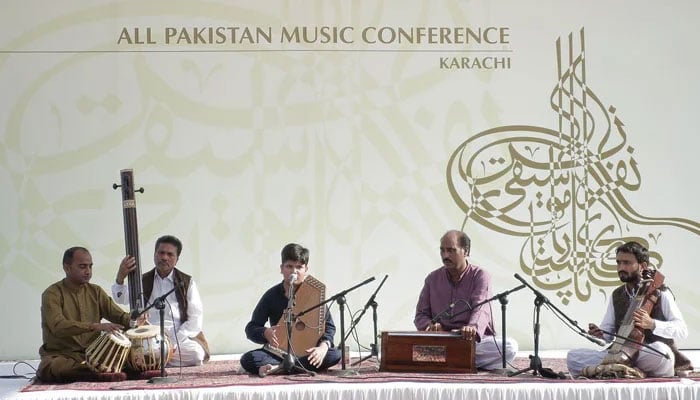
Even before it was time for veteran classical singers and musicians like Ustad Fateh Ali Khan and Ustad Mumtaz Sabzal, who were to perform at the end, the young classical musicians who performed early at the event set the bar quite high on the concluding day of the two-day 23rd All Pakistan Music Conference (APMC) Karachi on Sunday.
The annual classical music event that is normally held in March was organised this time in April due to Ramazan. This year the venue of the music conference was the National Academy of Performing Arts (Napa), where several amateurs as well as experts showcased their musical talents.
On Sunday, after young students had sung, the main event began with Mehak Rashid, who sang a khayal in Raag Bhimpalasi. Her mellifluous voice and clarity in enunciation of notes was met with appreciation.
The performance ended with a tarana, which delighted the audience, particularly the younger lot, who are usually more fascinated with fast tempo singing rather than slow delineation of raag in vilambit tempo.
The next performer was a sitarist from the Jaipur-Senia tradition, Shahzad Hussain, son of the late Ustad Sajid Hussain. The young performer chose to present Jhinjhoti, a romantic raag that beautifully resonates with sitar.
The sitarist took sufficient time to perform alaap, showing his confidence. The resounding notes coming from strings he skilfully plucked during alaap drew spontaneous “Waah” from the audience time to time.
Later, the tabla joined in slow and fast tempo. The tabla player, Waqas Gulab, appeared to be thoroughly enjoying, as his energy perfectly matched with the sitarist’s in the fast tempo. Following Jhinjhoti on sitar, came the young Izzat Fateh Ali Khan of the Gwalior Gharana, who dared to sing Puriya Dhanashree, a raag with dark and somewhat depressing vibes, when the audience had been under the spell of Jhinjhoti, a raag poles apart from Puriya Dhanashree.
The young singer sang vilambit well, but it was the drut bandish in praise of a Sufi saint and tarana where his solid foundations of classical music clearly emerged. An interesting part of the performance was little use of Pancham, which is considered the most important note of the raag as per the textbook descriptions, in the various Sargam that he sang throughout the performance. Izzat deservedly received prolonged applause as the tarana finished.
The next performance had a folk touch, as it was an instrumental performance on Rubab, a folk instrument of the northern areas of the country. The musician was Liaquat Homayoun. He announced that he would play Yaman (also known as Aiman). He also announced that this was the first time his father had come with him to witness his son performing before an audience.
Given that Rubab is a folk instrument, the performance did not have much classical nuances, but the raw emotions and immediacy of the folk instrument kept the audience engaged. The performance added a pleasant folk flavour to the evening.
Salman Haider, classical singer of the Gwalior Gharana from Shikarpur, was the next performer. He surprised many in the audience by announcing that he would be rendering a rare raag called Parameshwari, also called Din Ki Todi.
He explained that the raag resembled Ahiri Todi, but the latter allows the use of Pancham (the fifth note), which is not allowed in Parameshwari. The singer performed the raag beautifully showcasing his vocal range that went to extremely low pitch. The audience was enthralled.