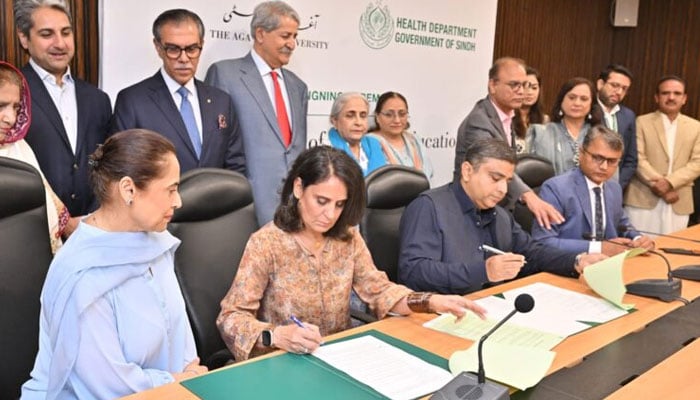
The Aga Khan University (AKU) has signed a memorandum of understanding with the Sindh government to provide technical oversight for a nursing college in Tando Muhammad Khan with the first cohort of around 50 students expected to enroll in 2027.
The initiative marks a strategic public private partnership aimed at expanding access to high quality nursing education in rural Sindh and addressing Pakistan’s growing shortage of trained nursing professionals, officials in the Sindh health department said on Saturday.
Under the agreement, the AKU’s School of Nursing and Midwifery will build capacity for admissions, curriculum, faculty development, teaching and quality assurance, while the Sindh government will bear all financial costs, including infrastructure, equipment, student support and operational expenses.
Dr Salimah Walani, dean of the AKU School of Nursing and Miwdifery, said the programme would offer nursing education along with a mandatory one-year internship. She explained that the degree would be awarded through affiliation with a public sector university rather than the AKU itself.
She stated that the first batch was expected to comprise 50 students from Sindh with a focus on providing opportunities to candidates from underserved areas, particularly in rural districts like Tando Muhammad Khan.
The students would receive training aligned with the AKU’s standards ensuring strong clinical exposure and professional competence comparable to graduates of leading nursing institutions.
The collaboration has been structured in phases, with the AKU providing academic and technical leadership in designing curriculum, setting admission criteria, recruiting faculty and establishing governance systems, while the provincial government ensures regulatory approvals, infrastructure readiness and long term sustainability of the institution.
Health experts say the initiative comes at a critical time as Pakistan faces a severe shortage of nurses with only around five nurses available per 10,000 population far below international benchmarks.
The shortage is even more pronounced in rural and remote areas where limited access to quality training institutions has constrained the development of a skilled nursing workforce.
Globally, the demand for nurses has been rising sharply with millions of additional professionals required over the next decade, particularly in low- and middle-income countries, creating opportunities for countries like Pakistan to train and deploy qualified nursing staff.
“It is time for young Pakistanis to consider nursing as a viable and rewarding career. There are opportunities not only within the country but globally, as the entire world is facing a shortage of trained nurses,” said Dr Walani.
Officials said the establishment of a modern nursing college in Tando Muhammad Khan would not only help address workforce gaps within Sindh but also contribute to improving healthcare delivery and patient outcomes in underserved communities.
They added that the initiative reflects a broader effort to strengthen nursing education, elevate professional standards and create new employment and career pathways for young people, especially women, in the healthcare sector.
The project is also expected to support capacity building of the nursing education system in Pakistan by introducing improved teaching methodologies, standardised curricula and stronger linkages between academic training and clinical practice.
With Pakistan producing relatively few nursing graduates annually and facing challenges in retaining trained staff, experts believe such collaborations between public institutions and leading academic organisations could play a key role in building a sustainable and globally competitive nursing workforce.