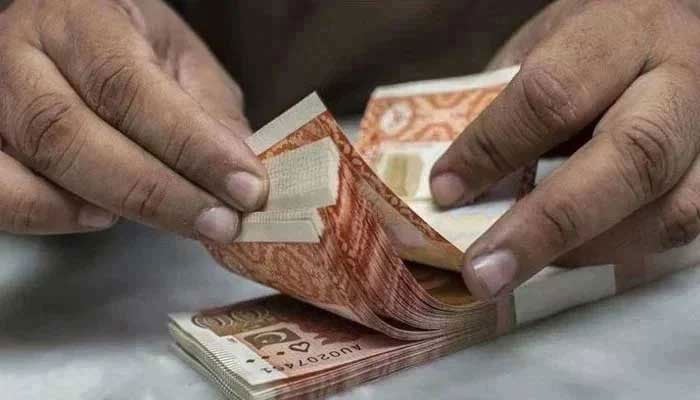
Public enemy number 1: Public debt. Silent predator: Public debt. Ticking time bomb: Public debt. Generational theft: Public debt. Democracy’s dirty secret: Public debt. The number that never goes down: Public debt. The coup that never ends: Public debt.
Last year: Rs71 trillion. This year: Rs80.5 trillion. A Rs9 trillion increase. This is what stabilisation looks like in Pakistan.
Rs71 trillion. Rs80.5 trillion. 360 days. Rs26 billion of additional debt every single day, including 19 gazetted public holidays. The government calls this stability. The debt clock calls it 9,000,000,000,000 reasons to stop believing the government. Rs1.08 billion an hour. Rs18 million a minute. By the time you finish reading this, the government will have borrowed another Rs1 crore.
Imagine this: In the year the government declared economic stabilisation, it borrowed Rs9 trillion. No stable economy does that. No honest government says it does. Four governors-general. Fourteen presidents. Twenty prime ministers. The current rate of debt acceleration: Rs26 billion a day – the fastest in Pakistan’s 79-year history.
Rs26 billion a day is not economic management. It is economic surrender. For every Rs100 this economy produces, Rs72 is already owed – before a single rupee reaches a school, a hospital or a road. At Rs26 billion a day, Pakistan is not building a future. It is mortgaging one. Pakistan is borrowing to pay for what it has already borrowed. Pakistan is not borrowing to build. It is borrowing to survive the last loan. That is not a fiscal strategy. That is a debt trap with a government letterhead. Rs26 billion a day. That is not a budget. That is a countdown.
So where does Rs9 trillion go? Grants Rs2 trillion. State-owned enterprises’ losses are Rs2 trillion. Wapda, Pepco, KE losses Rs1 trillion. PASSCO loses Rs200 billion. SNGPL and SSGC together lose gas worth Rs60 billion every year. Pakistan Railways loses Rs55 billion a year. Pakistan Steel Mills loses Rs30 billion a year, with accumulated losses of Rs255 billion. Pakistan Post loses Rs12 billion with accumulated losses of Rs93 billion. PIA’s accumulated losses are Rs713 billion.
This is a list of institutional failures, funded by the public, protected by the state, and never, ever reformed.
Yes, the government maintains a carpool of 85,500 vehicles, which takes in Rs114 billion worth of petrol and diesel every year. The UK has 86 vehicles. Pakistan has 137 ministers. Japan has 17 ministers (by law). Germany has 16; France has 20 ministers. Japan runs the world’s fourth-largest economy with 17 ministers, by law. Pakistan runs a Rs80.5 trillion debt with 137. The Government of Pakistan is not too small to fix the problem. The Government of Pakistan is too large to notice it.
By 2030, debt servicing will consume every rupee of tax revenue. Every IMF programme buys time. It does not buy reform. If we don’t put our house in order, there will be no house left to put in order.
As debt service crowds out other expenditures, spending on human capital will fall further. The children growing up today will enter adulthood without the skills, health or opportunity to compete in any economy. Remember, a country that cannot educate its children is not building a workforce. It is building a crisis.
In 1971, a Pakistani child was born owing Rs462. Today, a Pakistani child is born owing Rs333,041 – before it has taken its first breath, before it has eaten its first meal, before any government has done a single thing for it.
The writer is a columnist based in Islamabad. He tweets/posts @saleemfarrukh and can be reached at: [email protected]