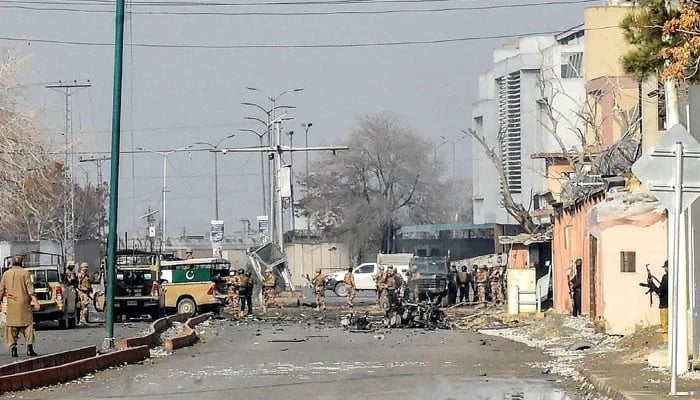
Pakistan is once again witnessing a disturbing surge in terrorism, particularly in Khyber Pakhtunkhwa and Balochistan, where militant groups.
This renewed wave of violence is a stark reminder that despite years of military operations and immense national sacrifice, the threat of terrorism in Pakistan has not been fully defeated but has evolved into a more complex and dangerous hybrid challenge.
Pakistan’s struggle with terrorism did not begin after 9/11, but the events that followed fundamentally transformed both the scale and character of violence within the country. Before the global war on terror, Pakistan was primarily confronted with sectarian conflict, ethno-political violence in Karachi and sub-nationalist insurgencies in Balochistan. Over the decades, political use of religion gradually shifted the state away from the inclusive vision articulated by Quaid-e-Azam in his August 11 speech.
However, after 9/11, the threat landscape changed dramatically. Terrorism in Pakistan acquired a far more organised, transnational and religiously motivated character.
Suicide bombing emerged as the principal weapon of terror, targeting civilians, mosques, educational institutions, security forces and public spaces. The number of terrorist incidents increased rapidly, reaching a peak in 2010 with more than 2,000 attacks recorded across the country. Pakistan paid an immense price. More than 80,000 Pakistanis, including civilians and security personnel, lost their lives, while the economic cost exceeded $150 billion.
The entire region was destabilised, social cohesion weakened and investor confidence severely damaged. Yet despite these enormous sacrifices, Pakistan’s resilience and the sustained efforts of its armed forces, intelligence agencies and law-enforcement institutions managed to significantly reduce the level of violence over time.
Through large-scale kinetic operations such as Zarb e Azb, Radd ul Fasaad, and extensive intelligence-based operations, the militant infrastructure was disrupted and terrorist networks were weakened. By 2020, the number of terrorist incidents had declined to nearly 200 annually, creating cautious optimism that the country was finally overcoming one of the darkest phases in its history. Unfortunately, this relative stability proved temporary. The abrupt US withdrawal from Afghanistan fundamentally altered the regional security environment. Anti-Pakistan militant organisations, including the TTP, Al Qaeda, Islamic State Khorasan Province, Haqqani network, BLA and its allies, have re-emerged with renewed confidence and operational capacity. Many of these groups gained access to sophisticated weapons abandoned in Afghanistan and reportedly benefited from external Indian sponsorship.
The nature of violence has also evolved into a more dangerous hybrid threat. Terrorism today is not confined to bombings and armed attacks. It now combines cyber attacks and propaganda, disinformation campaigns, digital radicalisation and psychological operations designed to erode public confidence in state institutions and deepen political and ethnic fault lines.
Pakistan is once again witnessing coordinated assaults occurring simultaneously across multiple regions, targeting both civilians and security personnel. Last year, the number of incidents and casualties reportedly surpassed even the peak levels recorded in 2010. What remains missing in reaction is a comprehensive and coherent national counterterrorism strategy. Pakistan has introduced several national security and internal security policies, along with the National Action Plan and its revised version, but implementation has remained fragmented and inconsistent. Counterterrorism still operates largely through a security-centric lens without adequately addressing the political, ideological, economic and governance dimensions of the crisis.
Nacta was envisioned as the central coordinating institution responsible for integrating national efforts and developing a counter-extremism narrative. However, its institutional role remains weak and unclear. The counter-narrative effort has largely remained confined to a single framework that addresses only the broader frustrations and aspirations of Pakistan’s youth. Extremism today spreads not only through religious arguments but also through perceptions of injustice, exclusion, unemployment, corruption, and political alienation.
At the operational level, the challenge is equally serious. Police and security forces in Khyber Pakhtunkhwa and Balochistan are still not fully equipped with modern surveillance systems, advanced weapons, cyber monitoring capabilities and technological resources needed to confront contemporary hybrid threats. Intelligence-based operations remain necessary, but they cannot alone eliminate the underlying causes of militancy.
Balochistan presents perhaps the clearest example of why a purely kinetic approach cannot succeed indefinitely. The perception that local populations do not sufficiently benefit from the province’s natural wealth has contributed to deep political grievances and feelings of alienation. Similarly, the unresolved issue of missing persons remains one of the most emotionally charged and politically damaging issues in the province.
Without addressing these grievances politically and constitutionally, security measures alone are unlikely to produce lasting stability. Confidence-building measures are urgently required. Political engagement with peaceful and non-violent groups may help reduce alienation and restore confidence in democratic processes. Treating all dissent through an exclusively securitised framework risks widening the gap between the federation and already marginalised communities.
Pakistan, therefore, requires a shift from a narrow counterterrorism doctrine towards a broader national resilience strategy. Counterterrorism cannot succeed without political stability, democratic continuity, institutional coordination, economic reform and social inclusion. A credible civilian-led coordination structure is essential, with Nacta functioning effectively under a transparent national framework rather than remaining institutionally overshadowed.
Equally important is investment in human development. Many districts in Balochistan and Khyber Pakhtunkhwa suffer from poverty levels significantly higher than the national average. Lack of education, unemployment, weak healthcare systems and limited economic opportunities create fertile ground for radicalisation and militant recruitment. Development spending in these regions, especially in the newly merged districts, should therefore be viewed not merely as welfare but as a long-term national security investment.
At the same time, national security discourse itself requires maturity and balance. Observing national milestones should remain occasions for gratitude, reflection and renewed national resolve rather than triumphalism. These occasions should inspire humility, unity and preparedness rather than political spectacle or emotional chest thumping. Nations strengthen themselves through sober confidence, gratitude to Allah, institutional seriousness and constant readiness to safeguard sovereignty and national interests.
Pakistan has demonstrated extraordinary resilience over the past two decades. The sacrifices of civilians, police and the armed forces have prevented the collapse of the state under immense pressure. But resilience alone is not enough. The country now needs strategic clarity and political courage to move beyond reactive policies and perpetual crisis management.
The fight against terrorism today is not only military. It is ideological, political, economic, technological and psychological. Sustainable peace will only emerge when security measures are combined with justice, inclusion, constitutional governance and public trust. Without such a holistic approach, Pakistan risks remaining trapped in an endless cycle of violence and reaction rather than moving towards durable peace and national stability.
The writer is a former inspector general of police (Punjab) and a former Punjab caretaker home minister.