‘Incumbency fatigue’ is one of those phrases that sounds casual but captures a serious political condition. In political analysis, it describes the exhaustion that sets in when one party or one set of rulers stays in office so long that continuity no longer looks like stability and instead begins to resemble stagnation.
My family have been PPP supporters since 1977. For many of us, the party was never merely an electoral machine. It was a sentiment, a historical inheritance and a language of resistance, federalism and democratic aspiration. That is why the present disappointment is not casual. It hurts. I have returned to live in Karachi after two decades away. Of those twenty years, for eighteen Sindh was under PPP rule, and since 2008 the party has governed the province without interruption. So let there be no evasion and no convenient diffusion of blame.
If one returns to Karachi and finds a city battered, neglected and misgoverned, the principal responsibility lies with the Sindh government. A party that has ruled for so long cannot speak like a newcomer still waiting for a chance. The trouble with long incumbency is not only corruption – though allegations of corruption are never far away – it is also the subtler corrosion of competence. Governments begin to function as if time were on their side. Projects can be delayed, roads can be patched badly, and water shortages can be treated as mere inconveniences.
Files move, statements are issued and yet nothing quite changes. The system becomes less a government than a style of postponement. The same lethargy appears in offices, on roads and in hospitals because long rule dulls urgency. When defeat seems unlikely, accountability weakens. Files circulate, tenders are issued, repairs are announced and inspections are promised, but delivery remains partial. Citizens are left to adjust, improvise and lower expectations, which is itself a form of democratic injury every day. Karachi bears the marks of this fatigue everywhere. One need only drive. Take Shahrah-e-Faisal and travel from Bin Qasim to Star Gate.
Through Quaidabad, Malir City, Kala Board and Malir Halt, Wireless Gate, the road is badly uneven and visibly broken. Or drive on University Road, or travel from SITE to Garden Road via Bara Board to the IBA City Campus. The eye meets the same dispiriting sequence: battered surfaces, potholes, broken shoulders, badly managed diversions and traffic that appears less regulated than trapped. The roads around the KMC Zoo are in a terrible state, though this area is visited daily by thousands from within and outside Karachi. Keeping a city clean does not simply mean removing paper and plastic waste.
It also means keeping pavements in good condition, clearing away dirt and sand that gather along roads and removing bricks and stones lying at so many corners and sidewalks. Even roads that are repaired or carpeted often fail after the first serious rain. That points to poor workmanship, inadequate drainage, weak oversight or all three. One looks around and asks a simple question: where are the engineers and where is the old Traffic Engineering Bureau? Too often, one sees labourers working under contractors, but very little evidence of technical supervision. A city this large cannot be run by improvisation.
Even Karachi’s flyovers often feel like summaries of the problem. Drive across many of them and you encounter potholes, jolts, weak maintenance and the impression that no one with authority has inspected them. A road is not just a road. It is an index of administrative seriousness. In Karachi, that index reads badly. Just drive over the Teen Hatti or Lasbela Bridges and see for yourself. The city’s visual condition is equally revealing. Buildings in many areas wear facades of dust, stains and neglect. In properly managed cities, governments require property owners to keep their buildings and immediate frontages clean and presentable.
In Karachi, there is often no visible standard. Dirt has become democratic. It is spread evenly across power and poverty alike. The city looks unattended. I visited the Civic Centre. One encounters Karachi’s administrative malaise at once: parking chaos, the informal tyranny of agents, broken access roads, dirt within the compound and the ugliness that comes when public authority retreats and petty mafias fill the space. It is a major civic complex, yet it feels abandoned.
I am a regular visitor to the old book bazaar in Saddar on Sohrab Katrak Road, where Karachi’s memory still flickers. Yet the street on which this bazaar is held every Sunday is often filthy, broken and strewn with debris, as if paving had been forgotten for years and gutters had been left to overflow. Much of the city centre itself is in miserable shape. Near the Karachi Press Club, one can still find heaps of garbage close to the main gate. What does it say about city management when even the symbolic heart of urban public life cannot be kept clean and functional? Just take a walk from the Officers’ Mess to the KPC Roundabout, and you will be lucky if you do not fall into one of the big holes wide enough to devour a couple in one go, and that is right across the road from the Governor’s House.
Water is another humiliation. Qasre Zainub Building on Club Road, where I have stayed for six months, has hardly any water from the line despite being located in one of the city’s most privileged zones. It is difficult to imagine a clearer metaphor for governance failure. Even in the shadow of power, a basic service falters. If people living there cannot rely on water, what chance does the ordinary citizen elsewhere in the city have? Frere Hall Park offers another revealing scene. What one often sees is cleaners arriving in uniform at 7am, attendance apparently marked and then idleness while the park remains dirty. Workers sit scrolling on their phones and the litter remains where it is. This is organisational fatigue made visible. Presence without performance. Salaries without supervision. Employment without outcome.
A government that has lost its habit of enforcing work will eventually lose its habit of governing altogether. One sees the same pattern in public health. I visited Abbasi Shaheed Hospital and found the conditions there pathetic. Shortages, dysfunction, inadequate facilities and poor support for the poor are not the profile of a city being governed with seriousness. The broader picture is unmistakable: the public system feels under-managed and morally fatigued.
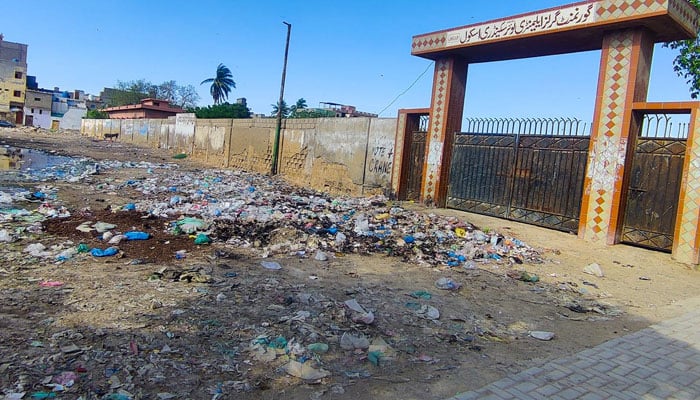
To be fair, the Sindh government will point to mega-projects. It will mention bridges, underpasses, transport schemes and selective modernisation. But selective achievement cannot excuse general decay. A state cannot claim success on the strength of isolated showcases while daily civic life continues to crumble. This lived fatigue is visible in small and large things alike. It is in the asphalt that peels away after rain. It is in the overflowing gutter beside a freshly carpeted road. It is in the garbage pile near the Press Club. It is in the smell outside public offices. It is in the dry taps of buildings close to the centres of authority.
It is also in the weary official promise that improvement is just around the corner, a promise repeated so often that it now sounds less like hope than habit. The PPP still commands memory, loyalty and emotional capital among many. It still speaks the language of the people. But too much of Karachi now lives the language of neglect. And when even a long-time supporter returns after twenty years and finds himself with nobody else left to blame, that is not merely a political disappointment. It is a verdict.
The writer is dean of the faculty of liberal arts at a private university in Karachi. He tweets/posts @NaazirMahmood and can be reached at: [email protected]