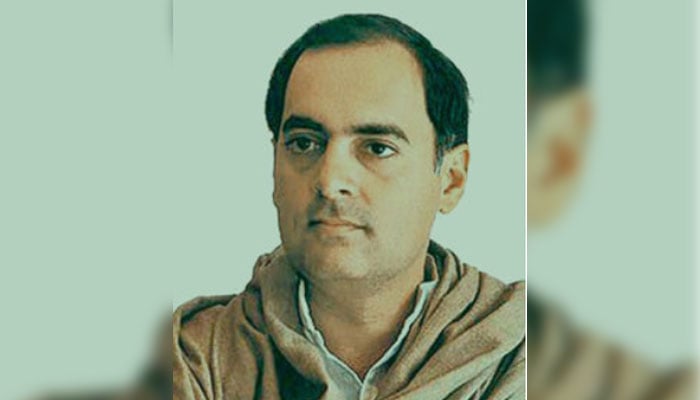
In May 2026, India marks the 35th death anniversary of Rajiv Gandhi. For many in India, his assassination belongs to a national archive of grief. For me, it is also lodged in a small domestic memory in Malir, Karachi.
I was asleep at home when a family member woke me up and said that my senior friend Nazeer Leghari, then magazine editor of Daily Jang, wanted to speak to me urgently. There were no mobile phones then. The landline was in another room. Such calls carried a certain weight even before one picked up the receiver. When I did, Leghari’s voice carried the shock of history. Rajiv Gandhi had been assassinated. For a moment, I could not absorb it.
The horror of Indira Gandhi’s assassination in 1984 returned at once. The killing, the convulsion, the anti-Sikh violence and the sense that India, so proud of its constitutional stability, was also a land where politics could suddenly turn murderous. Then Leghari asked me to write a detailed article immediately. He was planning full-page coverage for the next day. I sat down and wrote through the night. In a few hours, I produced a full-page piece on Rajiv which appeared the following day. I still believe it was perhaps the best coverage in any Pakistani newspaper of that assassination.
The India of 1991 was a country in distress. The economy was near collapse. Foreign-exchange reserves had fallen to a level that threatened national humiliation. Gold had to be pledged. The Soviet Union, long a pillar in India’s global imagination, was disintegrating. The old world of state planning, non-alignment and Congress dominance was cracking. P V Narasimha Rao would soon become prime minister and Manmohan Singh would begin the reforms that opened the economy. Those reforms later acquired a heroic glow, but at the time they were born from crisis, not triumph.
Rajiv belonged to the old order and also tried to transcend it. He was young, urbane and technologically minded. He spoke of computers, modernisation and taking India into the 21st century. To many middle-class Indians, he seemed to represent efficiency after the tired rhetoric of old Congress politics. Yet his years in power had also weakened the moral authority of the Congress. The Shah Bano reversal suggested capitulation before conservative religious pressure. The unlocking of the Babri Masjid site gave Hindu majoritarian politics an opening. The Bofors scandal damaged his reputation for clean government. His intervention in Sri Lanka ended in blood and bitterness.
In a cruel irony, the LTTE’s anger over that intervention returned to kill him. To understand this rise, one must place Rajiv’s death beside three other eruptions: Mandal, Mandir and the market. Mandal came first as social justice and social shock. V P Singh’s implementation of the Mandal Commission recommendations in 1990 brought reservations for Other Backward Classes into the centre of national politics. For historically disadvantaged communities, this was overdue recognition. For many upper-caste groups, it felt like dispossession. Indian democracy was forced to confront caste not as a village leftover but as the central grammar of power.
The BJP faced a problem. If politics became principally a contest over caste justice, its upper-caste and urban trading base would be exposed. Its answer was Mandir. L K Advani’s Rath Yatra in 1990 converted a temple campaign into a national political spectacle. It offered a larger Hindu identity to counter the fragmenting force of caste politics. The message was simple and potent: Hindus might be divided by caste, but they could be united by grievance. Ayodhya became less a place than a weapon of mass mobilisation. That memory returns now because Rajiv’s death was not only the end of one life. It was one of the events that helped close one age of Indian politics and open another.
The BJP did not rise because Rajiv died. That would be too simple. But his assassination removed the last Congress leader who still carried a national emotional inheritance from the Nehru-Gandhi line. It deepened the uncertainty of the early 1990s. It accelerated the erosion of the Congress system. It helped create the political vacuum into which the BJP, already mobilised by Mandir, stepped with growing confidence. His assassination in May 1991 changed the election that was already underway.
The Congress gained sympathy but not revival. In the 1991 Lok Sabha election, it won 244 seats, enough for Rao to form a minority government. The BJP won 120 seats, a remarkable leap that showed how far it had travelled from the margins. The state elections told the same story in sharper form. Uttar Pradesh was the central battlefield because Ayodhya lay there and because the state sent the largest number of MPs to parliament. In the 1991 assembly election, the BJP won 221 of 425 seats and Kalyan Singh became chief minister. This victory gave the temple movement a government in India’s most politically important state.
After the demolition of the Babri Masjid in December 1992, BJP governments in several states were dismissed. In the 1993 Uttar Pradesh election, the BJP remained the largest party with 177 seats, but Mulayam Singh Yadav’s Samajwadi Party and Mayawati’s Bahujan Samaj Party kept it out of office through a caste-based alliance. That result showed both the strength and the limit of Hindutva. It could mobilise a vast Hindu vote, but it could still be checked by Mandal politics. Elsewhere too, the BJP’s rise was uneven but unmistakable. In Madhya Pradesh, Sunder Lal Patwa had led the BJP to power in 1990 but the party lost to the Congress in 1993 after the Babri backlash and Digvijaya Singh became chief minister.
In Rajasthan, Bhairon Singh Shekhawat returned to office in 1993, giving the BJP one of its most experienced state leaders. In Delhi’s first assembly election in 1993, Madan Lal Khurana led the BJP to a clear majority and became chief minister. In Gujarat, Keshubhai Patel led the party to a sweeping victory in 1995 and became chief minister, before internal factionalism and Shankersinh Vaghela’s revolt briefly weakened it. These state-level advances mattered because they gave the BJP administrative experience, local networks and a wider cadre base. It was no longer merely a party of protest. It was becoming a party of government.
The Left, by contrast, remained important but regionally confined. In the 1991 Lok Sabha election, the CPI-M won 35 seats and the CPI 14, enough to matter in parliamentary arithmetic but not enough to shape the national imagination. In West Bengal, Jyoti Basu’s Left Front remained formidable, winning the 1991 assembly election and securing another term in office. In Kerala, however, the LDF lost the 1991 assembly election to the Congress-led UDF, with K. Karunakaran returning as chief minister. In Tripura, the CPI-M recovered strongly in 1993 as Dasarath Deb led it back to power.
The Left thus held ground in West Bengal, regained Tripura and remained competitive in Kerala, but it could not convert Mandal, market anxiety or anti-communal sentiment into a wider national surge. Its tragedy in the early 1990s was that it understood both class and communalism better than most parties, yet the political energy of the decade moved elsewhere: towards caste-based regional parties on one side and the BJP’s Hindu consolidation on the other. When I remember that night in Malir, I remember not only the shock of a killing.
I remember the feeling that the Subcontinent had entered another dark passage. In 1991, we could not yet see the full shape of what was coming: Babri, Bombay, coalition politics, liberalisation, nuclear nationalism, Gujarat and then Modi. But the foundations were being laid. The BJP rose from the ashes of the early 1990s because those ashes were everywhere: in a broken economic model, a shaken Congress, a wounded secularism, a caste revolution, a religious mobilisation and an assassinated leader whose absence left India more vulnerable to forces already waiting at the door.
The writer is dean of the faculty of liberal arts at a private university in Karachi. He tweets/posts @NaazirMahmood and can be reached at: [email protected]