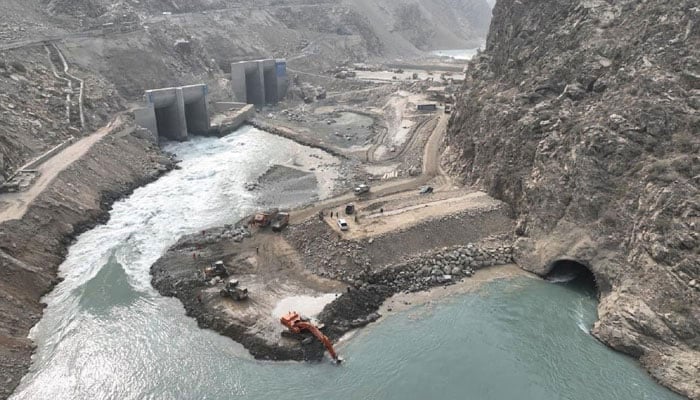
Three dams. Two rivers. One moment in history. Three dams under construction: Diamer-Basha on the Indus. Dasu on the Indus. Mohmand on the Swat. All three under construction simultaneously. This has never happened in Pakistan’s 78-year history. All three. Under construction. Right now. As you read this.
Remember: Pakistan’s last big dam was Tarbela, completed in 1976. That’s a 50-year gap.
Here are the numbers: combined installed capacity of 9,620MW. Total cost: Rs2.6 trillion. Dasu alone is 4,320MW. Diamer-Basha 4,500MW. Together, those two dams will double Pakistan’s entire existing hydropower capacity. Imagine: doubling the capacity.
Pakistan has been talking about water storage since Ayub Khan. We have been holding seminars, forming committees, issuing white papers and passing resolutions for six decades. And now – finally, actually, physically – three mega-dams are being built at once.
Ground reality: River Indus was successfully diverted at Dasu in February 2023 and at Diamer-Basha in December 2023 – a major construction milestone for both. Construction at Diamer-Basha is ongoing simultaneously across 13 work fronts, and RCC (roller-compacted concrete) work on the main dam body began in early 2026. Mohmand broke ground in 2019.
The official completion targets are Dasu Stage 1 in 2026 and Diamer-Basha in 2028. Mohmand Dam remains on track for completion in 2026-27.
This is not a press release. This is concrete. Steel. Tunnels. Diverted rivers. All visible from satellites above.
Here’s why this matters so much: Pakistan currently faces a severe energy crisis – expensive imported fuel, frequent loadshedding and a circular debt problem in the power sector. These three dams together add roughly 9,620MW of clean, domestic hydropower, which could transform that situation fundamentally.
Cold truth: Pakistan today stores 30 days of water. India stores 220 days. Complete all three dams – Basha, Dasu, Mohmand – and Pakistan reaches 45 days. Better. But still not enough.
Remember: the 2022 floods caused over $30 billion in damage. Here’s the flood control dimension: Regulated water flow from these reservoirs provides a buffer that saves lives and protects crops every monsoon season. Once completed: Cheaper electricity, water security and flood resilience – all from one coordinated programme.
Here are four major challenges to watch. First: funding gaps. The money pipeline is nowhere near consistent enough to match the ambition. The Rs2.6 trillion price tag also needs sustained financing Second: cost overruns. Diamer-Basha’s cost has already ballooned by 119 per cent due to redesigned seismic parameters, security requirements and rupee depreciation. Final bills will almost certainly exceed current estimates.
Third: delays. Mohmand was originally due in 2024-25. These projects have a long history of missed deadlines. Fourth: resettlement of affected communities. Displacing thousands of families in remote, tribal areas like Gilgit-Baltistan and Mohmand district is politically sensitive and logistically complex, with Rs78.5 billion already committed just for resettlement support.
This is genuinely exciting news for Pakistan. Will there be delays? Yes. Cost overruns? Certainly. Political interference? Inevitably. But here is what cannot be argued with: the Indus has been diverted. Three rivers are being tamed. Three dams are rising. The concrete is being poured. The tunnels are being drilled. In Pakistan, that alone is a revolution.
The writer is a columnist based in Islamabad. He tweets/posts @saleemfarrukh and can be reached at: [email protected]