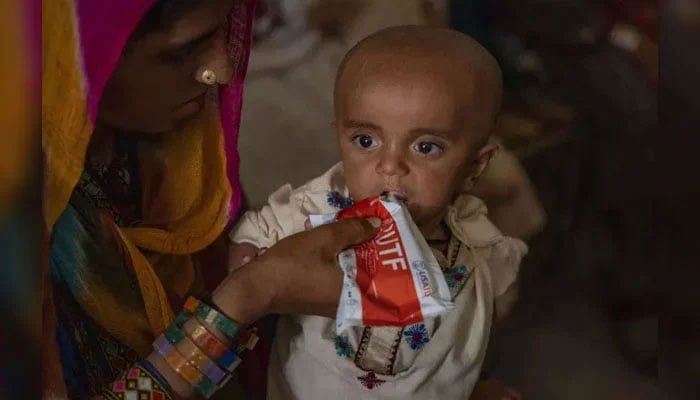
For years, I have been reading reports that say that about 40 per cent of our children who are under the age of five are stunted. This means that their physical and cognitive growth is permanently impaired. One wonders: can this be true?
Actually, UN agencies and some national studies have repeatedly made these assessments. They say that the main reason for this is chronic malnutrition of children born in poor families.
A question readily comes to mind: what happens to these children? An easy answer is that they grow up and become a living part of our society as teenagers and as adults. So, about one-third of the population of the young is likely to be physically and mentally deficient. And they are all wandering aimlessly in the crowded settlements of this country, with their passions and their needs and their ignorance.
Why am I talking about the stunting of our little children at this time? This issue is not directly linked to any major headline of the week. In that context, ‘cocaine queen’ Pinky is the story that everyone is talking about. I also want to talk about it, though my focus is on a specific aspect of how the drug mafia operates in Pakistan.
Apparently, the administration was provoked into launching this operation against Pinky and her network because of rising concerns about the spread of drugs in elite educational institutions. This was common knowledge for quite some time, but the alarm may now have been raised by some revelations about the reach and the impact of this terrifying menace.
Now, the Pinky story has a bearing on youth that belongs to the upper class and I was talking at the outset about children who are perennially stuck in the deep sludge of poverty. My excuse is that Pakistan’s destiny is umbilically connected to its youth, something that our leaders are fond of acclaiming because they see the pronounced youth bulge as a great asset.
Whether this youth bulge is an asset or a liability should be judged objectively, on the basis of the human capital that resides in the collective body of our youth, our young men and women. Numbers do matter. That is why I mention the extent of malnutrition. How many of the rest of them have access to a good education? Incidentally, any mention of education would make us shudder with fear as to where Pakistan is headed.
Like stunted children, there is another statistic about children out of school. The same figure is quoted year after year. Around 25 million children of school-going age – five to sixteen – are said to be out of school, and the number, instead of decreasing, has increased this year. Again, they are more than 30 per cent of all children aged five to sixteen.
When it comes to discussing the state of young people across the spectrum, I feel overwhelmed by the problems that they have to contend with. Drug addiction itself is the manifestation of their loss of purpose in life. For a large majority of them, finding a job or making a living is a nightmarish challenge. Our society does not allow the ordinary young woman, in particular, to realise their dreams and pursue their ambitions.
I have a few recent news stories that somehow relate to the young directly or indirectly. But it is not possible to expand on them in this space. Mental health issues, in a larger sense, serve as a backdrop for the prevailing state of their mind.
In this environment of social media and digital connections, young women and men from large segments of our traditional, mostly rural society are literally not allowed to fall in love. Honour killings are regularly reported. But an entire village, that of the girl, was set on fire in a tehsil of Jacobabad district after the couple had gone to Hyderabad for a court marriage. The incident took place in early May, but the media took it up this week. Are we marching backwards?
It was after a long campaign led by the Pakistan Mental Health Coalition that an attempt to commit suicide was decriminalised through legislation in 2022. It repealed Section 325 of the Pakistan Penal Code, which treated attempted suicide as a criminal act punishable by a year in prison and a fine.
But on Monday, the Federal Shariat Court in Islamabad declared the decriminalisation of suicide attempts as repugnant to the instructions of Islam and struck down the 2022 legislation. Experts tell us that the young are now more likely to suffer emotional turmoil and struggle with suicidal thoughts. In a system that does not promote social justice and ethical behaviour, the young do not have credible defences against, say, insanity. The irony here is that anyone who commits suicide cannot be punished.
Finally, some thoughts about the leaks of two papers of the Cambridge Assessment International Education (CAIE) exams in Pakistan. I am not well-versed in the O and A-level system that has taken over our high school education. Details about the number of students who pay large sums to appear in these exams are bound to boggle the minds of those concerned about the state of education in this country.
It is true that the credibility of examinations conducted in Pakistan remains suspect. That is why the concept of merit in our public life is so tarnished. However, this should not be a justification for accepting O- and A-level education, because this duality, if you understand its implications, may eventually be a disaster for Pakistan.
A disparity in the quality of education overlaps with the disparity that exists at all levels of our society. But can this brutal inequity prevail in the face of growing deprivations of those who lack not just education but also human dignity? After all, how many angry young men and women are able to seek escape into drugs? Unfortunately, an escape from reality is just not possible.
The writer is a senior journalist. He can be reached at: [email protected]