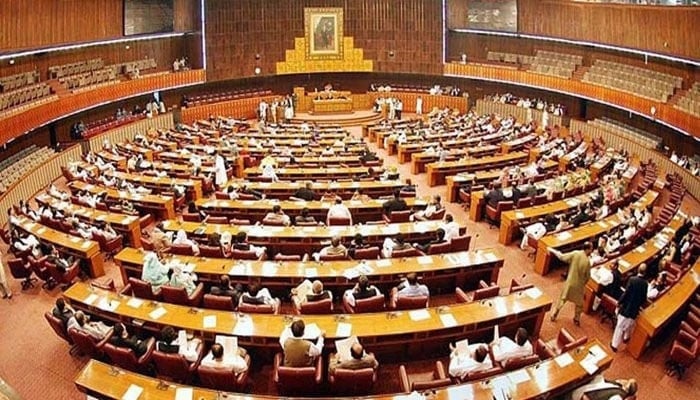
ISLAMABAD: The government on Thursday told the National Assembly during the Question Hour that Pakistan’s economy has achieved a notable turnaround over the past two fiscal years, citing a sharp decline in inflation, reduced interest rates and growth in IT exports, while also conceding a significant drop in foreign direct investment (FDI) in the ongoing fiscal year (July-February).
In a written reply to a question from Naeema Kishwar Khan, the House was told that inflation, which had surged to around 30 percent, had been brought down to approximately 5.5 percent. Similarly, the policy rate was reduced from 22.5 percent to 10.5 percent, reflecting easing macroeconomic pressures. FDI inflows during the last two financial years, 2023-24 and 2024-25, stood at $3,166.3 million and $4,280.3 million respectively, which is 35.2 percent higher than the previous period.
However, during the current financial year 2025-26 (July-February), the inflows declined 22.0 percent from $3,088.7 million to $2,409.2 million owing to regional and global geopolitical tensions, including the Russia-Ukraine war, Gaza tragedy, continuous Indo-Pak and Pakistan-Afghanistan tensions and the recent Iran-US-Israel war.
While responding to supplementary questions, Minister In-charge of the Prime Minister’s Office and Minister for Investment Board, Qaiser Ahmed Sheikh, told the National Assembly that Pakistan has recently presented itself as a strong and stable country on the global stage, expressing confidence that the FDI would increase in the coming years.
He said that foreign investment inflows have already witnessed growth, adding that international companies operating in Pakistan are allowed full repatriation of profits without restrictions.
He emphasized that Pakistan is currently playing an effective diplomatic role in the region, even acting as a mediator in evolving geopolitical dynamics.
Qaiser Sheikh further stated that Pakistan’s successful handling of recent challenges, including the military operation “Operation Bunyanum Marsoos,” along with effective diplomacy during ongoing regional tensions, has enhanced investor confidence. He added that overseas Pakistanis are also expected to increase their investments in the country.
The minister concluded by noting that Pakistan has asserted its position in the region, with international rating agencies increasingly viewing the country as stable, signaling a positive outlook for future economic growth and investment inflows.
The House was informed that IT exports had reached an annual level of around $3 billion, indicating steady growth in the technology sector. He said the government maintained that overall economic indicators remained on a positive trajectory, supported by stabilisation measures and structural reforms.
Earlier, MNA Naeema Kishwar noted that Pakistan’s diplomacy is moving in a positive direction and improving its global standing. She highlighted that the efforts of Prime Minister Shehbaz Sharif, Deputy Prime Minister Ishaq Dar and COAS & CDF Field Marshal Syed Asim Munir should be leveraged to attract foreign investment into the country.
Meanwhile, in a reply to another question, Parliamentary Secretary for Information Technology Sabeen Ghoury defended the country’s web monitoring system in the National Assembly, asserting that it was aimed at regulating unlawful online content and did not infringe upon citizens’ privacy, while lawmakers raised concerns over oversight, legality and the role of private telecom operators.
Responding to supplementary questions during the Question Hour, Ghoury said the web monitoring system had been in place since 2007 and had undergone periodic upgrades, including a comprehensive overhaul in 2019. She said 90 percent of startups became functional in software technology parks. She added that around 36 percent of them are women. The parliamentary secretary further informed that over 4.5 million people have been registered on the DigiSkills Programme since 2018.